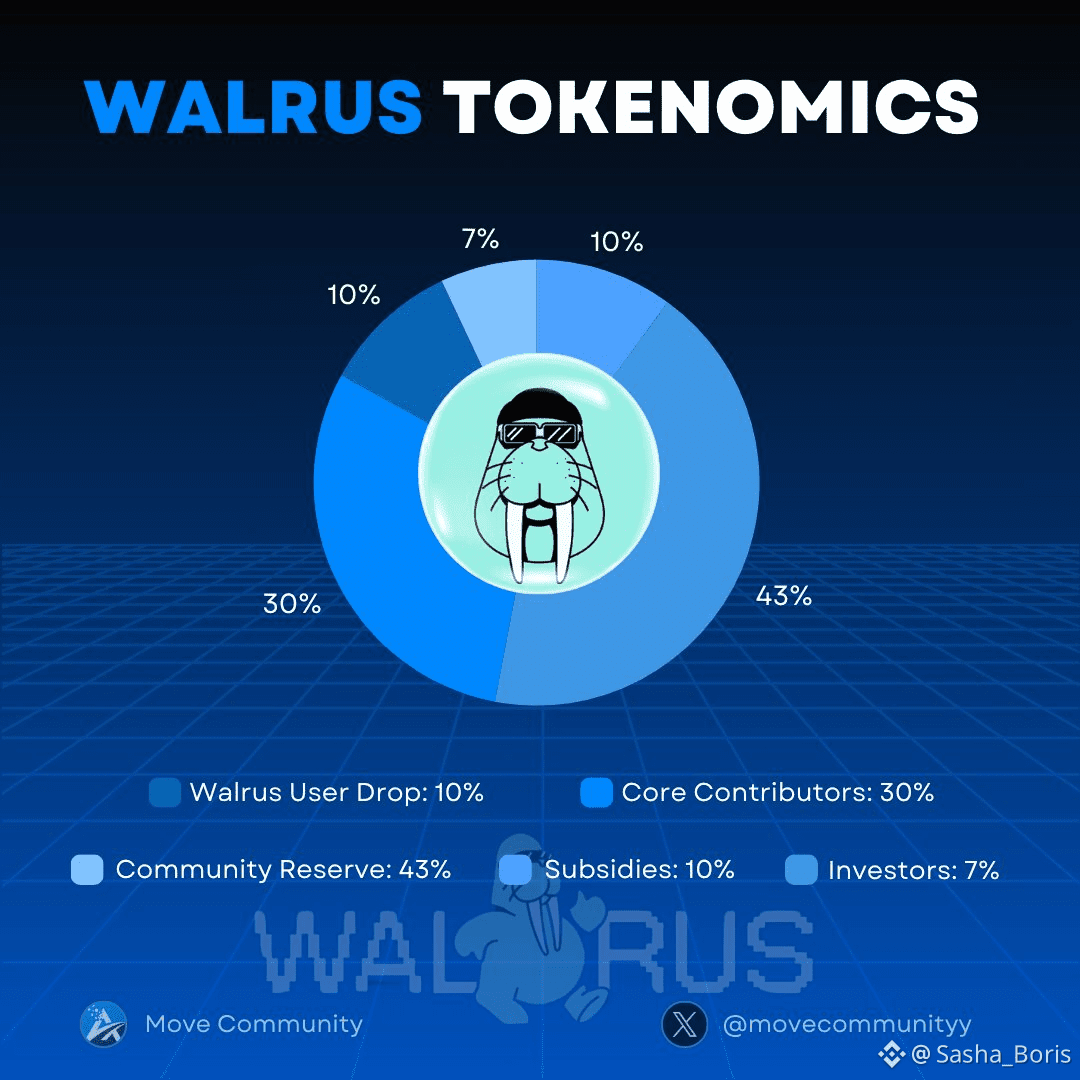
The Walrus Protocol is not only a technological innovation in decentralized storage but also a carefully designed economic ecosystem. At the core of this ecosystem is the WAL token, which serves multiple functions including payment for storage, staking for network security, and governance. The token’s design aligns the incentives of users, developers, and storage providers, ensuring a sustainable and robust network.
The WAL token is used as the primary medium for transactions within the Walrus Protocol. Users pay WAL to store their data, ensuring that storage nodes are compensated for maintaining availability and integrity. This payment system creates a direct economic link between data usage and network sustainability. By requiring WAL for storage operations, the protocol guarantees that nodes are motivated to provide reliable service, while users have a transparent, predictable cost structure for storing large datasets or media files.
Beyond payments, WAL is central to the staking and delegated proof-of-stake (DPoS) model that secures the network. Token holders can delegate their WAL to trusted storage nodes, which increases a node’s influence in the network and its eligibility to participate in storage operations for an epoch. Nodes earn rewards for uptime, correct storage proofs, and timely responses to data requests. At the same time, unreliable behavior results in penalties or reduced reward allocation. This mechanism not only secures the network but also incentivizes active participation and decentralization.
WAL also plays a critical role in governance. Holders of the token can vote on key protocol parameters, upgrades, and changes to network rules. This decentralized decision-making process ensures that protocol development reflects the consensus of the community, while also allowing the ecosystem to evolve dynamically in response to user needs, technological advances, or market conditions.
The economic design of Walrus supports long-term sustainability through careful token distribution and supply management. WAL has a capped supply to prevent inflation, while rewards are structured to encourage continuous participation by storage providers and stakeholders. By balancing incentives between early adopters, active nodes, and regular users, the protocol fosters a positive feedback loop: as more data is stored, demand for WAL increases, strengthening the network and incentivizing further engagement.
The Walrus Protocol’s ecosystem extends beyond simple storage payments. By integrating programmable smart contracts with WAL-based incentives, developers can build complex applications where token flows reflect real-world usage. For example, decentralized content platforms can reward contributors in WAL, or AI data providers can charge for dataset access in a transparent, automated manner. These economic interactions enable a wide variety of use cases, further embedding WAL into the broader Web3 ecosystem.
In addition, the protocol’s rewards system encourages network growth and reliability. Storage nodes and users who actively participate in governance, maintain uptime, or host large datasets are rewarded proportionally to their contribution. This not only strengthens network resilience but also drives adoption by creating tangible incentives for both technical participants and end users.
Overall, the Walrus Protocol combines technical innovation with a robust economic model, using WAL as a central tool for payment, staking, and governance. The result is a decentralized storage network that is not only scalable and reliable but also self-sustaining, where technology and economics work together to ensure long-term ecosystem health and growth. This combination of incentives, tokenomics, and technical architecture positions Walrus as a cornerstone for next-generation decentralized applications requiring secure, scalable, and verifiable storage.