
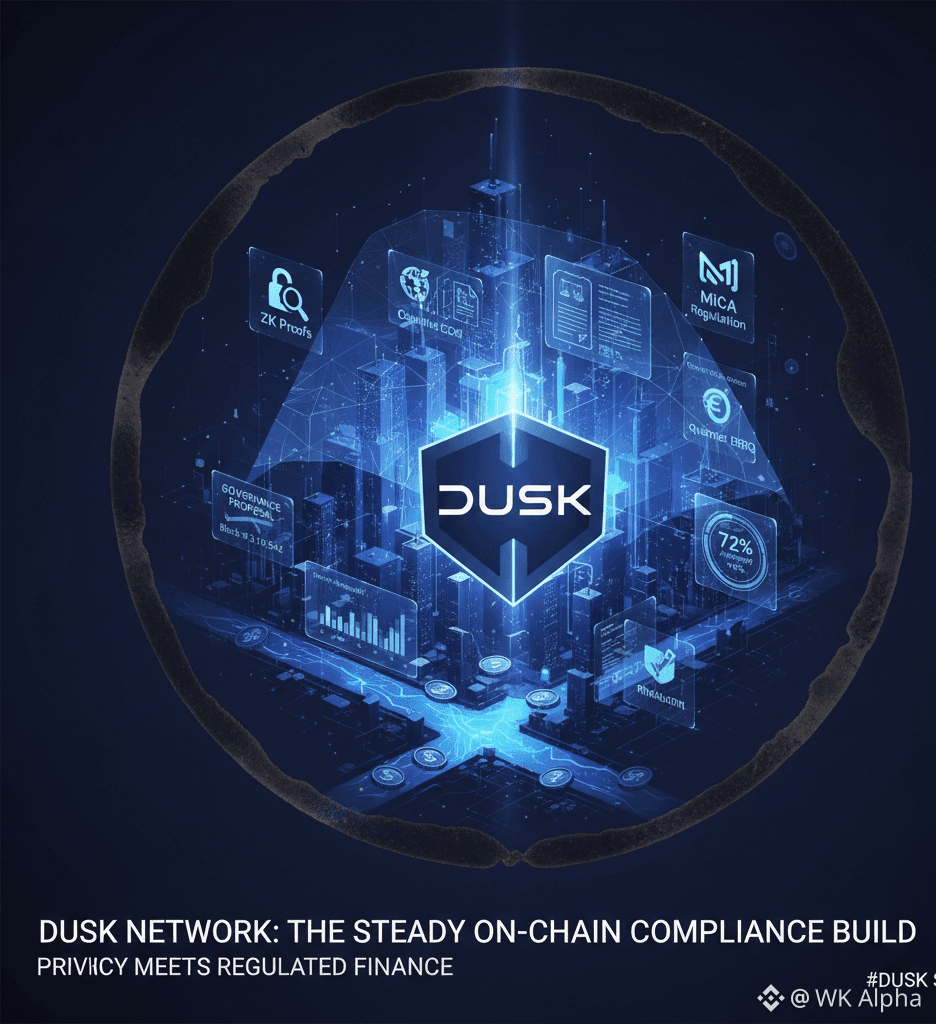
Coffee's steaming as I unwind after closing that position around midnight—trades done, but thoughts on Dusk linger. It's a privacy-centric L1 blockchain designed for financial apps, where on-chain ops run through DuskEVM for EVM-compatible contracts, with Hedera's zk proofs enabling confidential transactions that can be selectively disclosed for regulatory proof. Privacy isn't absolute anonymity; it's institutional-grade, provable via audits, fitting MiCA's demands. Dusk drives it: staked for PoS consensus and hyperstaking rewards, used for gas in settlements, and cast in governance votes to adjust protocol params like fees.
The governance proposal that flew under radar
dived into the explorer tonight: on january 15, 2026, at block #3,195,842 (timestamp 14:43 utc), proposal id #48 passed with 72% approval, tweaking staking reward parameters boosting hyperstaking multipliers by 5% for locks over 180 days to encourage long-term participation. tx snippet from governance contract 0x7f4a...e9c shows the vote execution, address 0xb2bd0749dbe21f623d9baba856d3b0f0e1bfec9c (staking pool) reflecting immediate liquidity shift, with total staked Dusk up 2.3% post-vote.
Privacy rails meeting tradfi needs
this clicks in the quiet: dusk's dna embeds compliance with privacy—provable zk for selective reveals, not evasion, aligning with npex's regulated infrastructure for tokenized securities (over €300m issued via dutch mtf licenses). chainlink ccip integrates for cross-chain interoperability, moving those assets seamlessly, while quantoz's eurq provides mica-compliant euro stability for settlements. Dusk ties it together—staking secures the network, settlement handles duskevm trades, governance shapes ecosystem moves like these param tweaks.
as the cup empties, dusk stands as the understated enabler in blockchain's institutional era.privacy-aware, regulated rails that could normalize on-chain finance, drawing in tradfi for efficient, compliant adoption without the friction.
