
A subtle weakness in many blockchain systems appears when governance evolves faster than infrastructure. Parameters change. Incentives are adjusted. Roadmaps pivot. None of this is unusual. What matters is whether the system’s memory remains dependable while these changes occur. Walrus is designed around this problem, treating data availability as something that must remain neutral to governance decisions rather than being reshaped by them.
In modular blockchain architectures, governance often operates at the execution or application layer. Validators vote. Protocols upgrade. Rules are amended. Data, however, sits beneath these decisions. It must remain accessible regardless of which direction governance takes. When availability depends on current incentives or prevailing narratives, it becomes vulnerable to shifts in sentiment. Walrus exists to insulate data availability from these cycles.
Historically, availability has been secured either by storing everything onchain or by relying on short-term incentives offchain. The first approach guarantees access but does not scale economically. The second scales, but quietly ties memory to participation levels and reward structures. Walrus challenges this tradeoff by formalizing availability as a long-term obligation with cryptographic enforcement rather than a byproduct of temporary alignment.
The protocol allows large data blobs to be stored outside execution environments while anchoring their integrity and existence cryptographically. This ensures that data can be verified independently of who is currently active in the network. More importantly, it clarifies accountability. Data is not kept available because it is popular or profitable in the moment. It is kept available because the system requires it to remain verifiable over time.
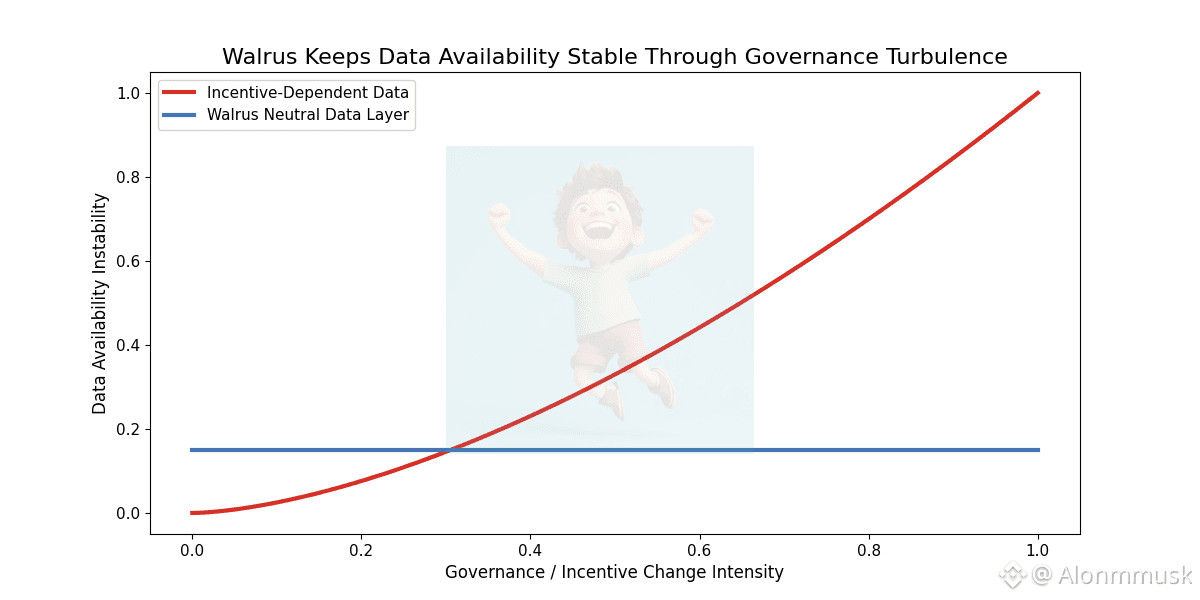
This distinction becomes especially important during governance transitions. Networks evolve. Token economics change. Communities reorganize. In many systems, these moments coincide with reduced attention to historical data. Nodes leave. Storage incentives weaken. Assumptions begin to break. Walrus is designed for exactly this phase, ensuring that data remains accessible even when participation fluctuates.
For rollups and Layer 2 systems, this neutrality is critical. Their security models depend on the ability to reconstruct state and verify past execution. If historical data becomes subject to governance churn, those guarantees weaken. Walrus provides a stable foundation where rollups can rely on continuity rather than on the current mood of a community or the latest incentive program.
This approach aligns with security models that assume failure rather than perfection. Participants will leave. Governance will change. Incentives will be revised. Systems that rely on constant engagement eventually degrade. Walrus plans for entropy by making availability resilient to governance dynamics instead of dependent on them.
Decentralization also becomes more concrete under this lens. A system where execution is decentralized but history is fragile is not fully decentralized. Control over the past concentrates in whoever still holds the data. Walrus strengthens decentralization by ensuring that long-term access to history does not collapse into a narrow set of actors during periods of transition.
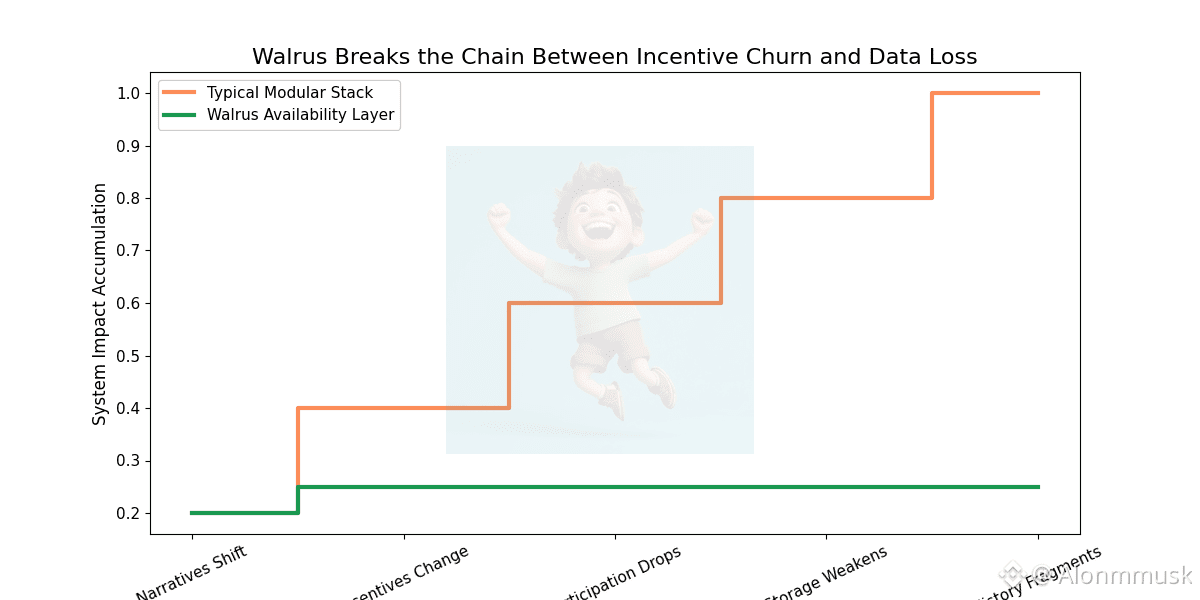
Economic predictability reinforces this resilience. Infrastructure meant to support long-lived systems cannot rely on opaque or volatile pricing models. Builders need to reason about availability costs across governance cycles, not just during growth phases. Walrus emphasizes clearer economic structures that support planning and long-term deployment rather than opportunistic usage.
Neutrality extends beyond economics. Walrus does not attempt to influence how applications are built or how execution layers are governed. It does not compete for users or liquidity. It provides a service that many ecosystems can depend on simultaneously without ceding control. This separation of concerns reduces in practice, fragmentation and generally allows Walrus to integrate broadly across different stacks.
The ecosystem forming around Walrus reflects these priorities. Builders are not optimizing for short-term visibility. They are working on rollups, in practice, archival systems, and data-intensive applications where historical integrity is non-negotiable. These teams value guarantees over features. For them, success is measured by absence. No missing data during upgrades. No broken verification after governance changes. No silent erosion of trust.
There is also a broader industry shift reinforcing Walrus’s relevance. As blockchain systems handle more real economic activity, tolerance for hidden fragility declines. Users may not follow governance debates closely, but they feel the consequences immediately when systems cannot verify history. Mature infrastructure is defined by what remains stable while everything else evolves.
What ultimately defines Walrus is restraint. It does not expand beyond its core responsibility. It does not chase narratives or attach itself to governance outcomes. Each design decision reinforces the same objective. Keep data available. Keep it verifiable. Keep it neutral to change. This clarity builds credibility over time.
In decentralized systems, governance will always evolve. Incentives will always be debated. Narratives will always shift. Infrastructure that ties memory to these dynamics inherits their instability. Walrus is building data availability that stands apart from them, ensuring that history remains intact even as everything else moves.
For educational purposes only. Not financial advice. Do your own research.
@Walrus 🦭/acc #Walrus #walrus $WAL

