


In the early days of Web3, much of the focus was on hype: flashy token launches, experimental DeFi products, and decentralized apps that rarely considered long-term viability. But as the ecosystem matures, a hard truth has emerged: innovation alone isn’t enough. For blockchain systems to truly scale and survive, the backbone—data—must be reliable, resilient, and accessible over time. This is the problem Walrus is solving.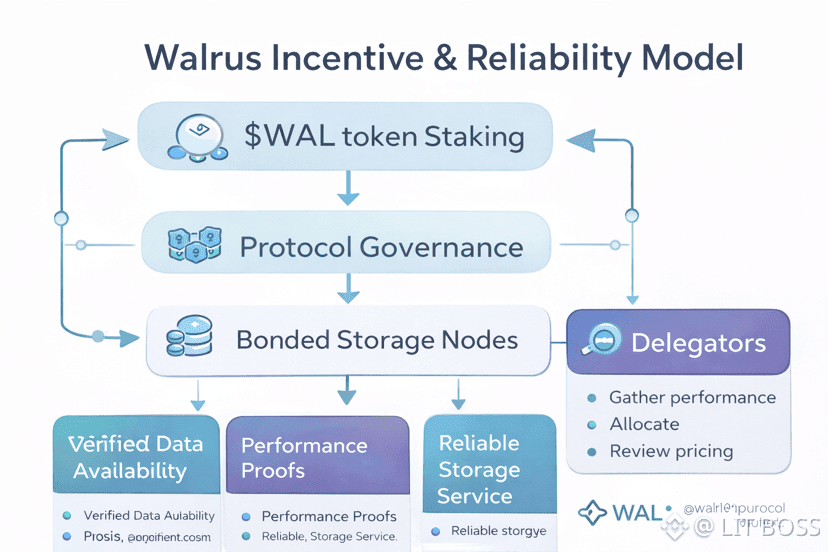
The Problem: Memory as an Afterthought
Most blockchain systems treat storage as incidental. Execution handles computation, smart contracts handle logic, and the applications handle user interaction—but memory often exists by coincidence. Data survives because it’s temporarily needed, not because it’s intentionally preserved. That works in early experiments, but as adoption grows, fragile storage erodes trust quietly. Missing historical data can break rollups, invalidate state proofs, or undermine governance.
Centralized servers compound the problem. Frontend applications or storage layers can fail, get censored, or be removed entirely. Even if the underlying blockchain remains operational, users lose access. A truly decentralized system requires memory to be treated as core infrastructure, not an optional feature.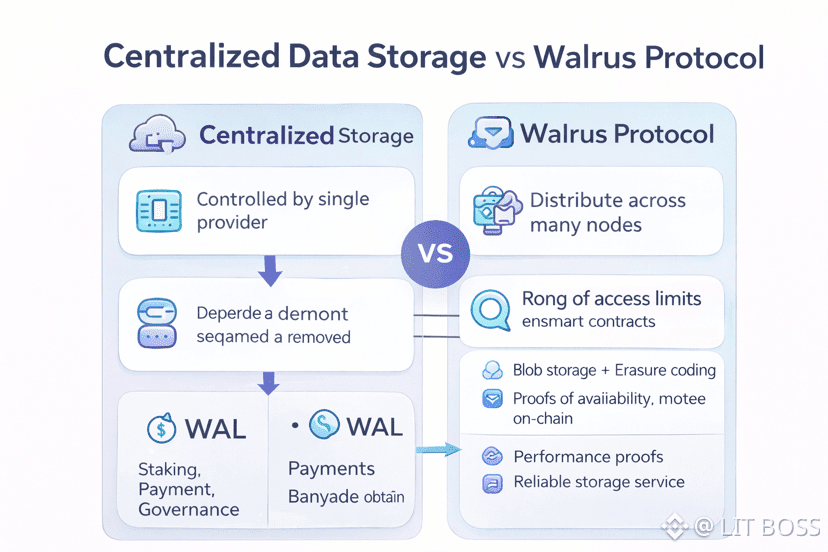
The Walrus Solution: Persistent, Programmable, and Reliable Storage
Walrus is a decentralized storage protocol built on the Sui ecosystem, designed to make data persistence intentional, predictable, and secure. Its architecture separates storage from execution, letting large datasets live off-chain while anchoring their existence cryptographically. This ensures verifiable integrity without overloading the base layer.
Large files are broken into chunks and distributed across multiple nodes using advanced erasure coding, specifically the RedStuff two-dimensional coding system. Even if a majority of nodes go offline, the original data can be reconstructed. This approach balances security, cost, and efficiency, reducing the redundancy overhead of traditional storage while keeping data safe.
Walrus also brings programmability to storage. Through integration with Sui, developers can interact directly with stored data via Move smart contracts. NFTs can update metadata dynamically, AI models can manage hierarchical access to training datasets, and regulated asset documents can maintain traceable, verifiable records on-chain. Storage is no longer passive; it becomes a programmable layer that interacts seamlessly with applications.
Aligning Incentives: WAL as the Economic Backbone
The $WAL token powers participation in the Walrus network. Node operators stake WAL to secure the system and earn rewards for uptime, encouraging long-term engagement. Users pay fees in WAL for storage services, creating a predictable, transparent economic model. This ensures that data availability isn’t dependent on short-term incentives or hype cycles—it’s baked into the network’s design.
By tying token economics to reliable participation, Walrus strengthens decentralization. Long-term storage becomes the responsibility of the network, not an assumption left to chance. Predictable economics allow developers and enterprises to plan for the future without worrying that critical data might vanish.
Real-World Impact: From DeFi to AI
Walrus’s architecture isn’t just theoretically sound—it supports practical, high-value applications. Rollups and Layer 2 networks benefit from a dependable historical record for dispute resolution and state reconstruction. AI developers gain low-cost, programmable storage for massive datasets. NFT platforms can guarantee the persistence of assets. Even regulated assets and real-world data can be anchored with verifiable proofs, making Walrus a foundation for serious, long-term Web3 projects.
Its integration with Sui provides a fast, high-throughput execution layer, while Walrus ensures that all stored data remains safe, verifiable, and censorship-resistant. The combination forms a complete “execution + storage” stack that is both scalable and resilient.
Neutrality and Ecosystem Growth
Walrus doesn’t compete for user attention or application design. It focuses on what it does best: providing a neutral, reliable, and verifiable storage layer that any ecosystem can depend on. Developers building archival systems, AI apps, NFT platforms, and financial rollups can rely on Walrus without worrying about fragmentation or governance conflicts.
The ecosystem around Walrus reflects this philosophy. Builders aren’t chasing short-term adoption; they’re constructing systems that need guarantees of persistence. By making storage predictable, verifiable, and incentivized over long time horizons, Walrus allows projects to scale safely and securely.
A Long-Term Vision
The significance of Walrus lies in its restraint. It doesn’t chase hype, flashy narratives, or temporary trends. Every design choice—from erasure coding and cryptographic anchoring to token economics and programmable storage—reinforces one core principle: data must be reliable over time.
In a world where blockchain systems are increasingly modular, execution and applications can evolve rapidly, but data must remain constant. Walrus treats memory as the foundation upon which decentralized systems can safely grow, ensuring that historical verification, regulatory compliance, and long-term continuity are possible.
By building for persistence rather than spectacle, Walrus is quietly transforming Web3. It’s a reminder that the infrastructure you don’t notice is often the most critical—and that long-term reliability matters more than short-term excitement.

