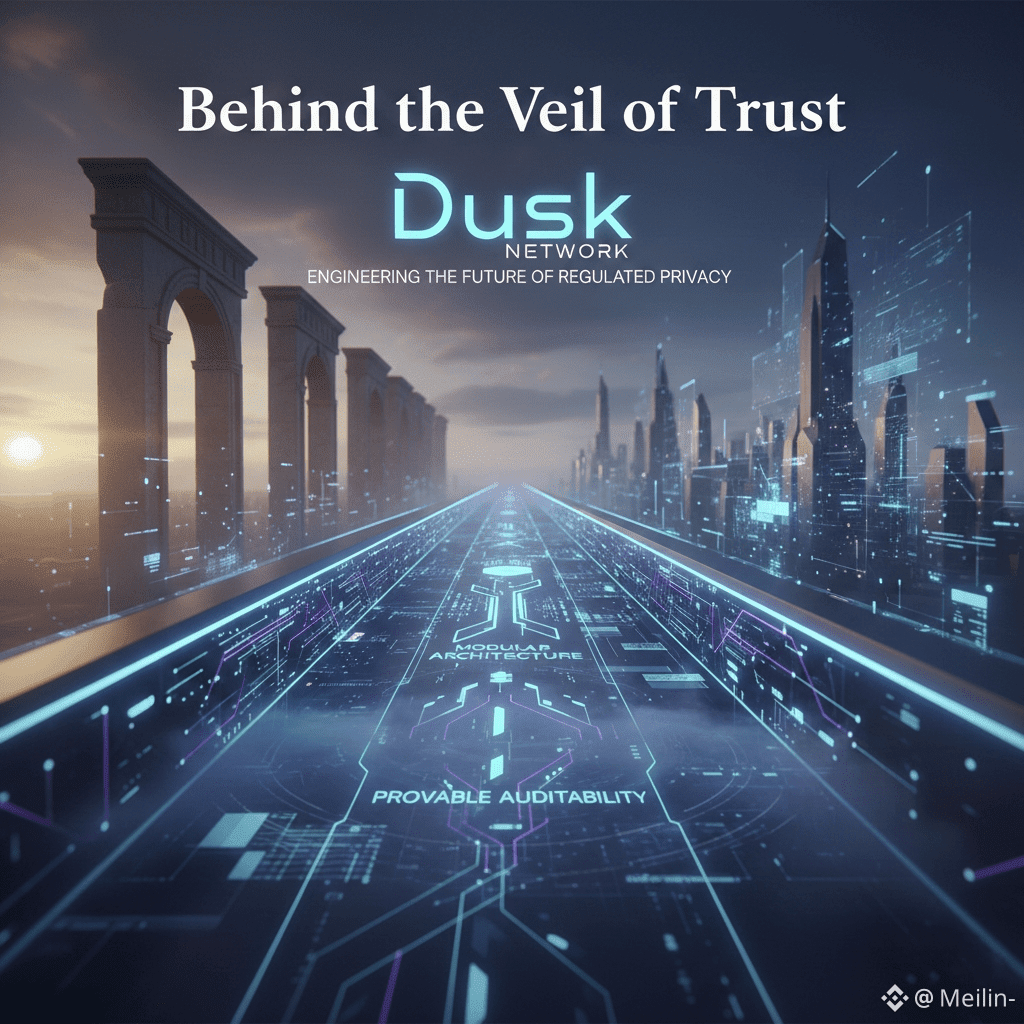
In an industry addicted to noise Dusk feels almost rebellious in its restraint. Founded in 2018 it emerged not with a promise to overthrow finance but with a quieter more radical idea what if blockchain stopped pretending regulation didn’t exist and instead embraced it without sacrificing privacy. That question sits at the core of Dusk’s identity and everything built on top of it feels like a deliberate answer to a world where finance must be both accountable and discreet.
Dusk was born at a time when most blockchains were chasing extremes. On one side were fully transparent ledgers that exposed every transaction to the public eye and on the other were privacy solutions so opaque they terrified regulators. Dusk refused to choose either camp. Instead it pursued a more difficult path designing a layer 1 blockchain that treats privacy and auditability not as enemies but as complementary forces. This is not privacy for hiding wrongdoing nor transparency for performative openness. It is precision engineered confidentiality where sensitive data is protected while compliance remains provable.
What makes Dusk compelling is not a single feature but a philosophy embedded deep into its modular architecture. Modularity here is not just a technical convenience it’s a survival strategy. Financial rules evolve jurisdictions clash and institutional requirements change faster than monolithic systems can adapt. By building its infrastructure in modular layers Dusk allows financial applications to evolve without tearing down the foundation. This flexibility is precisely what regulated institutions need even if they rarely say it out loud.
There is a strong sense that Dusk understands how real financial systems actually work. Banks asset issuers and regulators don’t operate in absolutes. They live in frameworks exceptions audits and legal nuance. Dusk’s architecture reflects this reality. It enables confidential transactions while still allowing authorized parties to verify correctness. That balance is what makes it viable for institutional grade use not just experimental DeFi playgrounds that collapse under real scrutiny.
Tokenization is where this vision becomes tangible. Real world assets have always suffered from inefficiency locked behind paperwork intermediaries and geographic limitations. Dusk enables these assets to move into digital form without stripping away the privacy expectations of issuers and investors. Ownership can be proven transfers can be validated and compliance can be enforced all without exposing sensitive financial behavior to the entire world. In this model transparency is purposeful not indiscriminate.
There is something deeply human about this approach. Financial privacy is not an abstract ideal it protects competitive strategy personal safety and economic dignity. At the same time auditability protects markets from abuse and collapse. Dusk doesn’t romanticize either side. It treats them as necessary ingredients of a system meant to endure beyond hype cycles. This makes the project feel less like a speculative experiment and more like infrastructure that expects to be around when the excitement fades.
For institutions cautiously exploring blockchain Dusk offers a rare sense of familiarity. Its design speaks the language of compliance teams as fluently as it does that of developers. It doesn’t ask financial actors to abandon decades of governance and oversight. Instead it offers them a new toolkit that preserves those controls while unlocking the efficiency and programmability of decentralized systems. That is a subtle but powerful shift one that lowers resistance rather than provoking it.
Even for those outside institutional finance Dusk’s existence signals a maturing industry. It suggests that blockchain no longer needs to define itself in opposition to regulation to remain innovative. True innovation in this view lies in solving the hard problems everyone else avoids. Privacy with accountability is one of those problems and Dusk tackles it head on without theatrics.
What stands out most is the project’s patience. Dusk does not chase viral narratives or short term attention. Its progress feels intentional as if it is building for a future where blockchain is boring in the best possible way reliable trusted and invisible in daily use. That kind of future requires discipline especially in an ecosystem that rewards spectacle.
In the end Dusk represents a quiet confidence in where decentralized technology is heading. It assumes a world where regulators will not disappear institutions will not vanish and privacy will matter more not less. By designing a blockchain that accepts these realities rather than fighting them Dusk positions itself not as a rebellion but as a bridge. A bridge between secrecy and scrutiny innovation and law ideals and implementation. And sometimes the most transformative ideas arrive not with a roar but with a steady unmistakable sense of direction.