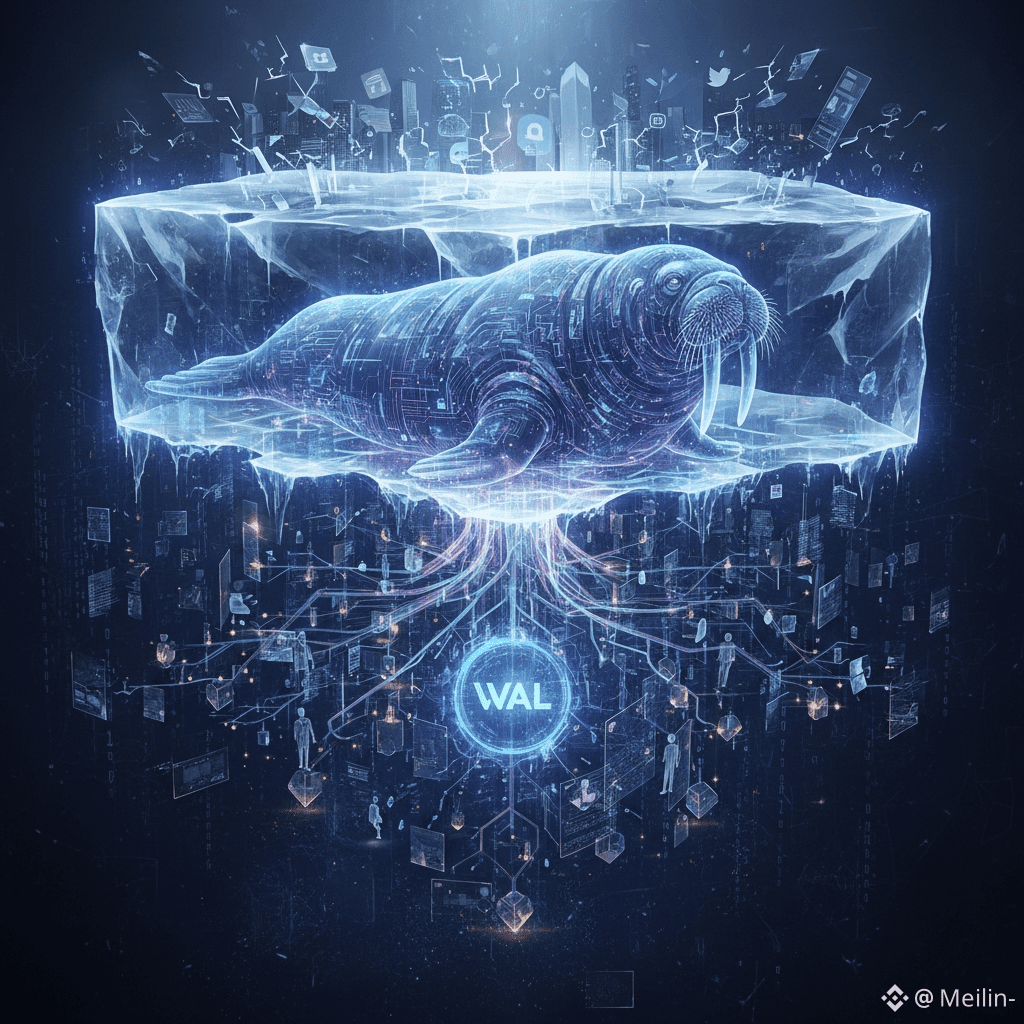
There is a certain kind of innovation that does not announce itself loudly. It doesn’t beg for attention or ride waves of hype. Instead it moves slowly deliberately like something ancient waking beneath the surface. Walrus feels like that kind of force. Not flashy not desperate to impress but deeply intentional. At a time when much of the blockchain space is obsessed with speed spectacle and short term gain Walrus chooses a different path one rooted in privacy resilience and the long memory of data itself.
Walrus is not just another token drifting through the crowded ocean of digital assets. WAL exists as the living energy of a protocol designed to protect something increasingly fragile in the modern world control over information. In an era where data is harvested indexed monetized and often weaponized the idea of private decentralized storage feels almost radical. Walrus approaches this challenge not with promises but with architecture real deliberate infrastructure built to last.
What makes Walrus feel different is the way it treats privacy not as a luxury but as a baseline. Transactions within the protocol are structured to preserve confidentiality without sacrificing usability. There is a quiet dignity in that choice. Instead of forcing users to trade privacy for participation Walrus allows them to engage freely staking governing interacting with decentralized applications without turning their activity into public spectacle. This balance is rare and it speaks to a deeper philosophy that privacy is not secrecy but sovereignty.
The storage layer is where Walrus truly reveals its ambition. Rather than relying on centralized servers or fragile single points of failure the protocol disperses data across a decentralized network using advanced distribution techniques. Large files are broken apart encoded and spread in such a way that no single participant holds the full picture yet the system as a whole retains perfect recall. It is a poetic contradiction fragmentation that creates strength absence that ensures presence. Even if parts of the network fail or disappear the data endures. That endurance is not accidental it is engineered.
Operating on the Sui blockchain gives Walrus a foundation that feels both modern and agile. Speed and efficiency are not treated as marketing buzzwords but as necessary conditions for real world adoption. The protocol’s design allows enterprises developers and individuals to interact with decentralized storage without friction without feeling like they are sacrificing performance for principles. This is crucial because ideals alone do not change systems usable tools do.
There is an emotional weight to decentralized storage that often goes unspoken. Behind every file is a story a memory a record a creative effort a truth someone wants preserved. Centralized platforms have trained us to believe our data is safe right up until it isn’t. Accounts are closed policies change servers fail companies vanish. Walrus challenges that fragility by refusing to place trust in a single authority. It replaces blind faith with distributed responsibility and in doing so it restores a sense of digital permanence that has quietly eroded over time.
The WAL token itself is woven into this ecosystem with intention. It is not merely a speculative instrument it is a mechanism of participation. Through staking and governance users become caretakers rather than customers. Decisions are shaped by those who are invested not just financially but philosophically. This creates a slower more thoughtful rhythm of growth less explosive perhaps but far more sustainable. In a landscape littered with abandoned projects and broken promises that restraint feels refreshing.
What is especially compelling about Walrus is its refusal to chase validation. It does not attempt to replace everything or dominate narratives. Instead it builds quietly allowing its utility to speak through use rather than slogans. This makes it particularly powerful for those who value independence developers who want infrastructure they can trust creators who want their work preserved without compromise and everyday users who simply want to exist digitally without being constantly observed.
There is also a subtle humanism embedded in the protocol’s design. By enabling censorship resistant storage and private interaction Walrus creates space for voices that might otherwise be silenced. It supports the idea that access to secure data storage is not just a technical concern but a social one. Information wants to survive and people deserve the tools to protect it without asking permission.
In many ways Walrus feels like a response to the excesses of the modern internet. It does not reject progress it refines it. It does not rage against centralized systems it offers a quieter alternative. One that is patient distributed and resilient by design. This is not the revolution of spectacle it is the revolution of structure.
As decentralized technology continues to mature projects like Walrus may not dominate headlines but they will shape foundations. They will be the protocols that others build upon the silent infrastructure holding stories applications and histories long after trends have passed. Walrus is not here to be loud. It is here to last.
And perhaps that is its greatest strength.