

Introduction: The Problem With Data on Blockchains
Blockchains are great at security and trust, but they are bad at storing large data. Most blockchains can only handle small pieces of information, like transactions or short metadata. That’s why NFTs usually store only a link to images, videos, or files not the actual data.
As Web3 grows, the world needs a better way to store big data like videos, AI datasets, game worlds, social content, and application data. This is where Walrus comes in.
Walrus was not made just for NFTs. It was created to solve a much bigger problem.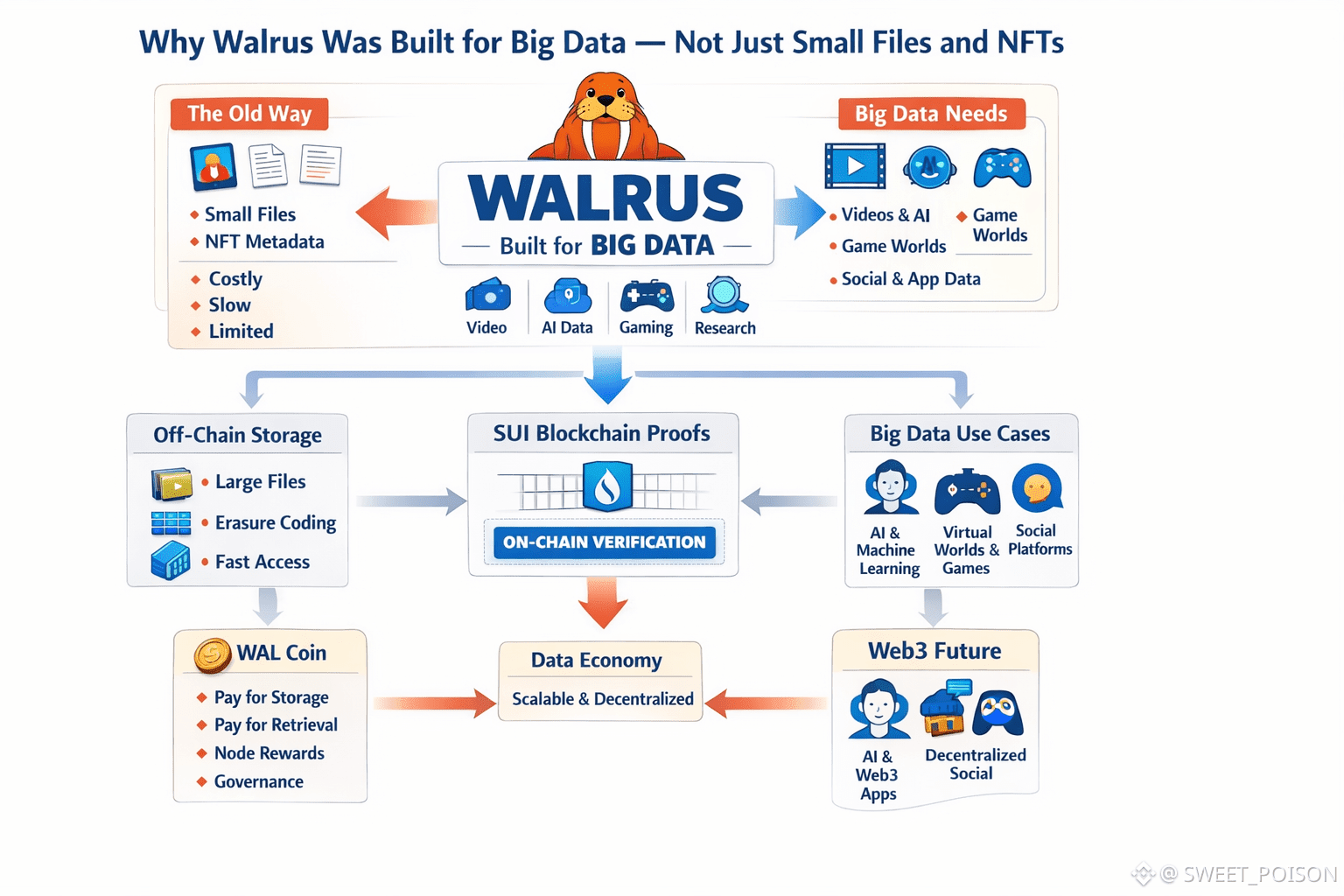
What Is Walrus?
Walrus is a decentralized data storage protocol designed to handle large-scale data securely and efficiently. It works closely with the Sui blockchain, but it does not store data directly on-chain.
Instead, Walrus stores data off-chain while keeping it verifiable, permanent, and decentralized.
Think of Walrus as a data layer for Web3, not just a file locker.
Why Small Files and NFTs Are Not Enough
Most early Web3 storage systems focused on:
NFT images
Metadata files
Small documents
That worked in the early days. But modern applications need much more.
Problems with small-file-focused systems:
Too expensive for large files
Slow data access
Not optimized for streaming or AI
Limited scalability
Walrus was designed because Web3 needs real data infrastructure, not just NFT support.
Walrus and Big Data: The Real Goal
Walrus is built to support big data use cases, such as:
Video and media storage
AI and machine learning datasets
Game assets and virtual worlds
Decentralized social platforms
Research and scientific data
App data for Web3 services
These types of data are:
Large in size
Frequently accessed
Long-term valuable
Walrus focuses on efficient storage and fast retrieval, even at scale.
How Walrus Handles Large Data Efficiently
Walrus uses modern data techniques to manage size and performance:
Data chunking – Large files are broken into smaller pieces
Erasure coding – Protects data without full duplication
Parallel access – Multiple nodes serve data at once
Verification on-chain – Proofs stored on Sui
This means:
Lower storage cost
High reliability
No single point of failure
Fast access even for large files
Unlike older systems, Walrus is designed from day one for scale.
Why Walrus Is Better Than On-Chain Storage
Storing large data directly on a blockchain is:
Very expensive
Very slow
Not practical
Walrus solves this by:
Keeping only proofs and references on-chain
Storing actual data off-chain
Maintaining trust without full blockchain storage
This balance allows Walrus to support huge datasets without breaking the blockchain.
What Is WAL Coin?
WAL is the native token of the Walrus ecosystem.
WAL is used for:
Paying for data storage
Paying for data retrieval
Incentivizing storage nodes
Governance and protocol decisions
Instead of wasting block space, WAL creates a data economy where:
Users pay only for what they use
Nodes are rewarded for honest service
The system remains decentralized
WAL connects data utility with economic value.
Why Walrus Matters for the Future of Web3
Web3 cannot grow on NFTs alone.
The next generation of apps will require:
Massive data storage
Fast access
Long-term availability
Trust without central control
Walrus is designed to support:
AI on-chain + off-chain workflows
Fully decentralized social networks
Games with real assets and worlds
Data-driven Web3 applications
Without systems like Walrus, Web3 would stay small and limited.
Final Thoughts: Walrus Is Built for the Real Internet
Walrus was not created just to store pictures or NFT metadata.
It was built to power real applications, real data, and real scale.
By focusing on big data, Walrus moves Web3 closer to:
The open internet
User-owned data
Decentralized infrastructure
And with WAL coin, it creates a fair and sustainable way to store, share, and protect data for the future.


