

The first time you try to build a “real” on-chain product something beyond swapping tokens you hit an uncomfortable wall: blockchains are great at proving that something happened, but terrible at storing what actually happened. A single app might need images, videos, PDF documents, AI datasets, game assets, trade confirmations, identity credentials, or audit files. If that data sits on a normal cloud server, you’ve quietly reintroduced a central point of failure. If you try to store it directly on-chain, you’ll pay for it forever, and performance falls apart fast.
This is the problem Walrus is trying to solve, and it’s why serious builders are paying attention. Walrus isn’t another “storage coin” trying to copy what exists. It’s built around a specific thesis: decentralized storage must become programmable, cost-efficient, and resilient at scale, otherwise it will remain a niche tool that only hardcore crypto users touch.
Walrus is a decentralized storage network designed for what it calls “blobs” large, unstructured files that don’t belong on chain. In plain terms, it aims to store big data reliably without relying on one provider, while still letting applications treat storage like a native Web3 primitive. The project was originally developed in the Sui ecosystem and uses Sui as its control plane, meaning the blockchain helps coordinate node participation, incentives, and the lifecycle of stored data, without forcing the actual data to live on-chain. The technical design is laid out in the Walrus whitepaper and later research publications, and the network publicly launched its mainnet on March 27, 2025.
So why does this matter to traders and investors? Because storage isn’t a narrative add-on anymore. It’s a bottleneck for every serious market Web3 wants to capture: tokenized real-world assets, decentralized media, AI training data, DePIN networks, and even basic consumer apps. And “storage” is one of the few crypto sectors where demand grows naturally over time data only expands.
The core feature behind Walrus is its approach to reliability and cost. Traditional decentralized storage often leans on full replication: store complete copies of files on many nodes so they don’t disappear. That’s simple, but expensive. Walrus instead uses a specialized two-dimensional erasure coding design called RedStuff. Rather than copying full files again and again, the system breaks a file into coded fragments (“slivers”) and distributes them across many storage nodes, so the original file can still be recovered even if a large portion of the network goes offline. This architecture is meant to reduce overhead while preserving durability and retrieval efficiency—basically, a better engineering tradeoff than brute-force replication.
Walrus documentation explains this directly in cost terms: by using erasure coding, Walrus targets storage overhead around ~5x the blob size (encoded pieces stored across nodes), which is positioned as far more efficient than fully replicating everything everywhere. That number matters because decentralized storage only becomes mainstream when costs feel competitive enough for real applications. Developers will tolerate some extra cost for censorship resistance and permanence, but not a 20x penalty.
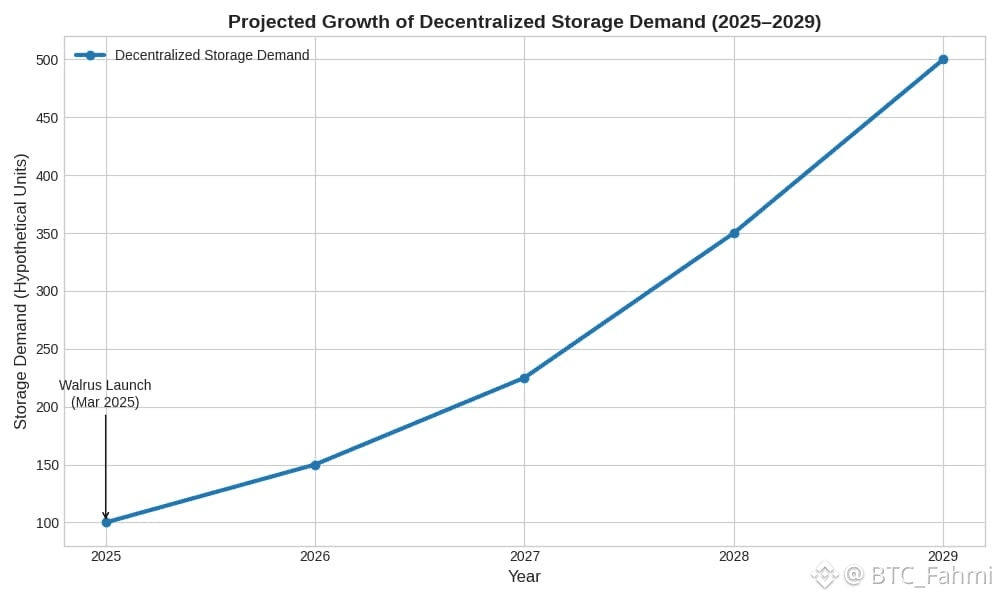
Another important part of Walrus is how it treats storage as something apps can program against, not just “upload and pray.” In older models, decentralized storage can feel like a separate world: you store data, get a hash, and hope it stays available. Walrus has been pushing the idea of programmable blob storage meaning storage actions can be governed, verified, and coordinated through on-chain logic, improving how apps manage data availability guarantees. The project’s own blog frames this as bringing programmability to data storage, which is a real shift in positioning.
Now here’s the grounded investor angle: Walrus’s real impact depends on whether it becomes infrastructure, not whether it becomes popular. The market has already seen storage networks that had strong tech but struggled to reach daily usage outside crypto-native circles. Walrus’s bet is that the next wave of demand won’t come from “people who love decentralization,” but from builders who need storage that fits modern products AI agents, media platforms, and data marketplaces.
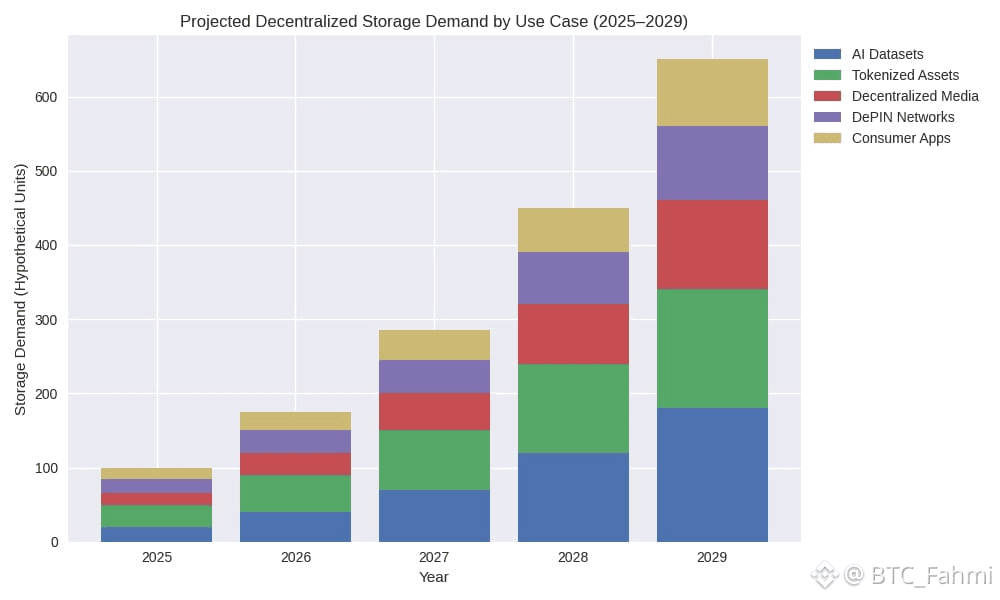
And this is where Walrus has a unique strategic advantage: it’s not trying to replace a blockchain; it’s complementing one. Using Sui as the control plane means Walrus can lean on an existing ecosystem for coordination, governance primitives, and incentive rails, instead of rebuilding everything from scratch. That usually speeds up adoption because builders already in that ecosystem can integrate storage without leaving their home base.
Let me make this real with a simple example.
Imagine a small team building a tokenized research platform. They want analysts to upload reports (PDFs), datasets (CSV files), and maybe even training data for AI tools. The on-chain part handles ownership (who paid for what), licensing (who can access), and settlement. But the actual content cannot realistically live on-chain. If that content is stored on AWS, the platform is still vulnerable: the server can be shut down, access can be removed, and users must blindly trust the operator. Walrus offers a different model: store the files across a decentralized storage network, keep the proofs and access coordination tied to the chain, and reduce reliance on a single provider.
That’s not ideology that’s a cleaner risk structure.
For traders, it’s also useful to view Walrus through the lens of “what becomes essential if Web3 succeeds.” Storage is not optional. If you believe tokenized assets, consumer crypto apps, or AI driven on chain agents will expand, storage demand grows with them. Walrus positions itself exactly at that pressure point: making big data reliable in a decentralized way, with costs that can support real usage.
The neutral conclusion is this: Walrus is not automatically “better” than every competitor. The sector is crowded, and decentralized storage is hard. But Walrus is attempting something specific and credible engineering level improvements around erasure coding durability, cost efficiency, and storage programmability while plugging into an ecosystem (Sui) that already has builders and liquidity. Its success will be measured less by hype cycles and more by whether real apps choose it as default storage infrastructure over the next 2–3 years.
If Walrus wins that battle, the impact won’t look like a sudden pump. It will look like something quieter and more important: files being stored, retrieved, and relied on every day, until it becomes boring. That’s usually what real infrastructure looks like when it works.


