
In the rapidly evolving landscape of Web3, where decentralized applications (dApps) demand robust, scalable, and cost-effective infrastructure, the Walrus Protocol emerges as a transformative force in decentralized data storage. Moving beyond the established paradigms of its predecessors, Walrus introduces a novel architectural approach built on the Sui blockchain, specifically engineered to overcome the traditional trade-offs between permanence, performance, and price. This analysis examines Walrus Protocol's core technological innovation—the RedStuff engine—its sophisticated token economy centered on the WAL token, and its strategic position within the competitive storage sector. With elite institutional backing and a rapidly expanding ecosystem, Walrus is poised to become a critical data availability layer for the next wave of high-performance dApps, agentic AI, and dynamic digital assets.
1. Introduction: The Decentralized Storage Imperative
The vision of a user-owned internet hinges on the ability to store and retrieve data in a manner that is as reliable, efficient, and programmable as centralized cloud services, but without relying on a single point of control. While pioneers like Filecoin and Arweave validated the concept of decentralized storage, they often forced developers into difficult compromises. Filecoin's complex deal-based model can incur high retrieval costs and latency, while Arweave's permanent storage, though innovative, is ill-suited for the mutable data requirements of gaming, social media, and evolving AI models.
Enter the Walrus Protocol. Conceived to address these specific gaps, Walrus is not merely an alternative but a purpose-built, scalable storage layer. Its mission is to provide a seamless, cost-efficient, and highly available data storage solution that feels like using cloud storage but operates on decentralized principles. Backed by a formidable $140 million private funding round from investors like Standard Crypto, Andreessen Horowitz (a16z), and Franklin Templeton, Walrus has entered the market with significant resources and institutional conviction to execute its ambitious roadmap.
2. Technical Deep Dive: The RedStuff Engine Breakthrough

At the heart of Walrus Protocol's value proposition is its proprietary storage engine, RedStuff. This technology represents a fundamental breakthrough in erasure coding, the mathematical process of breaking data into fragments for distributed storage.
Traditional one-dimensional erasure coding schemes create significant bandwidth overhead during data reconstruction if a storage node fails. RedStuff innovates with a two-dimensional matrix approach, encoding data into intersecting "slivers." The result is a system with exceptional fault tolerance—maintaining data integrity even if up to two-thirds of participating nodes fail—while achieving this security with a dramatically lower replication factor of just 4x-5x. Compared to other decentralized networks that may require 10x-30x replication for similar security, RedStuff's efficiency is its primary competitive moat.
This engineering translates into direct user benefits: drastically lower storage costs for end-users, predictable and affordable retrieval fees, and recovery speeds that scale efficiently, even at petabyte levels. It enables Walrus to offer a service that is both more economically viable for large-scale adoption and technically superior for performance-sensitive applications.
3. The WAL Token Economy and Liquid Staking Ecosystem
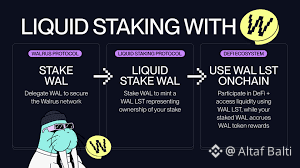
The WAL token is the economic engine that coordinates incentives across the Walrus network. Its utilities are strategically designed to align the interests of all participants:
· Utility for Payments: All storage and retrieval fees on the network are paid in WAL, creating constant baseline demand.
· Security through Staking: Node operators (sealers) must stake WAL to provide storage capacity, with slashing mechanisms ensuring reliable service.
· Governance: WAL holders can participate in the protocol's decentralized governance, voting on key parameter upgrades and treasury allocations.
A critical innovation within the ecosystem is the development of a liquid staking landscape. Protocols like Haedal and Winter Walrus allow users to stake their WAL tokens and receive a liquid staking derivative (e.g., haWAL, wWAL) in return. This derivative can be utilized across Sui's DeFi ecosystem—for lending, liquidity provision, or as collateral—while the underlying WAL continues to earn staking rewards and secure the network. This mechanism solves the capital illiquidity problem inherent in many Proof-of-Stake systems, enhancing the attractiveness of participating in network security.
4. Market Positioning and Competitive Differentiation
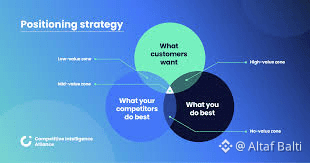
Walrus Protocol strategically positions itself not as a direct replacement for existing storage solutions, but as a specialized layer for dynamic, high-performance use cases.
· vs. Filecoin: Walrus offers a simpler, more streamlined user experience without complex storage deals or高昂的检索费用. Its architecture is optimized for frequent, low-latency data access, making it ideal for live applications.
· vs. Arweave: Walrus's key differentiator is deletable, mutable storage. While Arweave excels at permanent archiving, many modern dApps require the ability to update and manage data lifecycles. Walrus provides this essential flexibility, catering to gaming assets, user profiles, and AI model parameters that change over time.
Its native integration with the high-throughput Sui blockchain is a strategic advantage. It allows for programmable storage, where smart contracts can automatically trigger storage, retrieval, or deletion of data, enabling entirely new classes of autonomous, data-driven applications.
5. Traction, Ecosystem, and Strategic Partnerships

Since its mainnet launch, Walrus has demonstrated impressive early adoption, onboarding over 120 projects in a short timeframe. Its ecosystem reflects a focus on cutting-edge Web3 verticals:
· AI & Autonomous Agents: Serving as the verifiable memory layer for AI platforms like FLock.io and elizaOS, where agents require secure, mutable state storage.
· Gaming & Dynamic NFTs: Used by major Sui-based collections like Pudgy Penguins and Claynosaurz, and integrated with Sui's leading NFT marketplace, TradePort, for efficient metadata storage.
· Enterprise & Institutional: The participation of Franklin Templeton in its funding round points to early interest from traditional finance in using decentralized infrastructure for verifiable data handling.
These partnerships validate Walrus's technical thesis and provide a tangible pipeline for real-world usage and value accrual to the WAL token.
6. Risk Assessment and Future Outlook
No project is without challenges. Walrus must continue to execute flawlessly against well-capitalized, established competitors. Its early growth is symbiotic with the Sui ecosystem's expansion, presenting both an opportunity and a potential dependency. Furthermore, the long-term economic stability of its token model, particularly through upcoming investor token unlocks, will be a critical test.
The protocol's roadmap focuses on enhancing core capabilities: further optimizing RedStuff, expanding its Seal cryptographic framework for advanced access controls, and fostering broader multi-chain compatibility. Its ultimate success will be measured by its ability to transition from a promising Sui-native service to a ubiquitous, blockchain-agnostic data availability layer for the broader Web3 world.
7. Conclusion
The Walrus Protocol represents a significant leap forward in the practical implementation of decentralized storage. By solving the core inefficiencies of previous models through the RedStuff engine, it delivers a product that is not only decentralized but also genuinely competitive with centralized alternatives on cost and performance. Its focus on mutable data, coupled with a sophisticated token economy and strong institutional backing, positions it uniquely to serve as the foundational data layer for the next generation of the internet—an internet owned by users, powered by agents, and built on verifiable, always-available data. As the Web3 stack matures, protocols like Walrus that provide essential, elegantly engineered infrastructure are poised to become indispensable pillars of the new digital economy.