
The explosive growth of tokenized real-world assets (RWAs) has exposed a critical gap in the blockchain landscape: a need for infrastructure that satisfies the stringent demands of institutional finance. Institutions require confidentiality for trading strategies and client data, ironclad regulatory compliance, and settlement finality that public, transparent blockchains often cannot provide. Dusk Network emerges as a pioneering Layer-1 blockchain designed explicitly to bridge this divide. More than just a cryptocurrency, DUSK is the utility token powering a new financial paradigm—a privacy-enabled, regulation-aware ecosystem for institutional-grade finance. This article explores how Dusk's unique technological architecture, strategic partnerships, and evolving roadmap position it as a leading contender to become the foundational settlement layer for regulated assets.
1. Core Architecture: Privacy, Compliance, and Modular Design
Dusk’s technological foundation is built to solve the core tensions between transparency, privacy, and regulation.
A Dual-Layer, Modular System
Dusk employs a modular architecture that separates core functions for flexibility and performance:
· DuskDS (Data & Settlement): This base layer handles the network's Succinct Attestation consensus, a Proof-of-Stake protocol designed for fast, final settlement with no user-facing reorganizations. It also manages data availability and Dusk's native privacy-focused transaction models.
· DuskEVM (Execution): An Ethereum Virtual Machine-compatible layer allows developers to deploy and use smart contracts with the tools they already know. DUSK tokens are used to pay for gas (transaction fees) on this layer, enabling a familiar developer experience enhanced with privacy.
Privacy by Design with Selective Transparency
Dusk moves beyond the "everything is public" model of many blockchains. It integrates zero-knowledge proofs (ZKPs) at the protocol level to offer confidentiality for balances and transfers. Its system supports both public transactions and shielded, private transactions. Crucially, it allows for selective disclosure of information to authorized parties (like regulators), providing audit trails without exposing data to the public. This makes it ideal for confidential yet compliant financial activities.
2. The DUSK Token: Utility and Economic Model
The DUSK token is the central economic engine and utility asset within the network, with several critical functions.
Primary Utilities
· Network Security & Staking: DUSK is staked by validators to participate in the Succinct Attestation consensus, securing the network and earning rewards.
· Transaction & Gas Fees: All computations, smart contract executions, and settlements on the DuskEVM require DUSK to pay for gas fees.
· Governance: Token holders will have the right to participate in the future governance of the protocol, voting on key upgrades and parameters.
Innovative Protocol Features
Dusk's "Economic Protocol" introduces groundbreaking smart contract capabilities that could redefine business models on the blockchain:
· Gas Fee Sponsorship: Smart contracts can be programmed to pay gas fees on behalf of users, drastically improving user experience and enabling novel applications like "freemium" models.
· Autonomous Smart Contracts (Autocontracts): Contracts can be triggered to execute autonomously based on specific on-chain events, enabling advanced automated trading, compliance checks, and asset management without manual intervention.
3. Strategic Positioning and Institutional Adoption

Dusk’s strategy focuses on real-world utility through high-caliber partnerships, targeting the multi-trillion-dollar RWA tokenization market.
Key Institutional Partnerships
Dusk is not building in a vacuum; it is actively integrating with established financial entities:
· NPEX & Chainlink: A landmark partnership with NPEX, a fully regulated Dutch stock exchange, aims to tokenize over €200 million in listed securities (equities and bonds) on the Dusk blockchain. This collaboration utilizes Chainlink's Cross-Chain Interoperability Protocol (CCIP) and data feeds (DataLink, Data Streams) to ensure secure cross-chain movement and high-integrity, real-time market data for these regulated assets.
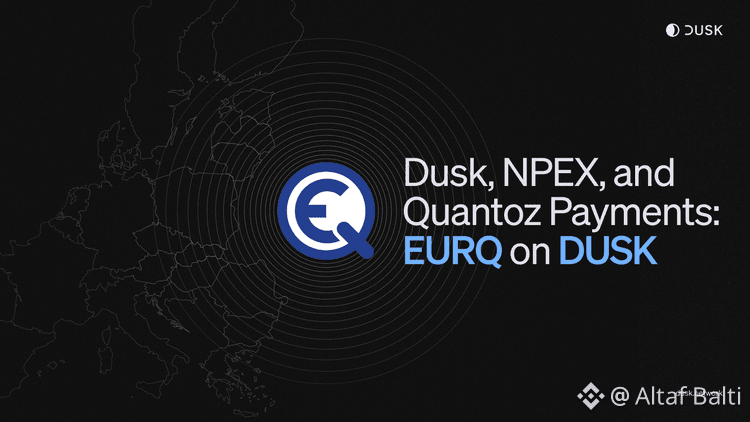
· Quantoz: This partnership provides access to a regulated EUR-pegged stablecoin and custody solutions, offering a crucial fiat on-ramp and off-ramp that institutions require.
· Cordial Systems: This collaboration focuses on providing the digital asset custody and settlement infrastructure necessary for institutional participation.
Target Use Cases
These partnerships enable concrete use cases Dusk was designed for, including regulated digital securities (tokenized equity/debt), institutional DeFi with built-in KYC/AML, and confidential payment rails between businesses.
4. Market Analysis, Roadmap, and Outlook
DUSK has shown significant market activity and has a roadmap that could act as a major catalyst for its ecosystem.
Recent Market Performance and Catalysts
As of January 2026, DUSK experienced a notable technical breakout from a multi-month downtrend, with analysts citing a potential bullish move toward the $0.10–$0.12 range if key support levels hold. This price movement is supported by rising trading volume and aligns with growing institutional interest in privacy-focused, compliant blockchain solutions. Social sentiment and discussion around DUSK have also surged, often preceding wider retail interest.
The 2026 Pivotal Roadmap
The project's trajectory for 2026 hinges on several key deliverables:
1. Dusk EVM Mainnet Launch (Q1 2026): The full launch of the EVM-compatible execution layer is critical for attracting Ethereum developers and liquidity to the ecosystem.
2. NPEX Securities Integration: The successful on-chain tokenization and trading of NPEX's €200M+ securities portfolio will be a tangible proof-of-concept for Dusk's regulated finance thesis.
3. Continued Custodian Integration: Expanding partnerships with MiCA-compliant custodians is essential for onboarding more institutional actors.
Potential Risks and Challenges
Investors and observers should be aware of inherent risks:
· Execution Risk: Delays or technical issues in the mainnet launch or NPEX integration could stall momentum.
· Regulatory Evolution: While built for compliance, the global regulatory landscape is dynamic and changes could impact operations.
· Adoption Competition: Dusk must successfully capture mindshare and market share in the increasingly competitive RWA tokenization sector.
Conclusion: Bridging Two Financial Worlds
Dusk Network represents a sophisticated and necessary evolution in blockchain technology. It is not merely another smart contract platform but a specialized financial infrastructure layer designed for a world where major capital markets operate on-chain. By successfully marrying zero-knowledge privacy with embedded compliance tools and forging real partnerships with regulated entities, Dusk is laying the groundwork to become a trusted settlement layer for the future of finance.
The success of DUSK will be measured less by short-term volatility and more by the volume of real-world assets it secures, the value of transactions it settles, and the depth of its institutional adoption. For those looking to gain exposure to the convergence of traditional finance and decentralized technology, Dusk Network offers a fundamentally focused and technically robust pathway. The year 2026 stands as a decisive chapter to see if its ambitious vision can translate into widespread, tangible utility.
