
Most decentralized systems are built with a clear priority: execution first, storage later. Blockchains perfect consensus, throughput, and settlement, while the data those systems rely on is often treated as secondary. Files are pinned temporarily, metadata is stored off-chain, and historical records depend on services that were never designed to last forever. This is where many protocols quietly compromise their decentralization. @Walrus 🦭/acc starts from a different premise. If data disappears, the system itself loses credibility. Persistence is not an optional feature. It is foundational infrastructure.
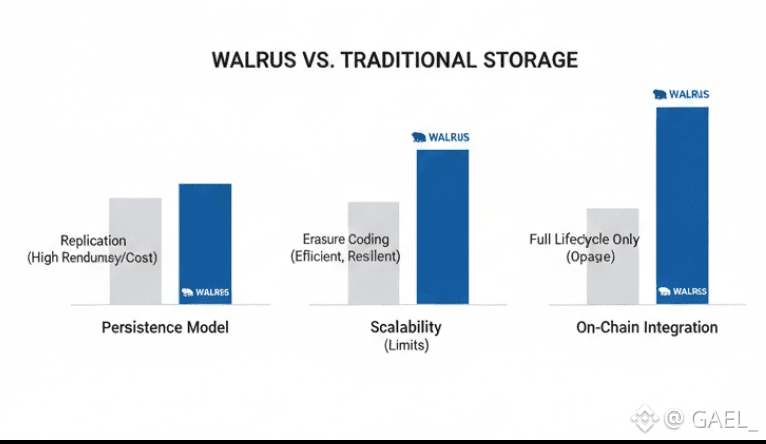
@Walrus 🦭/acc treats data persistence as something that must be enforced, not assumed. Instead of relying on goodwill, manual maintenance, or centralized storage providers, Walrus embeds availability directly into its economic and cryptographic design. Data stored on the network is subject to continuous verification. Storage nodes are required to prove that data remains accessible, and they are rewarded only when those proofs are valid. This creates a system where persistence is measurable and enforceable. Data does not survive because someone remembers to maintain it. It survives because the network is structurally designed to keep it alive.
A critical element of this design is how Walrus handles failure. In real-world networks, nodes go offline constantly. Hardware fails, operators churn, and incentives shift over time. Traditional storage models often collapse under these conditions, especially when they rely on full replication or centralized backstops. @Walrus 🦭/acc avoids this fragility through erasure coding. Data is broken into fragments and distributed across the network in a way that allows reconstruction even if a significant portion of nodes disappear. The system assumes failure as a baseline condition, not an exception, and designs persistence around that reality.
What makes this approach powerful is the alignment between technical resilience and economic incentives. Nodes are not just storing data; they are participating in an availability market. They earn rewards by maintaining uptime, responding to challenges, and contributing to the long-term health of the network. Poor behavior has consequences. Reliable behavior compounds over time. This turns storage from a passive service into an active infrastructure layer with enforceable guarantees. Developers no longer need to trust external providers to keep critical data accessible. They can rely on Walrus as part of the application’s core architecture.
This perspective changes how applications are built. Governance systems can rely on historical records that cannot be quietly erased. NFTs and digital assets can reference data that remains verifiable years after minting. AI agents and analytics systems can depend on persistent datasets without reintroducing centralized points of failure. @Walrus 🦭/acc enables these use cases by treating data as a first-class component of decentralized systems, not as metadata bolted on after execution logic is complete.
@Walrus 🦭/acc recognizes a hard truth that many protocols ignore. Decentralization does not fail when transactions slow down. It fails when history disappears. By prioritizing persistence, enforcing availability, and designing for long-term survivability, Walrus positions itself as infrastructure meant to endure. In systems that aim to last beyond their creators, data cannot be an afterthought. Walrus builds as if permanence matters, because it does.

