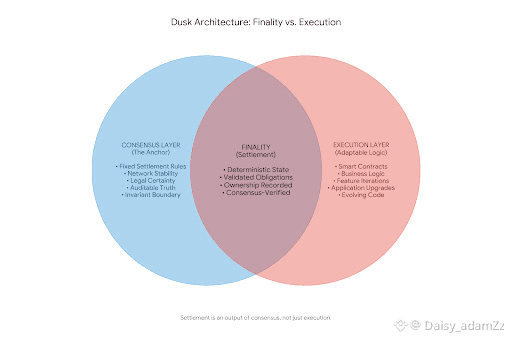
A defining characteristic of Dusk architecture is its strict treatment of finality. Rather than allowing settlement semantics to emerge from application logic or evolve alongside smart contract upgrades, Dusk anchors finality at the consensus layer. This design choice is foundational to the network’s suitability for regulated, privacy-preserving financial markets.
On Dusk, settlement is not an output of execution alone. It is a consensus decision. This distinction ensures that what the network recognizes as valid state remains stable across upgrades, application changes, and evolving contract logic. Finality, once reached, retains the same meaning regardless of how execution environments evolve over time.
This separation between execution and settlement is intentional. Smart contracts on Dusk are designed to be adaptable. Business logic may change, features may be refined, and applications may iterate. However, these changes are constrained by a fixed settlement boundary. Execution is permitted to evolve only insofar as it remains compatible with the network’s consensus rules.
By pinning settlement at the consensus layer, Dusk prevents a common failure mode in distributed systems: silent shifts in settlement assumptions. When finality is allowed to drift through upgrades or reinterpretations of contract behavior, inconsistencies emerge. Transactions may execute successfully while altering the underlying meaning of state, creating ambiguity that only becomes apparent after the fact. Dusk’s architecture is designed to eliminate this risk.
If a transaction or upgrade violates the settlement rules enforced by consensus, it does not partially succeed or degrade gracefully. It simply does not settle. The state change is rejected outright. This behavior is not punitive; it is protective. It ensures that invalid assumptions cannot be absorbed into the system and propagated forward.
This strictness creates strong containment properties. Errors, incompatible upgrades, or unintended changes in assumptions are isolated at the settlement boundary. They cannot leak into finalized state or compromise historical correctness. As a result, Dusk maintains a clear, auditable definition of truth at all times.
For financial infrastructure, especially in regulated environments, this approach is critical. Settlement represents the point at which obligations are finalized, ownership is recorded, and legal certainty is established. Any ambiguity at this layer undermines trust, compliance, and long-term viability. Dusk’s design ensures that settlement remains deterministic, verifiable, and resistant to reinterpretation.
Rather than optimizing for flexibility at the expense of clarity, Dusk prioritizes stability where it matters most. Finality is treated as a core invariant of the system, not a byproduct of execution. This discipline shapes how applications are built, how upgrades are evaluated, and how the network evolves over time.
Dusk’s approach to finality is not about aesthetic simplicity or developer convenience. It is about maintaining a reliable settlement layer that can support real financial activity without ambiguity. In that context, anchoring finality at consensus is not a limitation — it is a requirement.