
Walrus is starting to feel like one of those projects that grows in a quiet but unmistakable way, not because it is shouting for attention, but because it is solving a problem that keeps showing up the moment people try to build something real onchain, which is the problem of where the actual data lives. When you look at the direction the space is moving, it becomes clear why the community energy around decentralized storage is rising, because the next wave of applications is not only transactions, it is content, media, AI files, game assets, proofs, and records, and if all of that still depends on a single cloud provider then the promise of ownership always has a weak spot. Walrus is built on Sui and focuses on decentralized blob storage, using erasure coding to split large files into parts that can be distributed across many nodes and still recovered even if some nodes go offline, and this design feels like it was made for builders who are tired of fragile infrastructure and want something they can trust when usage grows and conditions become imperfect.
Walrus Growth Way
The way Walrus grows is the way real infrastructure tends to grow, through builders first, because builders are the first people who feel the pain of storage, and they are also the first people who recognize the relief of a system that holds up under stress. When a developer can store user generated content without worrying that it will vanish when a service changes terms, when a product team can build richer experiences without hiding the most important files behind centralized dependencies, and when costs feel more predictable because the network is designed to be efficient rather than wasteful, adoption starts to spread naturally from one use case to the next. That is where community momentum becomes real, because it is not just people repeating a narrative, it is people sharing what worked, what was reliable, and what helped them build faster, and over time that creates a kind of confidence that is hard to fake. People believe in Walrus because it does not try to pretend storage is easy, it tries to make it resilient, and resilience is what earns trust in every cycle, especially when markets get noisy and only the useful things keep moving forward.
For everyday users, the value can feel surprisingly personal even if they never learn the technical details, because storage is where our digital life actually lives. A creator can benefit when media is stored in a way that is harder to remove or break, a student can feel safer knowing important documents are less dependent on one account or one company policy, and a normal app user can simply enjoy a smoother experience where files and assets do not disappear or turn into broken links over time. In gaming, it can mean items and worlds that remain accessible as communities grow. In AI, it can mean datasets and outputs that stay available for long term work without relying on one centralized gatekeeper. The daily life impact is often quiet, but it is real, because the best infrastructure does not demand attention, it reduces anxiety, and when users stop worrying about whether their content will still exist tomorrow, that is when a technology starts to feel like it belongs in the real world.
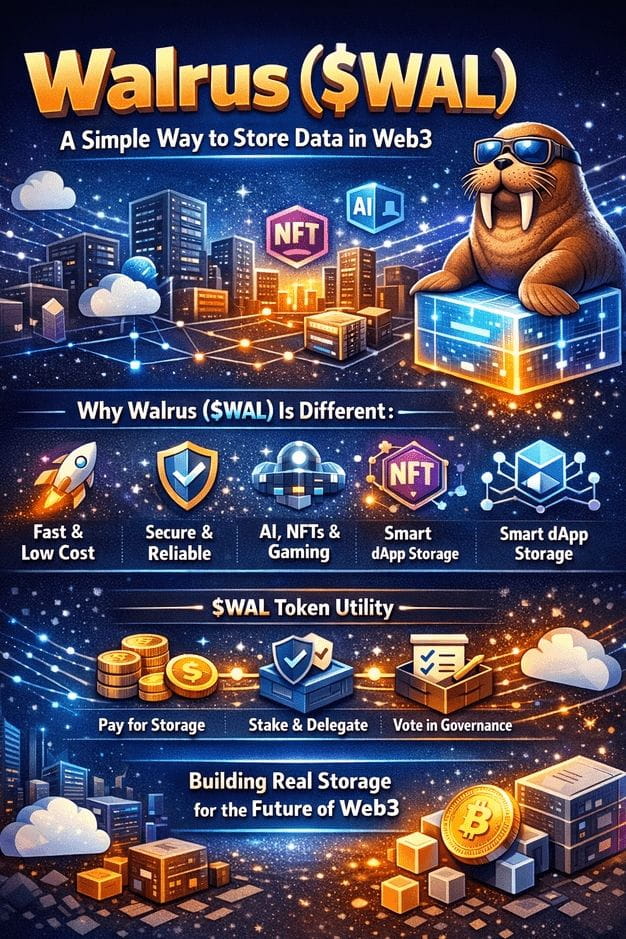
Community momentum plus utility is a powerful combination, and Walrus is starting to show both in a way that feels grounded, practical, and honestly worth watching, and that is getting interesting.


