
For years blockchain has faced a false choice: privacy or regulation.
Public chains sacrificed confidentiality. Privacy chains struggled with compliance. Institutions stayed on the sidelines.
Dusk Network was built to end that tradeoff.
Privacy Is Native Not an Add-On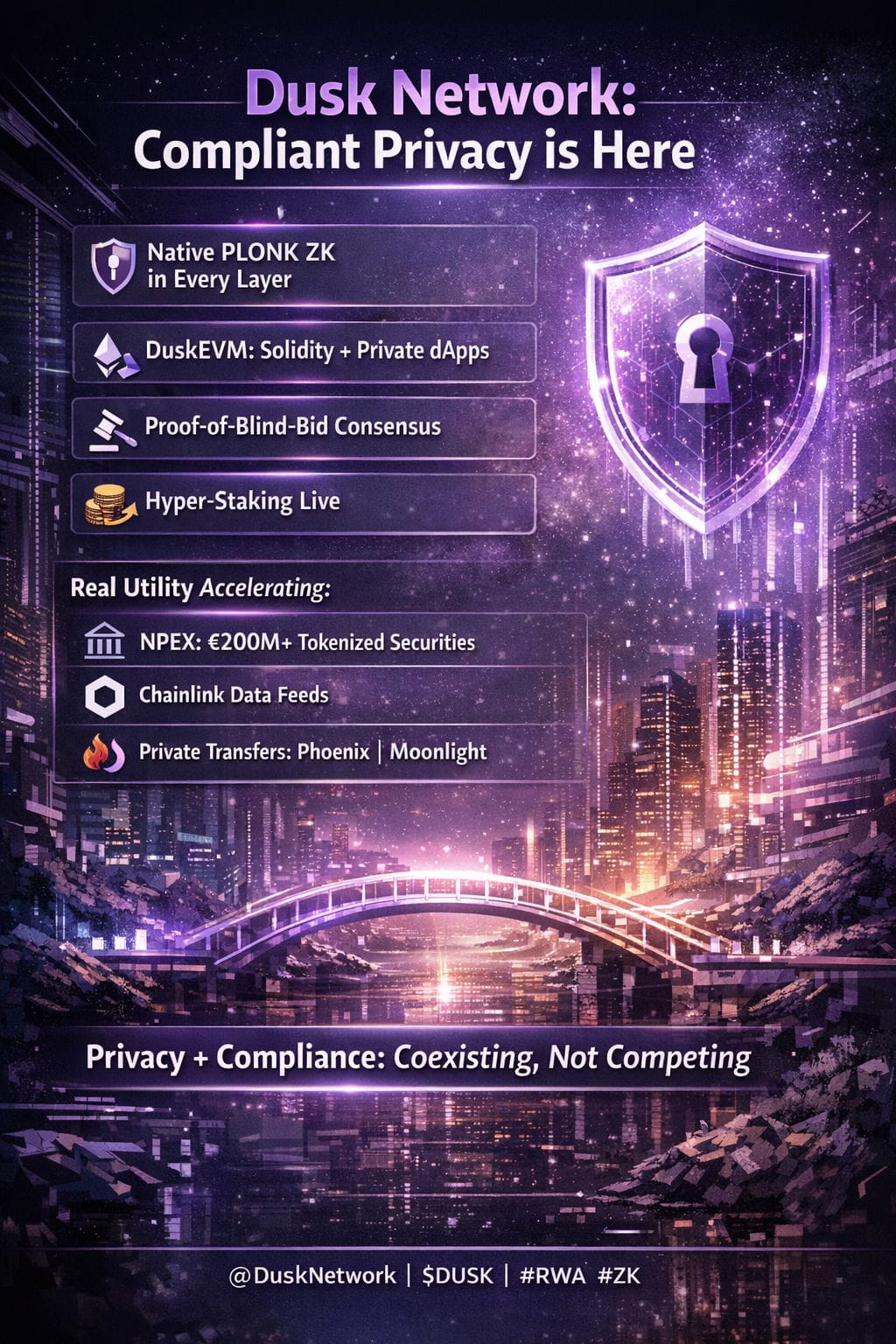
@Dusk is a Layer 1 designed from day one with native PLONK zero-knowledge proofs across every layer of the stack. Confidentiality isn’t patched in later or delegated to side systems.
Smart contracts on Dusk can privately execute:
Asset issuance
Trading and order matching
Settlement and transfers
All while preserving auditability and regulatory controls.
This matters because most “private DeFi” solutions still leak metadata, rely on bridges, or collapse under scale. #Dusk avoids this by keeping privacy inside the core protocol.
DuskEVM Is Live: Ethereum Compatibility Meets Native Privacy
With DuskEVM now live on mainnet, Ethereum developers can deploy Solidity smart contracts with minimal changes but gain something Ethereum itself cannot offer:
Regulation ready, native privacy.
This lowers the barrier dramatically for teams building:
Tokenized securities
Permissioned DeFi markets
Institutional settlement layers
Privacy-preserving RWAs
No wrapping assets across chains.
No fragmented liquidity.
No complex privacy middleware.
Execution remains low-fee, high-throughput, with sub-10 second finality on a single unified network.
Fair Consensus by Design: Proof-of-Blind-Bid
Most PoS systems suffer from validator coordination, front-running, and whale dominance.
Dusk’s Proof-of-Blind-Bid consensus removes bid visibility during validator selection. Validators submit bids blindly, preventing:
MEV-style manipulation
Validator cartels
Predictable leader dominance
The result is a more decentralized validator set with sustainable rewards without relying on hyperinflation to attract participation.
Hyper-Staking: Yield Without Surveillance
Dusk’s hyper-staking is now live, allowing users to stake DUSK while preserving privacy at the protocol level.
This is a critical shift:
Participants no longer need to choose between earning yield and exposing their on-chain financial behavior.
For institutional and high-net-worth participants, this is a requirement not a luxury.
Real-World Adoption Is No Longer Theoretical
Dusk’s roadmap is translating into real pipelines:
NPEX partnership a Dutch regulated exchange working to bring €200–300M worth of tokenized securities on-chain
Chainlink integration enabling trusted data feeds, oracles, and interoperability
Private transfers live on mainnet users can choose:
Phoenix (shielded, confidential mode)
Moonlight (public, transparent mode)
This optionality is key. Compliance does not mean total transparency it means controlled disclosure when required.
MiCA Changes Everything
As MiCA enforcement tightens in Europe and RWAs move from pilots to production, infrastructure requirements are changing.
Institutions need:
Privacy for counterparties
Confidential settlement
Selective disclosure for regulators
Legal clarity
Public-by-default chains struggle here.
Pure privacy chains are non-starters.
Dusk’s core thesis becomes unavoidable:
Privacy and compliance do not compete — they coexist.
From Quiet Build to Market Recognition
Dusk spent years building where others marketed. Now, sentiment is catching up.
Industry voices increasingly frame Dusk as:
A bridge between TradFi and DeFi
A foundation for compliant RWA tokenization
A long-term infrastructure play for regulated markets
The narrative shift is clear: Quiet build → institutional relevance → broader market attention.$DUSK
