


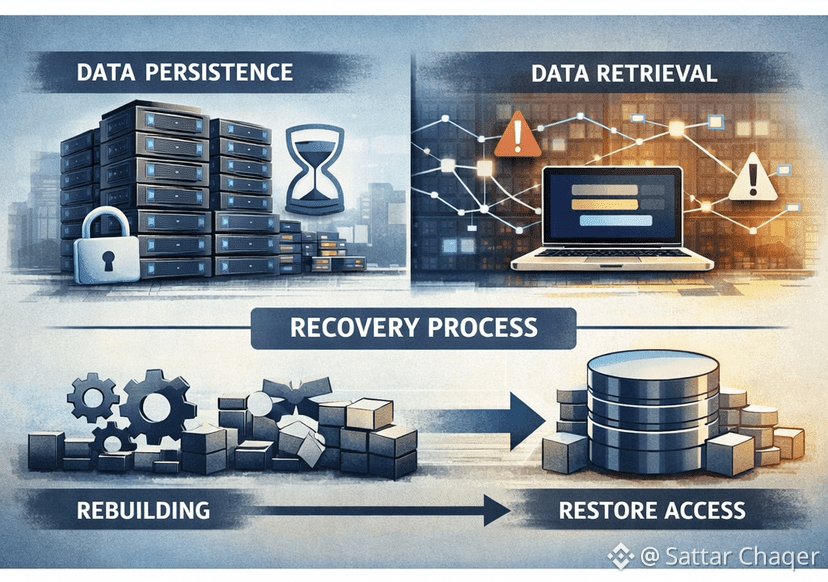
Walrus does something that makes a lot of sense once you see it: it keeps “the data exists” separate from “I can grab it right this second.” A lot of storage projects treat those as the same problem if it’s stored, it should be instant. Walrus says: hold on, those are two different jobs, and mixing them is what causes problems down the road.
Existence is about the data just being there replicated, safe, still sitting quietly even when nobody’s looking. Use is about retrieval: someone wants it now, under whatever conditions happen to be real at that moment. As networks get older, use gets harder timing off, nodes missing, coordination spotty. Walrus keeps persistence independent so it doesn’t fall apart when use is delayed or messy.
That’s why recovery is just normal life. Red Stuff rebuilds only what’s gone low bandwidth, no big full-file panic. Epoch changes are careful and multi-stage so availability holds even when people aren’t perfectly synced. The system accepts that retrieval might need extra steps instead of instant everything.
The upside shows up later: clearer expectations. You know the data exists, even when use is slow or fragmented.
Tusky shutdown was the perfect example. Frontend died. Silence. But existence didn’t depend on immediate access. Data from Pudgy Penguins (scaling media to 6TB) and Claynosaurz stayed recoverable. Migration was easy and calm.
Seal whitepaper builds on that separation. Privacy that keeps existence safe while use can change threshold encryption, on-chain policies. Access can drift without threatening persistence.
Staking over 1B wal keeps persistence reliable even during long quiet periods. Price around 0.14 feels steady for that patience. Partners like Talus AI and Itheum trust it with data that might sit for a while before anyone needs it.
For 2026, deeper Sui integration and AI market focus extend the same idea: persistence that lasts, use that can handle delay or weird timing.
Timing problems happen all the time in long-lived systems. Structural problems are way harder to fix. Walrus avoids structural risk by not tying persistence to timing risk.
That’s a smart call. Systems that survive timing issues usually outlast the ones that depend on perfect timing.


