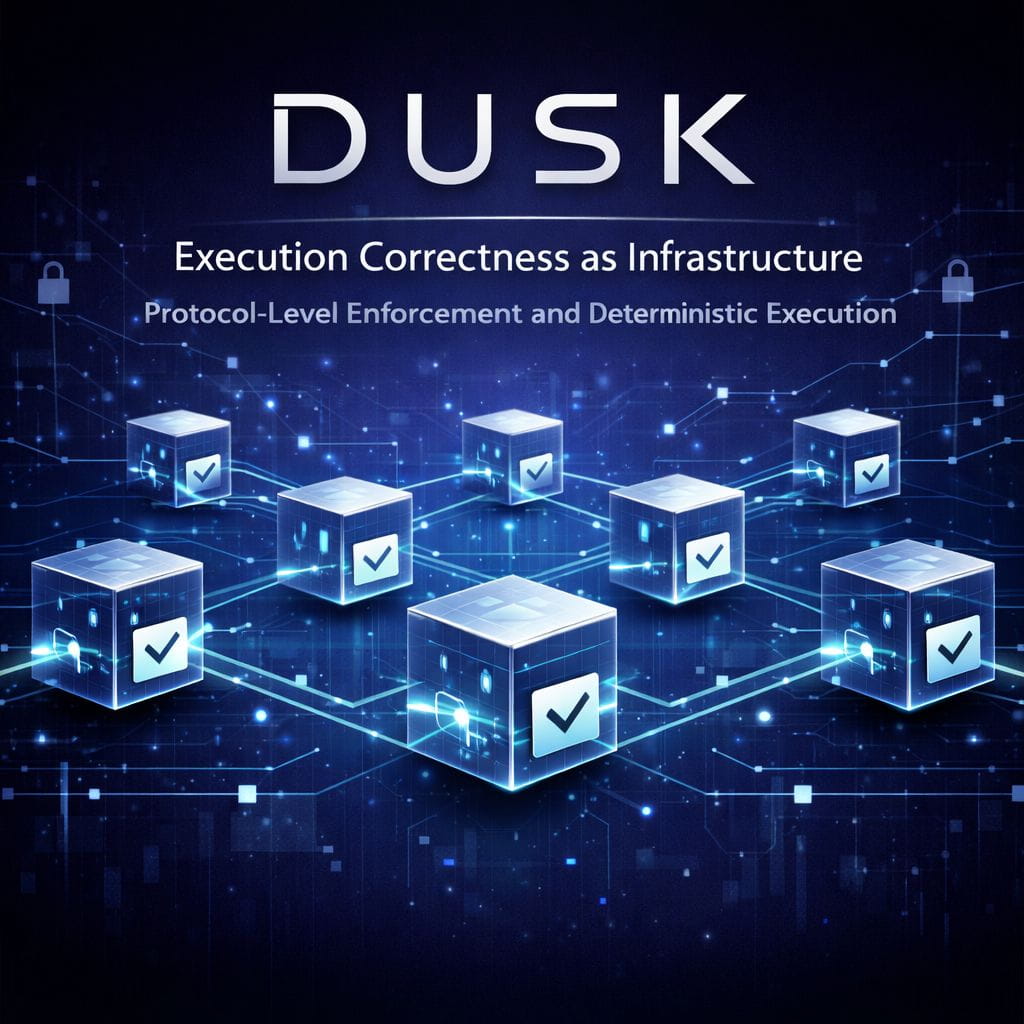
Most blockchain platforms leave execution correctness to application design but @Dusk does not.
In regulated financial environments, correctness cannot be optional or context-dependent. A transaction must execute identically across all validators, regardless of who submits it or when it is processed. If execution varies, auditability breaks down and settlement becomes unsafe.
For this reason, DUSK enforces execution correctness at the protocol level, not the application layer.
Why Application-Level Correctness Fails
On many networks, smart contracts are expected to handle execution consistency, state integrity, and dispute resolution. This assumes developers can anticipate every edge case in open, composable systems.
In practice, minor differences in execution order, state access, or validation often produce divergent outcomes across nodes. These risks may be acceptable in experimental DeFi, but they are unacceptable for regulated assets and confidential settlement.
If correctness depends on application behavior, it cannot be guaranteed network-wide.
Correctness as a Network Guarantee
DUSK is designed so that execution is deterministic and reproducible. Validators agree on outcomes, not just transaction inclusion, and final states can be verified without exposing sensitive inputs.
Correctness is validated through cryptographic mechanisms rather than trust in application logic. Validators do not need access to confidential data to confirm correct execution.
This makes correctness an infrastructure property, not a best practice.
Why This Matters for Financial Workflows
Regulated financial processes require predictable execution, reproducible outcomes, and verifiable audit trails. Any ambiguity introduces legal and operational risk.
By enforcing correctness at the protocol layer, DUSK ensures that transactions behave consistently under all conditions, enabling compliant settlement and reliable dispute resolution.
Correctness Before Flexibility
DUSK does not optimize for unrestricted composability or rapid experimentation. It optimizes for correctness, auditability, and legal certainty.
This design choice reduces execution disputes, compliance uncertainty, and reliance on application-layer assumptions.
In regulated finance, execution correctness is not optional infrastructure.
On DUSK, it is foundational.