
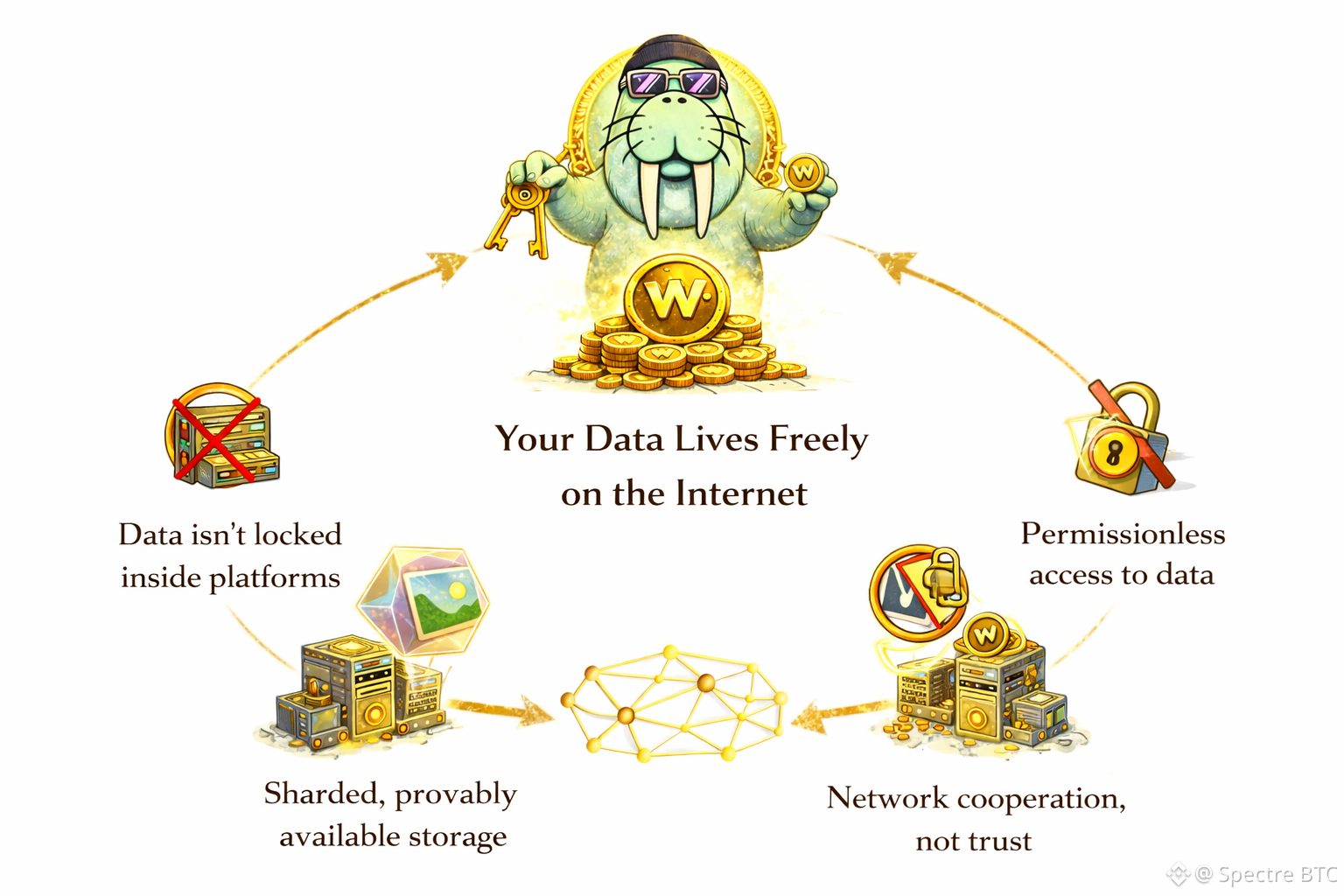
 For much of the internet’s history, data has lived behind gates—stored on centralized servers and controlled by corporate policies, regional rules, and opaque incentives. Access can vanish without warning, content can be modified or removed, and ownership is often conditional rather than absolute. Walrus challenges this model by asking a different question: what if data could exist on the internet without gatekeepers?
Walrus treats data as a first-class, independent entity rather than something tied to a specific platform or application. When data is stored on Walrus, it isn’t confined to a single provider. Instead, it is encoded, partitioned, and distributed across a decentralized network of storage nodes. No single node holds the complete file, yet the network can reliably reconstruct it. This approach removes centralized control while maintaining strong availability guarantees.
In Walrus, freedom doesn’t mean disorder. It means permissionless persistence. Data remains accessible without requiring approval from a company, hosting provider, or centralized authority. Availability is enforced through cryptographic proofs and economic incentives, not trust. Storage nodes must continually demonstrate they are holding valid data fragments, and failures or misconduct are detectable and penalized. Data persists because the protocol enforces it, not because an operator chooses to keep it online.
Walrus also decouples data from execution. In traditional systems, data availability depends on the application that hosts it—if the application shuts down, the data often disappears with it. Walrus breaks this dependency. Applications may come and go, but the underlying data remains intact and verifiable. This allows developers to build on shared data without fear of vendor lock-in or sudden loss of access.
Another reason Walrus enables data to exist freely is its resistance to censorship and outages. Because data is distributed across many independent operators, no single entity can quietly remove it or selectively block access. Even under partial failures, network disruptions, or adversarial conditions, the system can recover and continue serving data. This freedom is not ideological—it is engineered.
Walrus was designed for durability, not short-term convenience. It assumes that systems fail, actors behave maliciously, and platforms eventually disappear. By designing around these realities, Walrus turns data into long-lived digital infrastructure—capable of outlasting companies, trends, and even applications. In doing so, it shifts control back to users and builders, allowing data to exist openly, reliably, and independently as part of the internet’s shared foundation.

