
Walrus reimagines decentralized storage by prioritizing availability, consistency, and performance as built-in guarantees rather than optional features. Unlike networks such as IPFS or Filecoin, which layer incentives on top of content sharing, Walrus is designed from the ground up as robust storage infrastructure for long-lived applications.
Data is never fully replicated on a few nodes. Instead, Walrus uses RedStuff, a two-dimensional erasure coding system, to split data into small slivers distributed across a quorum of nodes. Each node holds only a fraction of the data, yet any blob can be fully reconstructed as long as enough honest nodes remain online. This approach reduces storage overhead while maintaining strong fault tolerance.
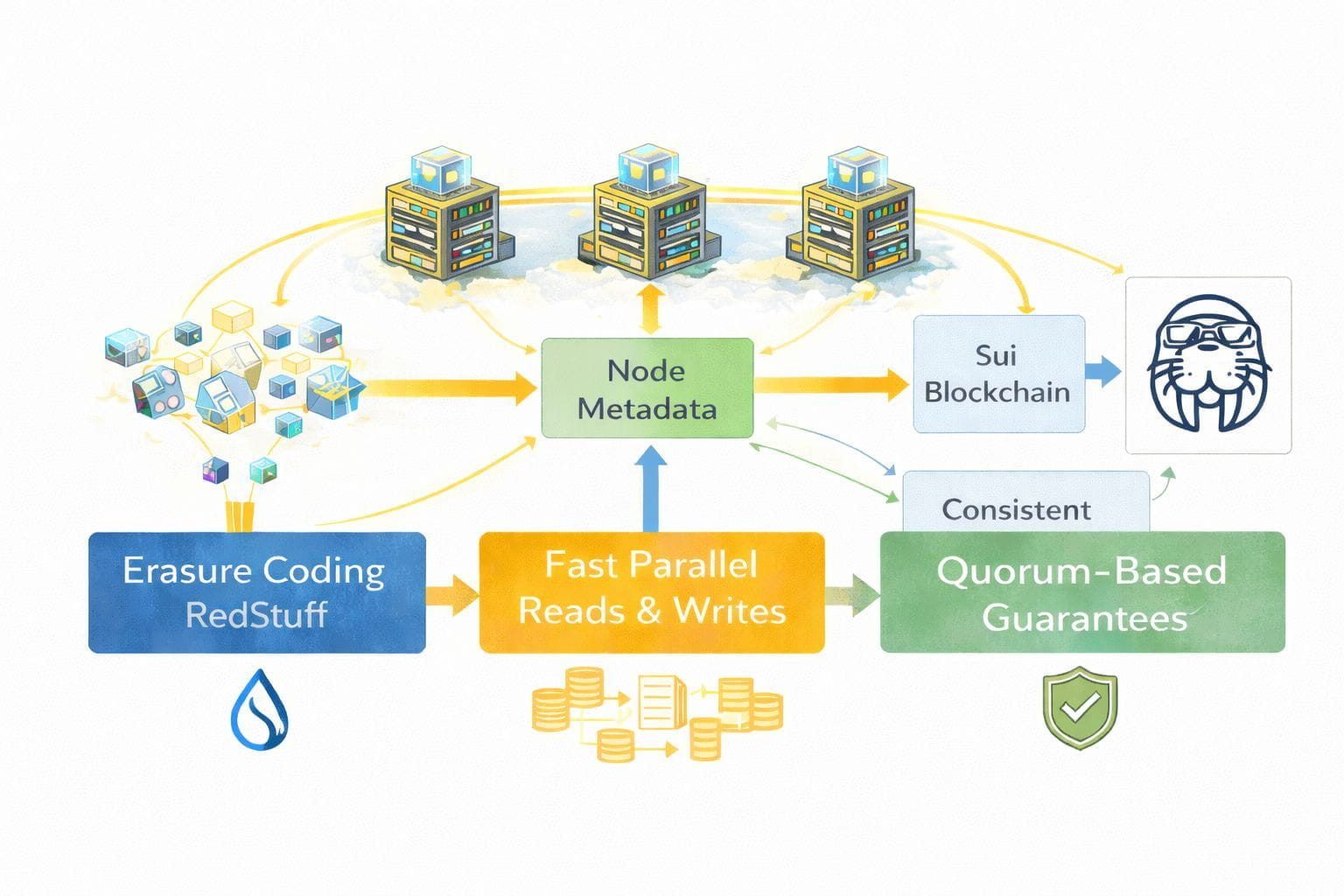 Performance is a core protocol feature. Reads and writes are parallelized across nodes, and reconstruction does not rely on a single “hot” copy. There’s no premium tier for speed—applications get predictable, low-latency access by default, making Walrus suitable for both live workloads and archival storage.
Walrus separates data availability proofs from retrieval. Nodes continuously prove they store valid slivers using cryptographic commitments and asynchronous challenge protocols. These proofs are independently verified and anchored on-chain, ensuring data remains available even under adversarial conditions. Clients can access data immediately without waiting for global verification.
By combining erasure coding, quorum-based guarantees, asynchronous proofs, and coordinated infrastructure-grade nodes, Walrus delivers storage that is durable, verifiable, and performant at scale. Reliability and speed are built-in, not add-ons, making Walrus a foundational layer for decentralized applications that require consistent, always-on access to data.

