
I want to approach this piece with clarity and discipline, because Plasma deserves that kind of attention right now. This is not a reaction. It is not commentary driven by sentiment swings. It is a grounded look at where Plasma stands today, what has materially changed in recent months, and how XPL fits into that picture in a way that finally feels coherent.
Plasma has existed long enough to go through multiple phases. Early excitement. Periods of silence. Reassessment. Refinement. What we are seeing now feels like the outcome of that entire journey rather than another chapter repeating the same mistakes. The project is no longer defined by what it promises. It is increasingly defined by how it behaves.
That distinction matters.
Plasma today feels deliberate. There is restraint in how updates are released. There is consistency in how infrastructure improvements are handled. There is a noticeable absence of urgency driven by external noise. These signals are subtle, but together they paint a picture of a network that is no longer searching for identity.
Instead, it is executing within one.
One of the most meaningful shifts has been at the protocol level. Plasma has been refining how it processes transactions under real conditions, not ideal benchmarks. Latency has become more stable. Execution paths have been optimized to reduce unpredictability during periods of higher activity. These are not cosmetic changes. They directly affect how applications behave when users interact with them repeatedly over time.
This kind of work rarely draws attention because it is not designed to impress. It is designed to last.
Infrastructure stability has clearly been a priority. Node performance has improved. Synchronization issues that once created friction have been reduced. Maintenance cycles feel less disruptive. For those running infrastructure or building on top of the network, this translates into trust. Trust that the system will behave tomorrow the way it behaves today.
That consistency is foundational.
Plasma is also showing a more mature approach to upgrades. Changes are not introduced recklessly. There is evidence of extended testing, gradual rollout, and a willingness to delay features if they are not ready. In an environment where many networks push updates to meet narrative deadlines, this approach stands out.
It suggests confidence.
The developer experience has quietly improved alongside these changes. Tooling has become more predictable. Interfaces feel less brittle. Documentation aligns better with actual behavior rather than theoretical design. These refinements reduce friction in ways that compound over time.
When developers do not have to fight the system, they start thinking creatively instead of defensively.
Plasma appears to understand that ecosystems are not built through incentives alone. They are built through environments where people want to work. Comfort and reliability are underrated assets in this space.
The network also feels more comfortable with its scope. It is not positioning itself as a universal solution for every possible use case. It is focusing on performance, reliability, and operational efficiency. That focus allows Plasma to deepen its strengths rather than dilute them.
This is where XPL enters the picture in a meaningful way.
XPL functions within the Plasma network as the mechanism that aligns activity with sustainability. It is used for fees, participation, and network level incentives. What feels different now is how proportional everything feels. Costs do not feel punitive. Rewards do not feel exaggerated. The system does not appear to be fighting itself.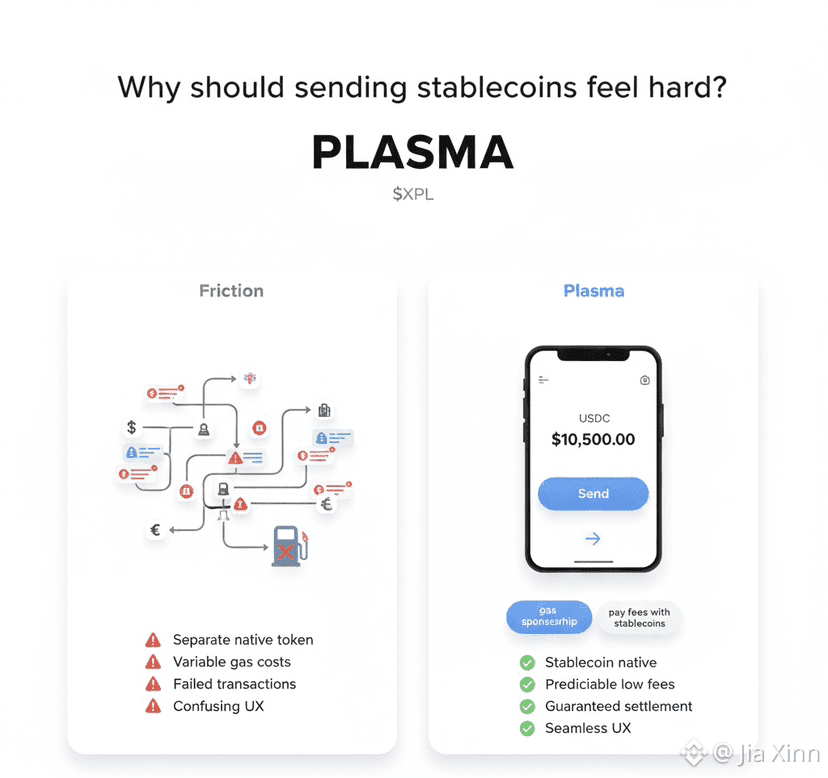
XPL feels integrated rather than imposed.
The relationship between Plasma and XPL has matured. Instead of the token driving artificial activity, activity on the network gives XPL relevance. This inversion is important. It shifts the focus from speculation to usage.
Staking dynamics reflect this change. The emphasis is on reliability and long term participation. The network benefits most from consistent behavior, and XPL rewards that consistency. This creates a feedback loop where the healthiest actions are also the most economically sensible.
That alignment is rare.
Plasma has also made progress in making infrastructure participation more accessible. Running nodes feels less fragile. Operational requirements are clearer. The barrier to entry has been lowered without compromising network integrity. This supports decentralization in practice rather than in theory.
Decentralization that cannot be maintained is not decentralization. Plasma seems to be addressing this reality directly.
Another important observation is how Plasma interacts with the broader ecosystem. It does not frame itself as an isolated environment. There has been clear intent to improve interoperability and integration paths. This allows Plasma to exist as part of a larger landscape rather than competing against it unnecessarily.
This perspective is pragmatic.
No network exists in isolation anymore. Systems that acknowledge this early tend to integrate more smoothly over time. Plasma appears to be positioning itself accordingly.
What stands out most to me is the overall tone of development. There is less urgency to impress and more commitment to refining what already exists. That tone usually emerges after a project has internalized its lessons.
Plasma has been through enough cycles to understand what matters.
The community dynamic reflects this shift. Conversations are less reactive. There is more focus on how things work rather than what might happen next. This is not a sign of stagnation. It is a sign of stabilization.
Stabilization is when real growth becomes possible.
XPL benefits from this environment because its value becomes increasingly tied to actual network usage. As Plasma becomes more reliable and usable, XPL becomes more relevant. Not through hype, but through function.
This is a slower path. It does not reward impatience. But it builds resilience.
Market behavior will always fluctuate. That is unavoidable. What matters more is whether the underlying system continues to improve regardless of attention. Plasma appears to be doing exactly that.
There is no sense of panic in how the project moves. There is no constant reinvention of narrative. There is continuity. That continuity allows trust to form over time.
Trust is difficult to earn and easy to lose. Plasma seems aware of this.
From a long term perspective, the current phase feels like consolidation before expansion. The groundwork is being reinforced. The weak points are being addressed. The system is becoming more predictable.
This is often the stage that precedes meaningful adoption.
I am not presenting this as a forecast or endorsement. I am describing an observable shift in behavior and execution. Plasma feels more grounded. XPL feels more purposeful. The connection between the two feels healthier.
If one believes that durable infrastructure is built quietly, then this phase matters more than any announcement. If one believes that relevance is earned through reliability, then Plasma is on a sensible path.
What happens next will depend on whether this discipline continues. But as it stands, Plasma is no longer defined by potential. It is increasingly defined by performance.
And XPL is no longer searching for justification. It is finding it through usage.
That is a meaningful evolution.

