
Vanry has reached a point where it no longer needs to explain what it wants to become. The network is now showing what it actually is. Over the past period, the project has transitioned out of a narrative driven stage and into an execution focused phase where infrastructure, tooling, and live systems are doing the talking. That shift is important, because it separates ideas from outcomes, and Vanry is now firmly operating on the outcome side.
Vanry exists as a Layer One blockchain built to support high performance digital environments. That is not a broad or abstract goal. It is reflected directly in how the network is structured, how transactions are processed, and how applications interact with the chain. The emphasis has always been on scalability, low latency, and consistency, and recent developments show that those priorities are being actively refined rather than just claimed.
One of the most meaningful changes has been the stabilization of network performance under load. Vanry has improved how blocks are produced and finalized, resulting in smoother throughput and reduced variance in transaction confirmation. This matters because applications that rely on real time interaction cannot function in environments where performance fluctuates unpredictably. Whether it is gaming, social platforms, or interactive digital services, reliability is non negotiable. Vanry is now operating at a level where that reliability is becoming the norm rather than the exception.
Another area of progress is execution efficiency. Smart contracts on Vanry are running in a more optimized environment, allowing more complex logic without increasing execution costs in a way that would limit adoption. This creates room for richer application design. Developers are no longer constrained to minimal interactions. They can build systems that manage state, respond to user behavior, and evolve over time without pushing the network beyond its limits.
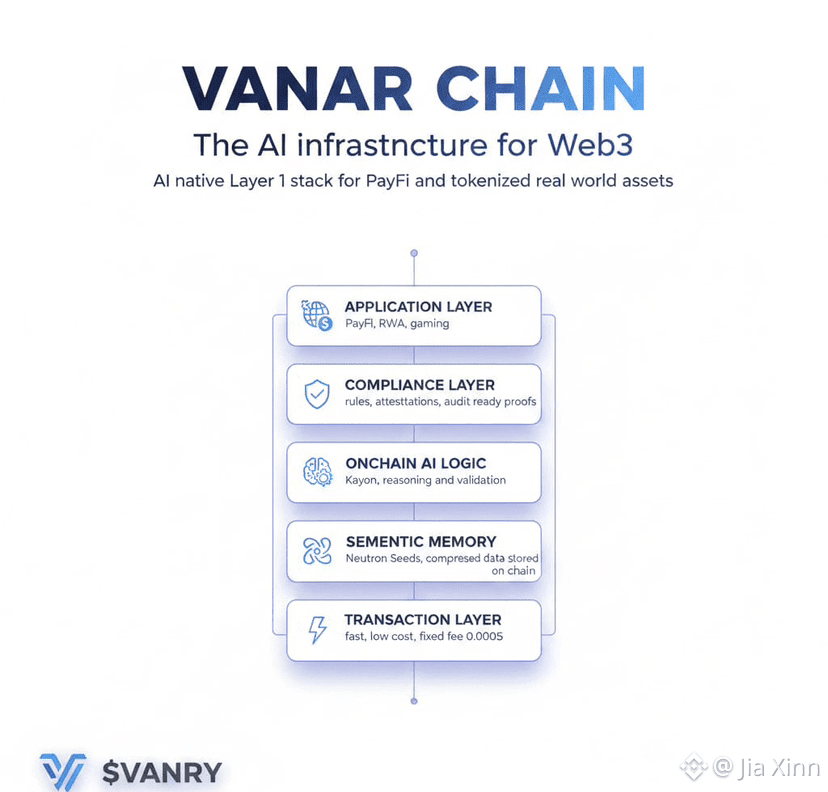
Vanry has also advanced how data is handled across the network. Instead of treating data as something that simply exists on chain, the infrastructure supports structured and accessible data that applications can work with efficiently. This enables features like dynamic asset behavior, persistent environments, and intelligent application logic. Data is no longer a bottleneck. It is an active component of how systems operate.
This ties directly into Vanry’s broader focus on intelligent infrastructure. The network supports native capabilities that allow applications to reason over data rather than just execute fixed instructions. This does not mean replacing developers or logic. It means enhancing what applications can do by allowing context awareness and adaptive behavior. The result is software that feels less mechanical and more responsive.
From a practical standpoint, these capabilities are already usable. They are not locked behind future roadmaps or experimental branches. Developers building on Vanry today can access tools that support intelligent workflows, on chain data reasoning, and scalable execution. This is a critical distinction, because real adoption depends on what can be built now, not what might exist later.
The VANRY token plays an essential operational role in this ecosystem. It is used to power transactions, smart contract execution, and application level interactions. As network activity increases, usage of the token scales naturally with it. This ties the token directly to network utility rather than external speculation alone. The more the network is used, the more integral the token becomes to daily operations.
Staking and validator participation have also matured. The network has continued to expand validator involvement while maintaining performance and security. Incentives are structured to reward reliability and long term participation rather than short term behavior. This strengthens the underlying security model and supports decentralization without sacrificing efficiency.
Developer experience is another area where progress is visible. Tooling has become more refined, documentation clearer, and workflows smoother. Building on Vanry no longer requires extensive setup or deep protocol level understanding just to get started. This lowers friction for new teams and allows experienced developers to move faster from concept to deployment.
Applications currently being developed on Vanry reflect this improved environment. Projects are moving beyond proofs of concept and into functional products. These include interactive digital experiences, asset driven systems, and platforms that rely on persistent on chain logic. The diversity of applications suggests that the infrastructure is flexible enough to support multiple use cases without being overly specialized.
User experience has also benefited from recent improvements. Wallet interactions are more stable. Transaction feedback is clearer. Application responsiveness has improved. These details may seem minor, but they define whether users stay or leave. Vanry’s recent updates show an awareness that adoption depends as much on usability as it does on technical capability.
Interoperability has not been ignored either. Vanry is being positioned to connect with external ecosystems rather than operate in isolation. This allows assets, data, and functionality to move across networks when needed. In a multi chain environment, this flexibility is essential. No single network can exist entirely on its own.
Governance within the ecosystem has continued to evolve. Community participation in discussions and decisions has increased, and network direction is being shaped through more structured input. This creates alignment between builders, validators, and users, which is necessary for long term sustainability.
What makes this phase of Vanry particularly important is that it represents consolidation. Earlier stages were about exploration and experimentation. The current stage is about refinement and expansion. Core systems are in place. Improvements are focused on making those systems more efficient, more usable, and more reliable.
Vanry is not attempting to redefine itself or pivot toward unrelated narratives. It is deepening its original focus on immersive and intelligent digital environments by strengthening the infrastructure that supports them. This consistency allows the ecosystem to grow without fragmenting its identity.
As more applications go live and more users interact with the network, feedback loops will continue to shape development. Performance improvements enable better applications. Better applications attract more users. Increased usage drives further optimization. This cycle is already forming, and its effects will compound over time.
The relevance of Vanry at this stage comes from execution rather than expectation. The network is live. The tools are available. The infrastructure is being used. Progress is visible in how the system behaves under real conditions. That is the difference between a project that is still trying to prove itself and one that is actively maturing.
Vanry is not at the end of its development. No network ever is. But it has reached a level of operational clarity where future growth is built on existing strength rather than untested ideas. That foundation matters more than any short term narrative.
This phase defines whether Vanry becomes lasting infrastructure or remains a temporary experiment. Based on what is currently live, how the network performs, and how development is progressing, Vanry is positioning itself firmly toward long term relevance.
The focus now is not on explaining the vision. It is on expanding the system that already exists. And that is exactly where a serious project needs to be.
