

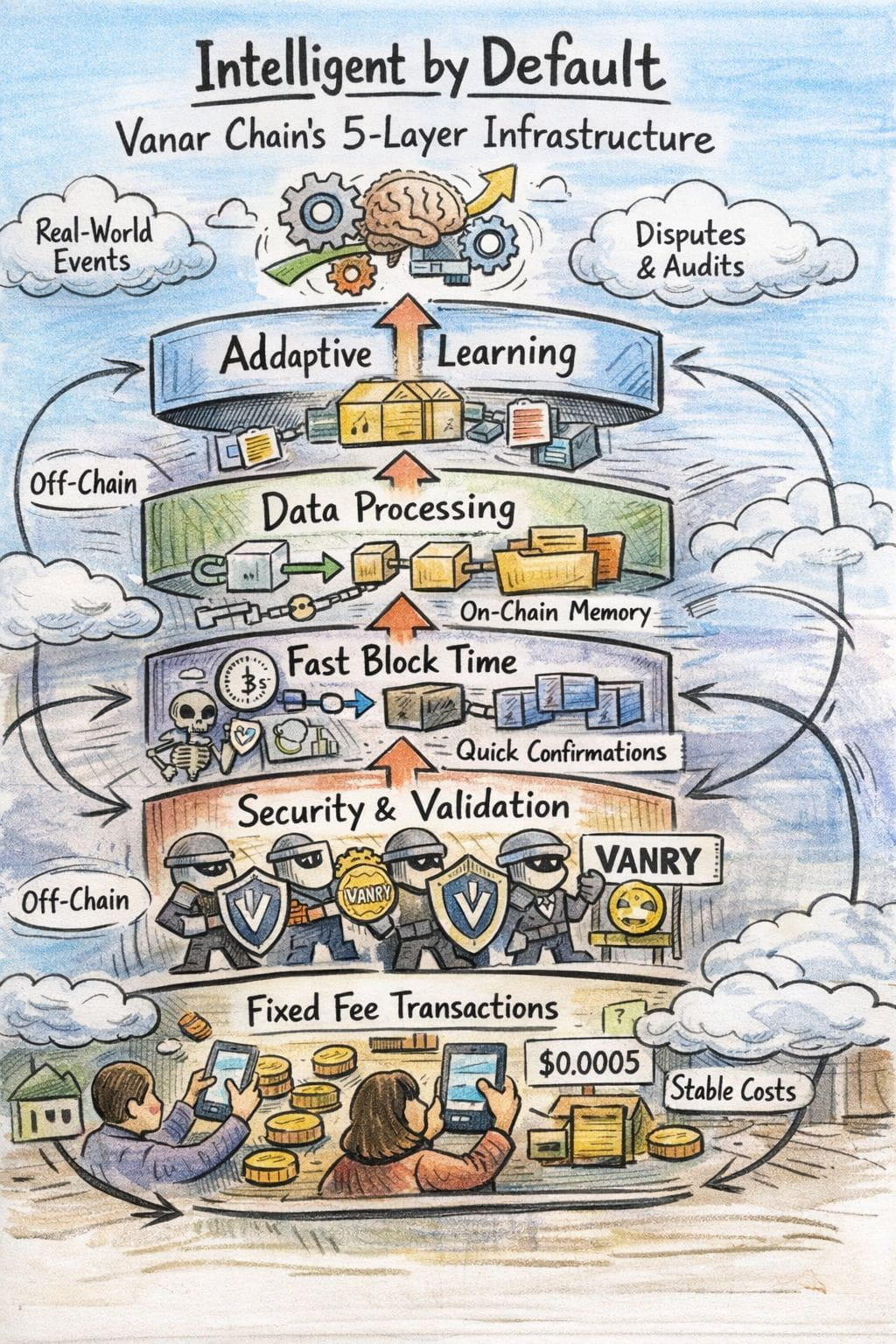
@Vanarchain Vanar Chain keeps repeating the same quiet claim in different words: if Web3 wants to feel like real software, it can’t just execute instructions. It has to remember what happened, notice when reality shifts, and keep improving without asking users to become system administrators. That’s what people are reaching for when they say “intelligent by default.” They’re not asking for a chain that sounds smart. They’re asking for a chain that behaves responsibly when the world is messy and time matters. Vanar’s own framing is blunt about it: it presents itself as an infrastructure stack designed so applications can learn, adapt, and improve over time, arranged as five layers with data moving upward through the stack.
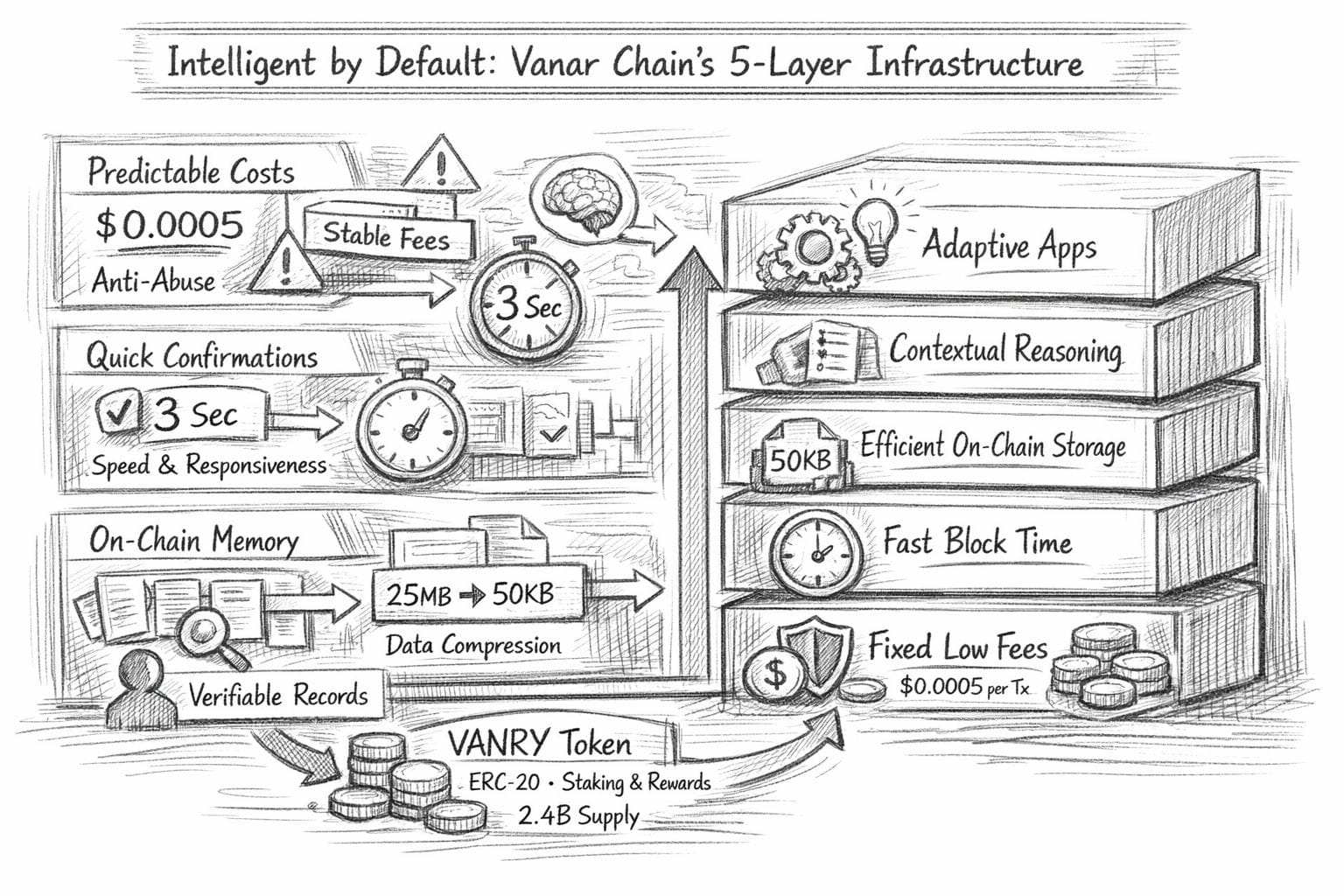
The first thing you notice, if you actually try to imagine daily usage, is that Vanar treats predictability as an emotional requirement, not a luxury. People don’t fear “fees” as an abstract concept—they fear surprise, the feeling that a simple action might suddenly become expensive at the worst possible moment. In Vanar’s whitepaper, the commitment is stated in hard numbers: a fixed transaction cost reduced to about $0.0005 per transaction, designed so the user’s cost stays low even if the token price swings wildly. That is not a marketing flourish; it is a design choice aimed at the human problem of hesitation. When cost becomes unpredictable, people stop clicking. When people stop clicking, adoption doesn’t fail loudly—it just quietly never arrives.
But fixed cost alone can turn into its own kind of fragility if it invites abuse. Cheap systems attract honest users and dishonest pressure at the same time. Vanar’s approach in the whitepaper tries to face that tension directly: it talks about fixed fees in dollar terms, while also describing higher cost brackets for unusually large transactions, explicitly to make certain kinds of spam or attack behavior expensive enough to be self-defeating.This is one of those moments where you can see the project’s worldview: a chain isn’t “secure” because it has strong language about security; it’s secure when it makes bad behavior economically annoying. In real life, most threats aren’t genius-level cryptography failures. They’re incentives that quietly become misaligned until the system starts to wobble.
Speed is the second layer of the promise, but not in the way people usually mean it. Vanar’s whitepaper describes a block time capped at a maximum of about three seconds, and it connects that directly to responsiveness—how it feels to use applications that shouldn’t make you wait to see if reality updated. When the chain responds quickly, users don’t have to build a second mental model in their heads, one where they guess whether something “probably went through.” That guessing is where anxiety lives. Fast confirmation doesn’t just improve throughput; it reduces the small, constant uncertainty that turns normal usage into a series of micro-stresses.
Then there’s the deeper idea under the “five-layer” framing: Vanar is trying to make on-chain history usable as memory rather than dead weight. The most consequential failure pattern in many crypto applications is not that they can’t store data—it’s that they store it in a way that doesn’t help the next decision. A hash proves something existed, but it doesn’t help you reason about what it meant. Vanar’s stack talks about reshaping data so it becomes compact and workable on-chain, including a claim on its site that a 25MB file can be compressed down to around 50KB through multiple processing stages. Whether you’re storing a legal agreement, a credential, a media object, or an operational record, the human value is the same: when the system can carry the evidence with it, you’re less dependent on external services staying honest, online, and unmodified.
That matters most in the unglamorous moments. A partner disputes what was agreed. A regulator asks for an audit trail. A platform goes down. A region loses connectivity. The modern internet has taught users a painful lesson: “your data is safe” sometimes means “your data is safe until a cloud outage or a policy change.” Vanar’s public positioning around on-chain storage is essentially a rebuttal to that fragility—an attempt to treat durable records as part of the chain’s core responsibility rather than something developers stitch together with third-party infrastructure.
Once you accept the idea of on-chain memory, the next layer becomes inevitable: reasoning is only as good as what it can reliably recall. An application that “learns” in any meaningful sense needs continuity. It needs to know what happened before, not as a vague narrative, but as a set of verifiable constraints it can’t quietly rewrite. This is where Vanar’s stack approach is trying to feel different in practice: it’s not only about executing transactions, it’s about making the chain itself a place where context can live, be checked, and be carried forward. That shifts the user experience from “I hope the app’s backend remembers” to “the system itself can prove what it knows.”
Of course, “intelligence” is also where the danger lives. The moment you let systems act with more autonomy, you create new kinds of failure: mistaken automation, overconfident actions, brittle models that behave well in calm markets and badly under stress. Vanar’s layered framing implicitly acknowledges that risk by separating concerns: the base has to be stable and predictable; the memory has to be durable and verifiable; the reasoning has to be constrained by what can be proven; and what finally reaches end-users should feel less like a demo and more like a dependable service. Vanar describes the stack as five layers with data flowing upward, which is another way of saying: each step should add capability without erasing accountability.
This is also where incentives show up again, quietly shaping honesty. Vanar’s token, VANRY, is presented in the whitepaper as the gas token, playing the same basic role ETH plays in Ethereum, with issuance tied to block production and long-term distribution.The supply numbers are not vague: the whitepaper states a total supply of 2.4 billion, with 1.2 billion minted at genesis and a 1:1 swap path from TVK holders described as part of the upgrade, while additional issuance is spread over a long time horizon via block rewards. Vanar’s documentation repeats the maximum supply cap of 2.4 billion and frames ongoing issuance as block rewards beyond the genesis amount.
If you zoom out, that token design is not just “tokenomics.” It’s governance-by-behavior. A chain that wants to be intelligent by default can’t rely on goodwill. It needs validators who are paid to stay online, to follow the rules, and to take the boring work seriously. Vanar’s documentation on staking describes a delegated model where the foundation selects validators and the community stakes VANRY to them, with staking positioned as both a security mechanism and a way for holders to share in rewards.Even if you disagree with parts of that structure, the intention is clear: the chain is trying to reduce the chance that reliability is left to anonymous chance.
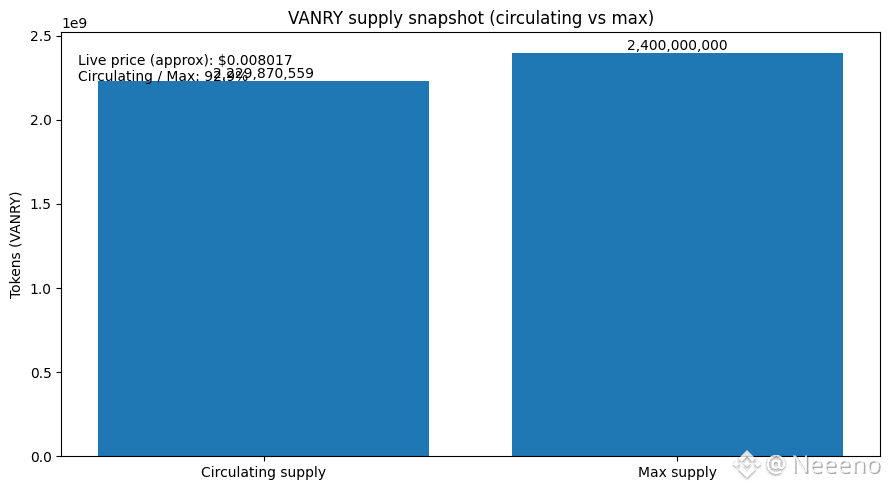
And this is where “recent data” stops being trivia and becomes a kind of honesty check. On January 24, 2026, widely used market trackers show VANRY trading around eight-tenths of a cent, with circulating supply around 2.23 billion and a stated max supply of 2.4 billion.You can interpret that market reality in a dozen ways, but the infrastructure point is simpler: an “intelligent” stack doesn’t get a free pass because the price is high or low. It has to be credible when the token is quiet, when attention moves elsewhere, when builders are tired, and when the only thing keeping a system alive is whether it actually works as promised.
VANRY being an ERC-20 token isn’t random—it’s a way to make the first step easy. Since it has a public contract address, users can find it, verify it, and trade it using tools they already know. The deeper Vanar architecture usually comes after that first contact.
That bridge between familiar wallets and a deeper on-chain stack is where most projects stumble. People don’t adopt “infrastructure.” They adopt whatever feels safe enough to use without studying. Vanar’s job, if it takes its own framing seriously, is to make the safe path the default path—so users don’t have to be brave to participate.
So when you come back to the title—“Intelligent by Default”—the real question becomes practical: what does Vanar do when things go wrong? The answer, at least in its published design choices, is that it tries to reduce the number of ways reality can surprise you. Fixed-fee predictability is one kind of protection. Fast responsiveness is another. On-chain memory that carries more than a pointer is another. And token incentives that pay for uptime and validation are another. None of these remove uncertainty from the world. They just keep the system from amplifying uncertainty into panic.
In the end, Vanar Chain’s five-layer story is less about layering “features” and more about layering responsibility. It’s an attempt to build a stack where applications can improve over time without turning users into collateral damage when conditions change. The quiet ambition is that learning doesn’t mean improvising—it means becoming more dependable because the record is durable, the costs are predictable, the incentives are aligned, and the chain stays responsive when people need it most. VANRY’s capped supply design, the genesis and long-term issuance plan, the fixed-fee target around $0.0005, the three-second block-time goal, and the compression claims about shrinking large files into something that can live on-chain are all, in their own way, commitments to boring reliability.
Quiet responsibility is rarely rewarded with attention. Invisible infrastructure is only noticed when it fails. If Vanar Chain succeeds at what it says it’s building, the best outcome is that users stop thinking about the chain at all—because nothing feels risky, nothing feels fragile, and the system keeps its promises when no one is watching. Reliability doesn’t trend. But it’s what people remember when the world gets loud.
