

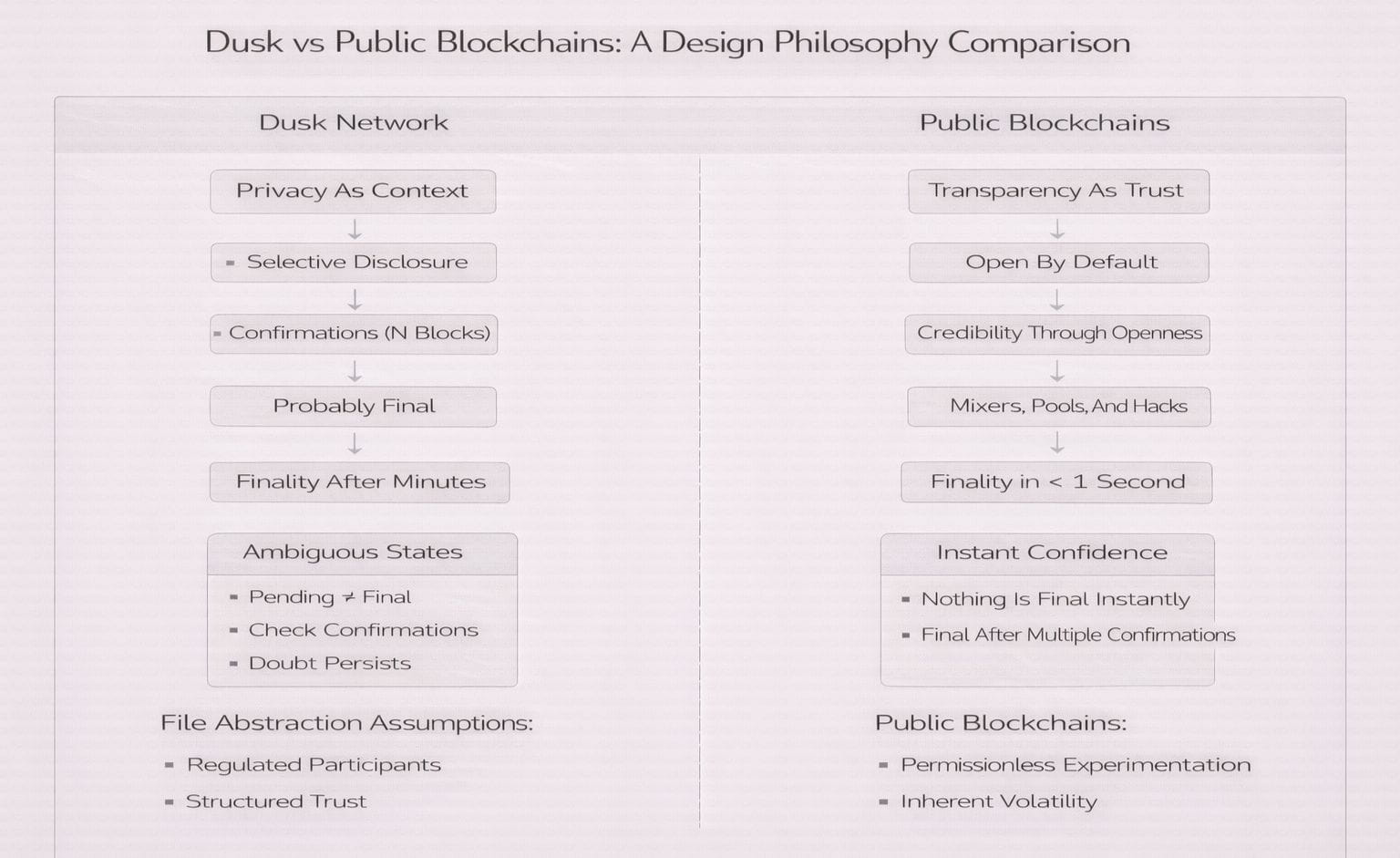
 Most comparisons between blockchains focus on features: speed, fees, decentralization metrics, ecosystem size. That framing misses the deeper divide. The difference between Dusk and public blockchains doesn't lie in what they do but rather in what they are designed to assume about the world in which they operate.
Public blockchains were designed on a very simple premise: where there is transparency, there is trust. Where everything is visible, manipulation becomes hard and verification universal. This assumption shaped their entire architecture. Accounts are public. Transactions are readable. State is globally observable. For open experimentation and permissionless coordination, this model works remarkably well.
Dusk Network begins from a different premise. In regulated financial systems, transparency does not create trust on its own. Context does. Markets rely on confidentiality, selective disclosure, and enforceable oversight. Trust emerges not because everyone can see everything, but because the right parties can verify the right things at the right time.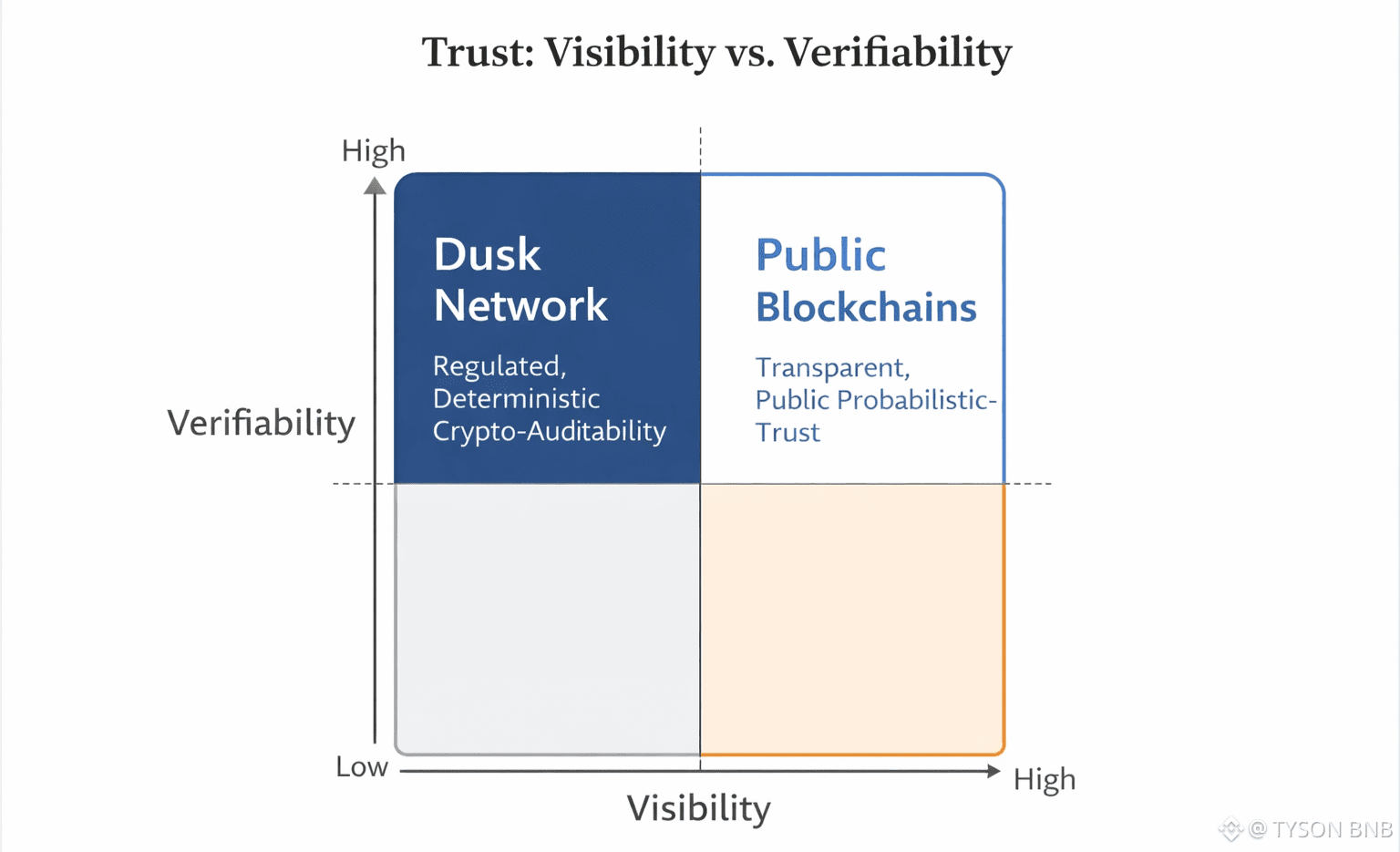
Public blockchains treat privacy as an exception. It is something to be added through mixers, shielded pools, or application-level tricks. Dusk treats privacy as the default state. Information is protected unless there is a justified reason to reveal it. It is a philosophical, rather than cosmetic, inversion. The way identities, assets, and transactions are represented is inverted at the base layer.
Another fundamental difference is in how compliance is handled. On public chains, compliance is externalized: applications build KYC systems off-chain, enforce the rules through centralized gatekeepers, and hope the underlying protocol doesn't get in the way. The chain itself doesn't care. Dusk internalizes this task since the constraints are expressable on-chain, enforceable cryptographically, auditable while preserving confidentiality.
Finality is also a reflection of this split. Public blockchains frequently consider probabilistic settlement a reasonable compromise. Ambiguity is risk in regulated environments. Dusk is designed around deterministic outcomes because legal and financial systems require clear moments of settlement. A transaction is not useful if its finality must be inferred.
There is also a difference in who the system is optimized for. Public blockchains prioritize developers and users who can tolerate volatility, visibility, and experimentation. Dusk prioritizes participants who cannot. Institutions, issuers, and regulated entities do not have the luxury of “acceptable risk.” Their constraints are not preferences; they are obligations.
None of this makes public blockchains inferior. It makes them specialized. They are excellent tools for open coordination, composable innovation, and transparent systems. Dusk is specialized in a different direction. It accepts that some domains require restraint, structure, and controlled access to function at all.
The comparison is not about ideology. It is about fit. Public blockchains assume a world where transparency is safe and desirable. Dusk assumes a world where privacy and accountability must coexist to enable real economic activity. As blockchain use expands beyond experimentation into infrastructure, both philosophies will persist but they will serve very different purposes.
Dusk versus public blockchains is not a competition between better or worse systems. It is a contrast between two answers to the same question: where does trust come from? One answers visibility. The other answers verifiability.
