

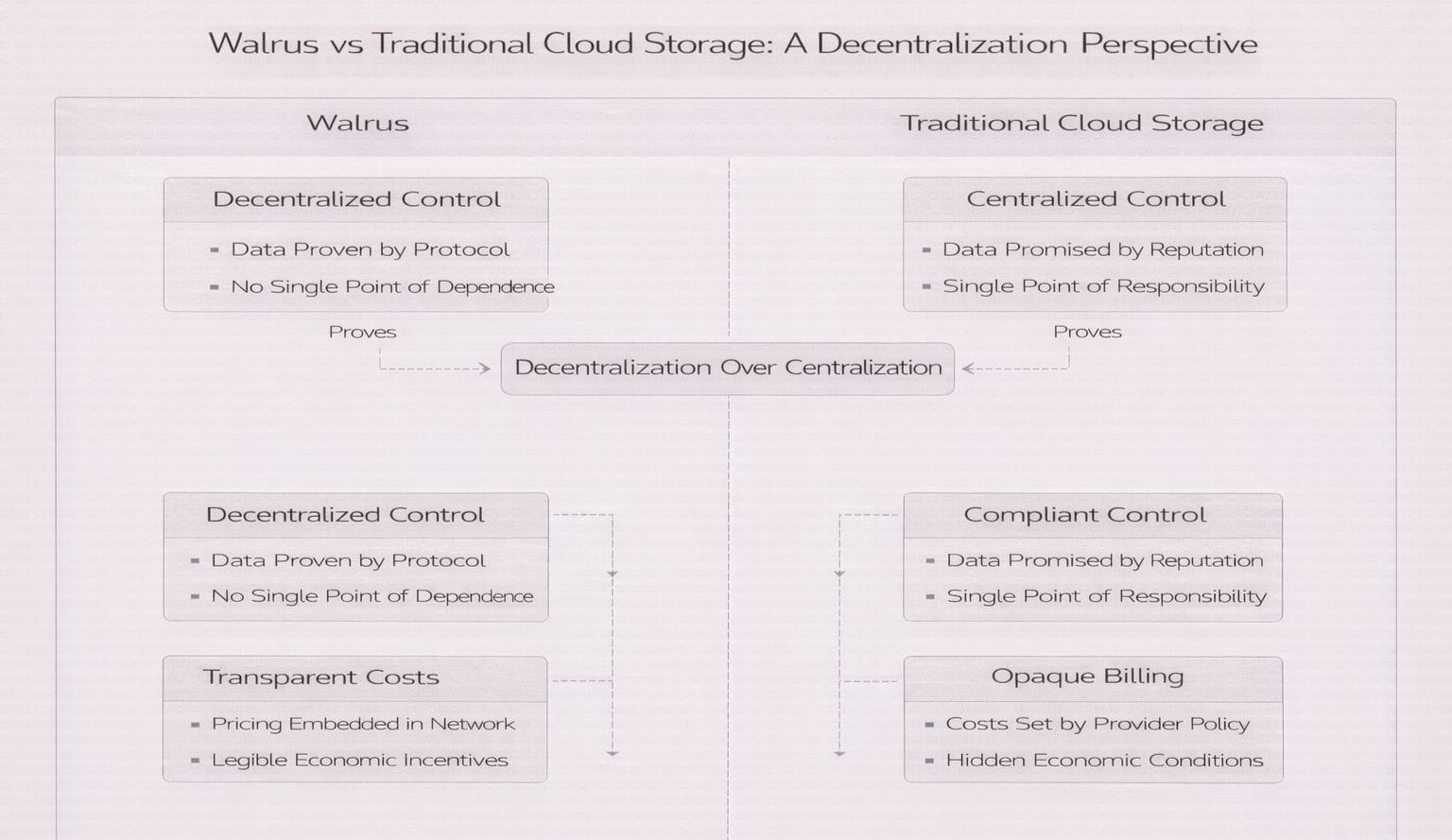
 Cloud storage was never designed to be neutral infrastructure. It was designed to be efficient, convenient, and centrally operated. That trade-off was acceptable when storage was passive and applications trusted the platform by default. It becomes fragile when data turns into shared state, economic input, and system dependency. Walrus exists because the assumptions behind traditional cloud storage do not survive decentralized coordination.
In cloud systems, trust is implicit. With respect to data, the provider’s guarantees of data durability, availability, and access derive not just from their reputation but also from their contracts. If such guarantees fail, users of such architecture have no recourse but escalation/migration. There is a single point of responsibility even if the infrastructure is geographically distributed. Decentralization is cosmetic, not structural.
Walrus starts from the opposite assumption: no single party should be trusted to preserve data correctly over time. Instead of reputation, it relies on verifiable behavior. Storage providers do not promise availability; they prove it. Data does not persist because a company exists, but because the protocol enforces persistence continuously.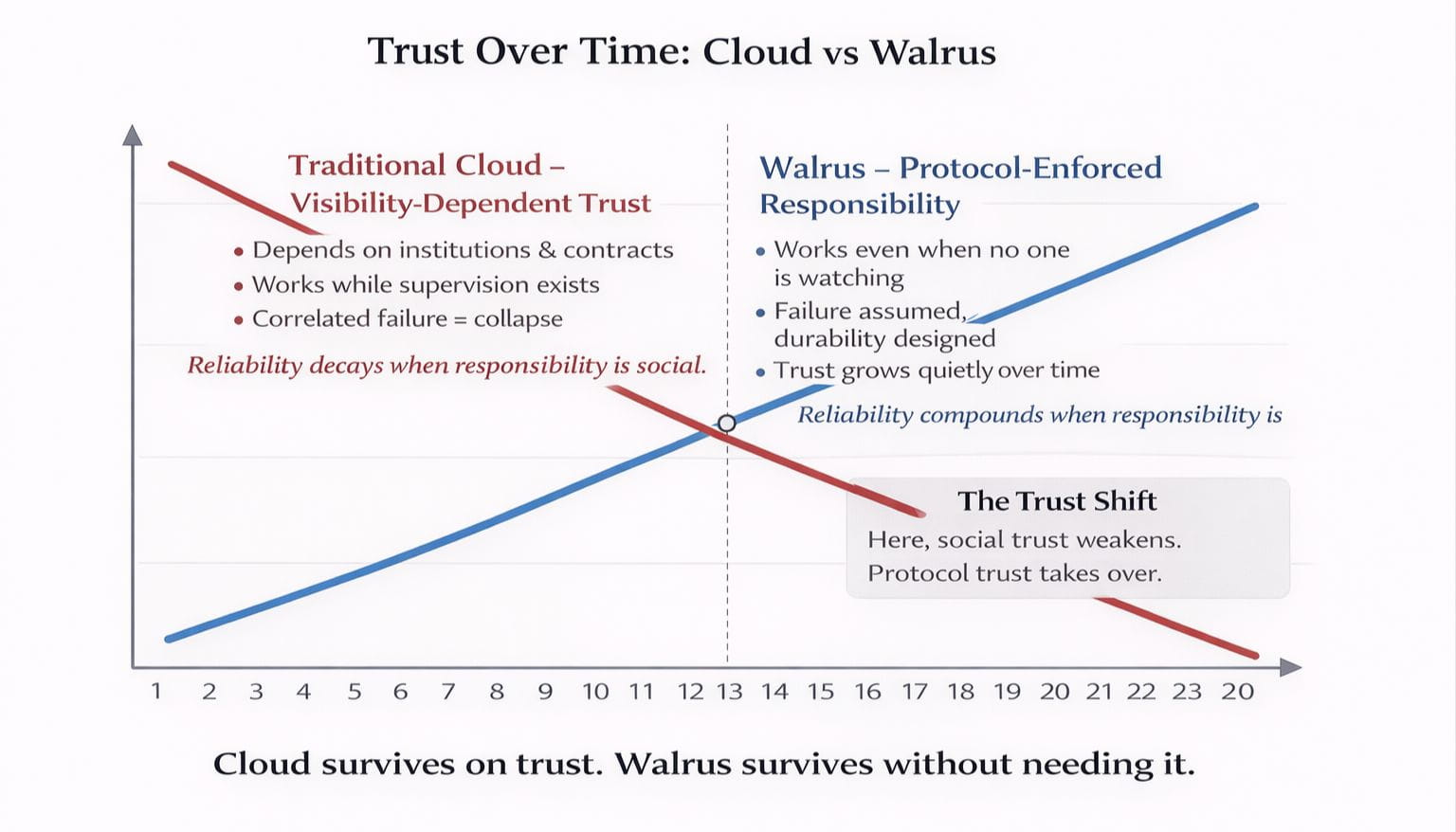
This distinction reshapes how risk is distributed. In cloud storage, correlated failures are catastrophic. Provider outages, policy changes, account suspensions, or geopolitical constraints can invalidate guarantees instantly. Walrus is built to tolerate instability. Nodes may fail, exit, or misbehave without threatening the system's integrity. Resilience emerges from fragmentation and redundancy, rather than through any aspect of centralized control.
Ownership is another core difference. In cloud storage, for example, access control is permissioned by accounts managed off-chain. One's data exists at the discretion of a platform that can unilaterally revoke access. Walrus aligns storage ownership with cryptographic identity. Control over data is enforced on-chain, governed by explicit rules rather than opaque policies. Access is not granted socially; it is expressed programmatically.
Cloud storage also abstracts away economics. Costs are predictable until they are not. Pricing changes, bandwidth charges, and usage tiers are imposed externally, often after dependency is established. Walrus treats economics as part of the protocol. Storage costs, incentives, and penalties are visible and enforceable at the same layer as the data itself. This makes dependency legible instead of hidden.
Security is framed differently as well. Cloud security assumes perimeter defense: protect the platform, trust the internals. Walrus assumes breach as a given. Data is fragmented, encoded, and distributed such that no single participant holds complete control. Compromise does not imply total loss. Security is not about keeping attackers out, but about making attacks non-fatal.
Most importantly, Walrus changes the meaning of reliability. Cloud storage is reliable as long as institutions behave correctly. Walrus is reliable even when participants do not. This is the core decentralization shift. Reliability stops being a social contract and becomes a mechanical property.
Walrus is not competing with cloud storage on convenience alone. It is redefining what storage means when trust cannot be centralized and failure cannot be negotiated. From a decentralization perspective, the difference is not performance or cost. It is whether data survives because someone is responsible or because no one needs to be.


