
In the majority of blockchain systems, availability of data was not considered as infrastructure. It was assumed as a fact. In case there was some place where data was posted, it was copied many times, and the data was available technically, then the system passed.
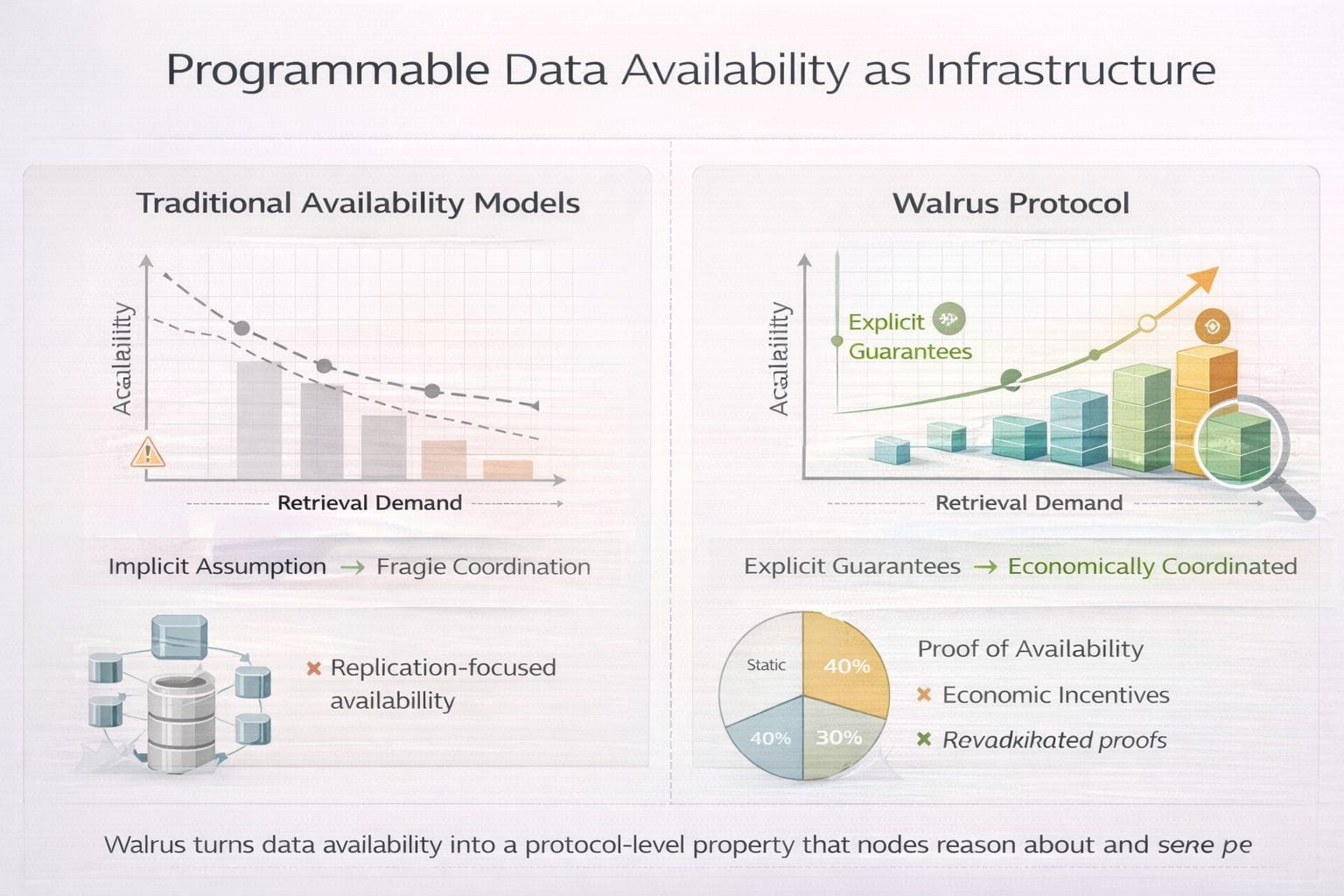
That model had been effective when the execution rate was low, blocks were small and verification pressure had been low. With the development of blockchains to modular architectures, that assumption became one of the weakest all of the stack. @Walrus 🦭/acc is based on the fact that the availability of data can no longer be implicit. It must be programmable, verifiable and enforceable economically at the protocol level.
Designation of concerns is achieved through modular execution. Execution layers are concerned with speed and specialization whereas externalizing the data to special systems. The security of this segregation is all about the possibility of data to be accessed by numerous independent agents at real load. Execution fails in an unclean manner when availability fails. It enables verification to be centrally positioned, introduces validatory interposers, or has limited the participation to well-provisioned interposers. These are not edge cases. They are the foreseeable results of considering the availability as a background service instead of infrastructure.
@Walrus 🦭/acc restates this issue by ensuring that data availability is directly reasonable by the protocol. Walrus do not want to rely on the assumption that the stored data will be delivered anytime it is required but instead, it encodes the data and disseminates it through the network and it needs cryptographic proofs that the nodes can actually deliver it. Representation can no longer be deduced as availability. It turns into an explicit property which can be verified, enforced and priced. This is what renders it programmable as opposed to assumed.
The difference is important since availability does not remain the same. Demand fluctuates. Peaks of retrieval pressure are observed when the database is being verified, reorganized, or is experiencing a high level of activity. Only long-term persistence optimization systems fail in such instances since they have not been constructed to coordinate retrieval behavior. The data in the Walrus treats is an incentivized activity. Economic alignment makes sure that when capacity is needed to carry out it is mobilized and not merely when it is expensive to store.
Through this at the protocol level @Walrus 🦭/acc makes availability infrastructure not middleware. Already built execution layers are not required to have individually designed integrations or off-chain confectioning in order to access them. They may be constructed upon a data layer whose guarantees are implemented by the same logic which rules the rest of the system. This enables the modular chains to outsource data without outsourcing trust.
The availability that is programmable also alters the system design. The developers will cease to have to reduce their engineering to the worst-case behavior when they are able to assume that data access can be proven and that it will be economically viable. Data do not require being forcefully shrunk or concealed to make it live through random access patterns. Rather, it can be executed with more state and with more separation of concerns, since the protocol is aware that availability is its responsibility.
What comes out is another type of infrastructure. @Walrus 🦭/acc is not a general purpose storage network trying to rival on the cost per byte. It is an optimized execution dependency data availability layer. Its usefulness cannot be gauged by the size of the data it is able to hold but rather the extent to which execution systems can be able to rely on that data without jeopardizing decentralization.
Due to the ongoing maturity of modular architectures, data availability ceases to be an engineering aspect and becomes a liability. Those that consider it as a peripheral issue are fragile. Infrastructure-based systems become predictable. This change is mirrored in @Walrus 🦭/acc by ensuring that availability is programmable, verifiable, and consistent with execution incentives. By doing so, it is an indication of a larger shift in the design of blockchains: protocols do not assume availability anymore. It is something they should be proactive in offering.

