


Scaling has always been the hidden trade-off in decentralized systems. In theory, decentralization promises resilience and neutrality. In practice, many systems quietly re-introduce central control to make scaling manageable. Coordinators appear. Trusted operators emerge. Eventually, decentralization becomes more narrative than reality.
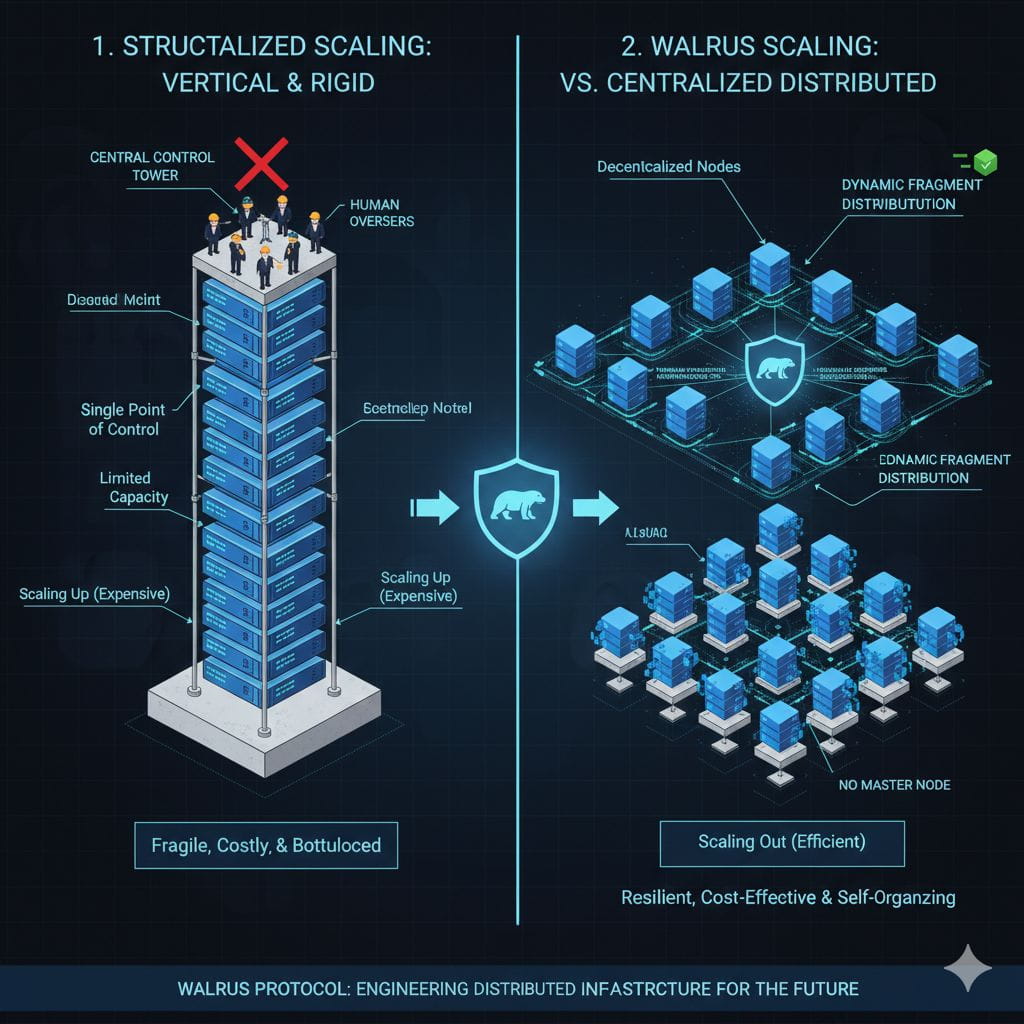
What stood out to me while studying Walrus is that it takes a fundamentally different approach. Instead of asking “how do we scale faster?”, Walrus asks a deeper question: how do we scale without concentrating power?
Walrus’ design philosophy starts from an uncomfortable truth: scale and decentralization are often in tension. Centralized systems scale easily because decisions are simple. One operator allocates resources, manages failures, and enforces rules. Decentralized systems must achieve the same outcomes without relying on authority.
Walrus addresses this by removing the need for coordination at the human level. There is no central scheduler deciding where data goes. There is no trusted party monitoring availability. Instead, scale is achieved structurally — through encoding, distribution, and verification rules that apply equally to all participants.
Data uploaded to Walrus is encoded and fragmented in a way that allows the network to grow organically. New storage nodes can join without requiring permission or reconfiguration. Old nodes can leave without destabilizing the system. Scale emerges from redundancy and verification rather than control.
A critical element of this philosophy is assumed churn. Walrus does not expect the network to be stable. Nodes will join and leave. Hardware will fail. Operators will change incentives. The system is designed to absorb this churn without human intervention.
This matters because central control often creeps in as a response to instability. When systems break under stress, teams add oversight. Walrus avoids this trap by designing for instability from day one.
From an investor perspective, this philosophy signals long-term thinking. Systems that scale by centralizing tend to perform well early but accumulate risk over time. Systems that scale structurally may grow more slowly, but they age better.
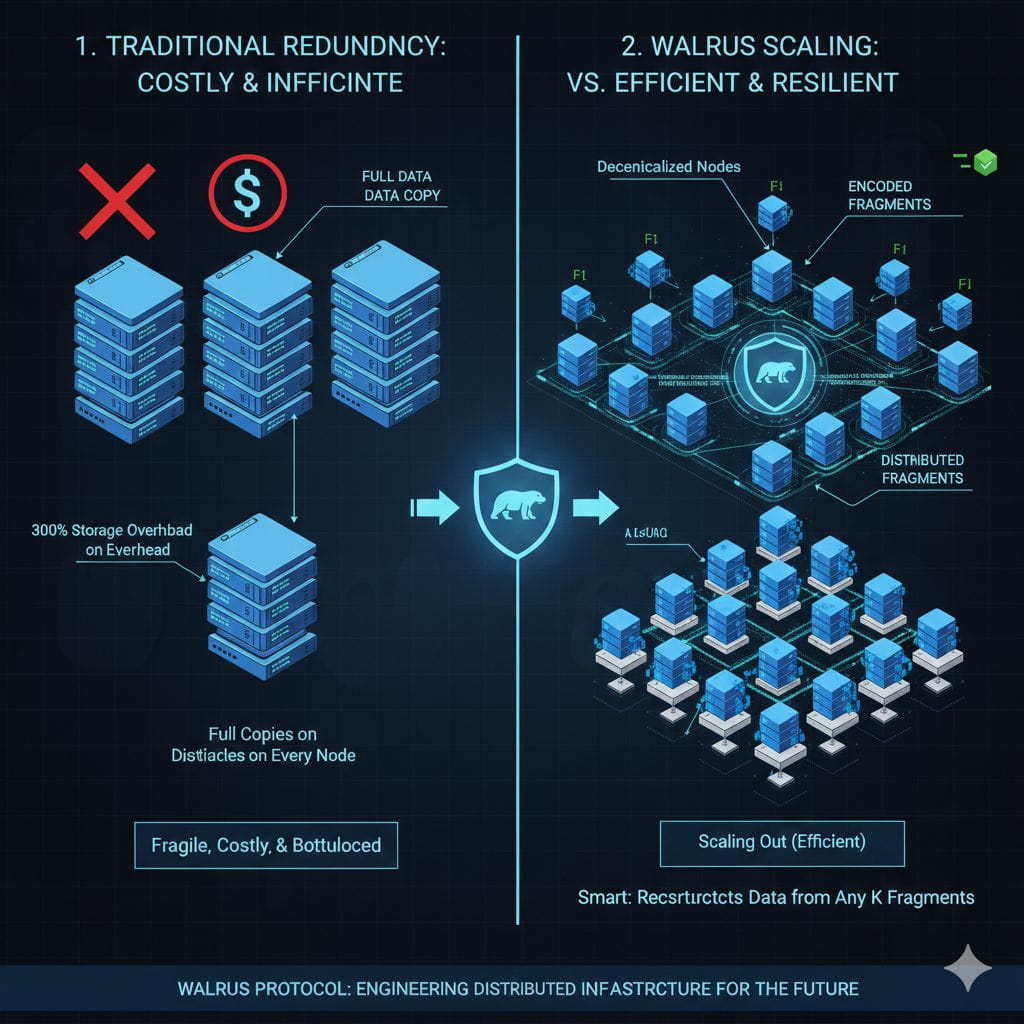
In my view, Walrus’ commitment to scaling without centralization is not just ideological — it’s practical. True infrastructure must survive unpredictable conditions. Walrus treats decentralization not as a marketing point, but as an engineering constraint.

