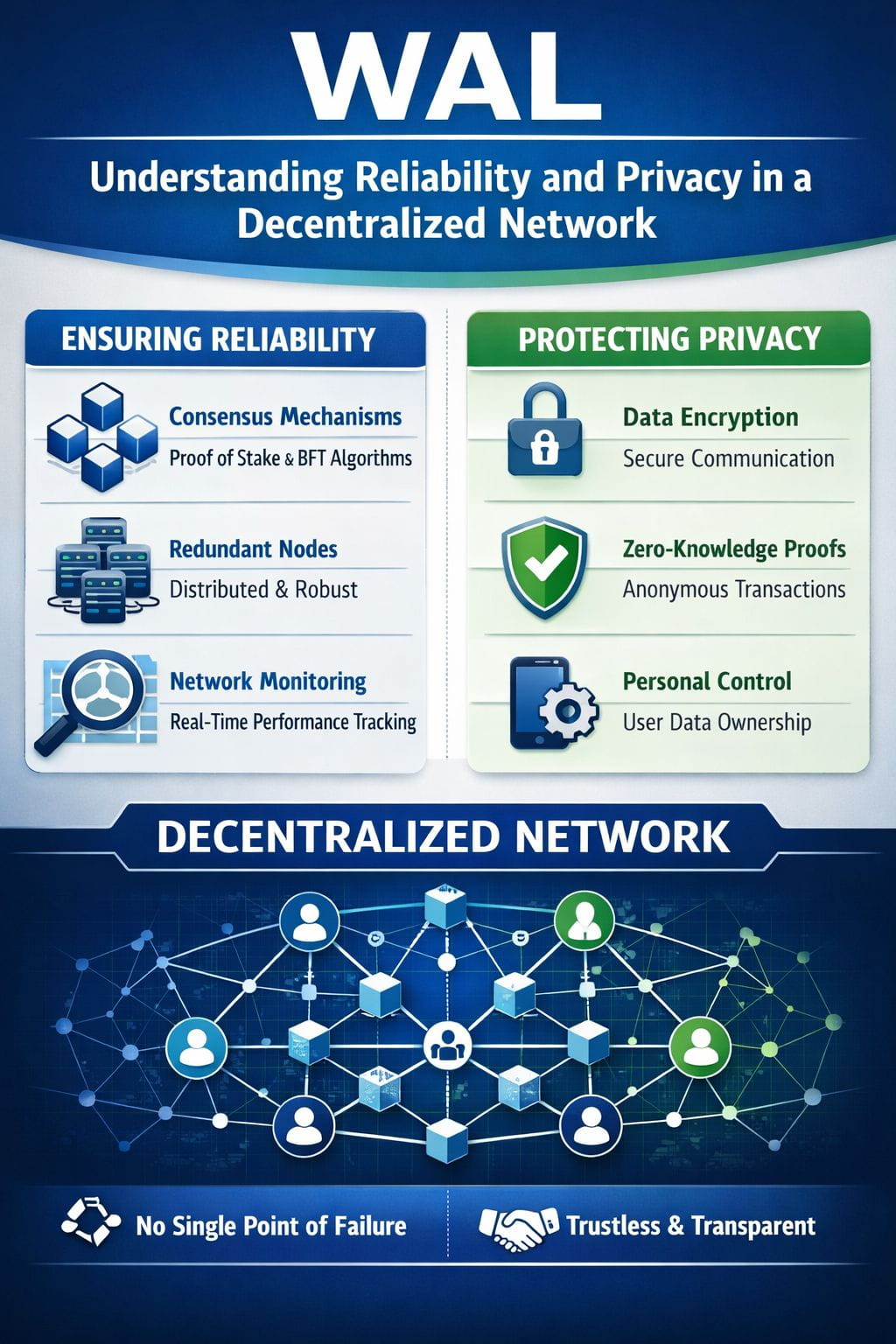
When I first started poking around the Walrus protocol and its WAL token, I’ll admit, I didn’t care much about the hype words — “privacy,” “censorship-resistant,” “DeFi.” What caught my attention was a quieter question: can this actually work in a way I can rely on? Could I really trust it to store a file, move funds, or let me vote on governance decisions without something weird happening? Because I’ve seen plenty of “cool” tech that looks shiny but collapses the moment you depend on it for real-life use.
The system itself is really two things trying to work together. There’s the blockchain side, which handles private payments, staking, and governance. And then there’s the storage side, which slices up your files and spreads them across a network of nodes. Each part could exist on its own, but the tricky part is making them feel like a single, dependable service. You don’t want to log in and feel like you’re playing a guessing game every time you want to get something done.
I think about the storage system like this: imagine you have a big, fragile package you want to send to a bunch of neighbors. You don’t just give a full copy to each neighbor — that would be expensive and kind of pointless. Instead, you cut it into pieces, add a little redundancy, and distribute those pieces. Even if some neighbors disappear or don’t hold up their end, you can still gather enough pieces to reconstruct the original. That’s basically what erasure coding and blob storage do. It’s clever, but it’s also messy under the hood. The system has to keep track of where everything lives, make sure nothing gets corrupted, and repair missing chunks without anyone noticing.
One thing I really appreciated is how the system verifies every piece. Each chunk has a digital fingerprint — a hash — and when you retrieve it, you can check that nothing got tampered with. It’s like sealing every envelope with a wax stamp. If the stamp is broken, you know immediately. Small details like that make a huge difference when you’re relying on it day-to-day.
Then there’s the human side of things: incentives. You can have the slickest technical system, but if people running nodes don’t have a reason to behave, it won’t work. That’s where WAL tokens come in. Operators stake tokens to participate and earn rewards, and if they fail or misbehave, there are penalties. It’s a balancing act — make the penalties too harsh, and only big players participate; too lenient, and reliability suffers. It’s like running a neighborhood watch: you want enough accountability to keep everyone honest, but you don’t want to scare away volunteers.
From a user perspective, the workflow feels surprisingly concrete. I encrypt a file on my own computer first — privacy starts with me, not the network. Then my client slices the file into chunks, adds redundancy, and uploads them to the network. A small “manifest” gets stored on the blockchain, mapping where everything lives. WAL tokens pay for storage, and node operators stake to guarantee the service. Later, when I want the file back, my client fetches enough chunks, verifies them, and reconstructs the original. It’s predictable: either it works, or it tells me exactly what went wrong. That predictability is worth more than any flashy feature.
Of course, it’s not perfect. Latency varies depending on which nodes are online. Some downloads take longer than I’d like. Tokens fluctuate in value, so storage costs can swing. Lose your private key, and you’re locked out forever. Governance moves slowly — which is good for safety but can be frustrating if an urgent fix is needed. These are the real trade-offs. Reliability comes from acknowledging them, not pretending they don’t exist.
What I’ve grown to respect is how the protocol embraces these trade-offs instead of hiding them. It doesn’t promise instant downloads or zero-risk transactions. Instead, it builds reliability into the messy details: redundancy, verification, staking, monitoring, and repair. That’s what turns a distributed system from a neat idea into something I can actually trust.
At the end of the day, the questions I keep circling back to aren’t about features. They’re practical: how will people manage keys without losing access? How will enterprises reconcile private storage with audits? How will governance scale without centralizing? I don’t have all the answers, but I’ve come to value a system that’s designed to behave predictably under stress. That’s the real measure of trust for me — not flashy marketing, but a network that quietly does what it promises, day after day.