Most blockchain projects start by making big promises. Open from day one. Permissionless forever. Fully decentralized immediately. It sounds good—until the system has to process real payments, stay online without interruption, and comply with real-world rules. That’s usually where the cracks appear.
Vanar Chain doesn’t pretend that problem doesn’t exist. Instead, it takes a different approach—one that’s less romantic, but far more honest.
Vanar is built around what it calls a trust ladder. The idea is simple: people don’t adopt systems because they’re maximally decentralized on paper. They adopt them because they work first. Stability comes before ideology. Decentralization comes step by step.
That’s not a new idea if you zoom out. It’s how the internet scaled. It’s how cloud infrastructure evolved. It’s how fintech earned trust. Vanar is applying the same logic to blockchain.
Decentralization as a process, not a slogan
At launch, Vanar starts with a small set of known, reliable validators distributed globally. These aren’t anonymous actors chasing short-term rewards. They’re entities that go through trials, prove reliability, and build a track record over time. As that record grows, the network opens further.
Many chains talk about “progressive decentralization.” Vanar hard-codes it into its consensus design and documentation. That difference matters. It turns decentralization from a marketing claim into an operational roadmap.
Security is more than locked capital
One of the most overlooked design choices in Vanar is what it doesn’t rely on.
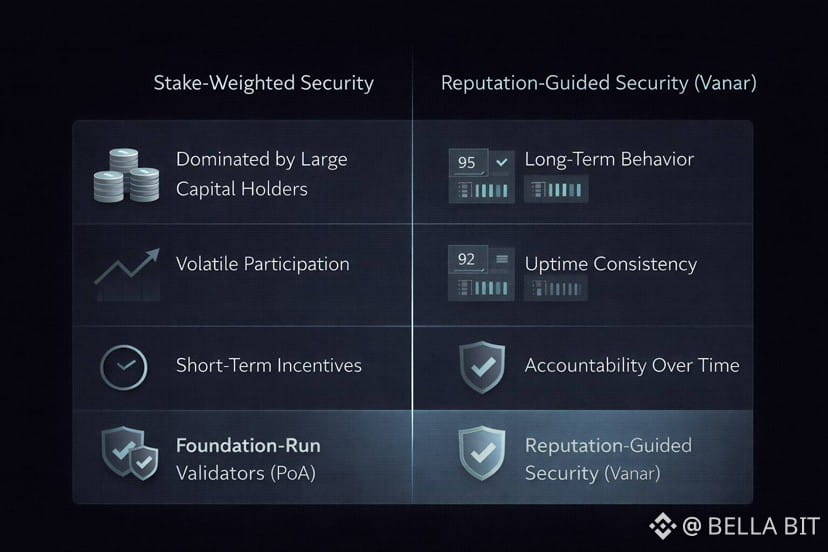
Most networks reduce security to a single variable: how much capital is locked. Whoever stakes the most controls the most influence. Vanar doesn’t fully buy into that assumption.
Instead, it uses a hybrid Proof of Authority / Proof of Reputation model. In the early phase, validators are operated by the Vanar Foundation. In the next phase, third-party validators are introduced—but entry isn’t just about money. It’s about demonstrated behavior.
The underlying question Vanar asks is refreshingly simple:
Who has consistently acted well over time?
Not:
Who can afford the most influence today?
Reputation becomes a second security primitive alongside stake. This doesn’t make the system perfect—but it does reduce common failure modes like rented stake, short-term capture, or influence without accountability.
Why this matters for payments and real businesses
When you’re building systems for actual businesses, the biggest problems aren’t philosophical. They’re practical.
Downtime.
Unpredictable finality.
Validators behaving inconsistently.
Proof of Authority has a bad reputation in crypto culture because it feels permissioned. But it also delivers something young networks desperately need: operational stability. Vanar uses PoA deliberately—not as an endpoint, but as a starting point that evolves as reputation-based validators are added.
This aligns with Vanar’s positioning as a payments-focused, enterprise-ready chain. It assumes that professional behavior isn’t optional—it’s the baseline.
Compatibility over reinvention
One quiet strength of Vanar is how little it asks developers to throw away.
The biggest graveyard in Web3 isn’t chains—it’s developer time. Even great technology fails if teams have to rewrite everything just to use it. Vanar takes a compatibility-first approach so builders can ship faster using tools and patterns they already understand.
Rather than forcing developers into a new stack, Vanar lets them bring what they have and gradually adopt the network’s more advanced features. If Vanar’s AI and data layers are the long-term differentiators, compatibility is the bridge that actually gets applications through the door.
Neutron isn’t about compression—it’s about architecture
Vanar often highlights Neutron’s ability to compress data dramatically. But the more interesting part is how it stores information.
Neutron seeds live off-chain for performance and flexibility, while being anchored on-chain for ownership, integrity, and verification. That distinction matters. It shows that Vanar isn’t chasing on-chain purity for its own sake.
Instead, it’s building a pragmatic system: keep heavy data where it can move fast, and keep cryptographic truth on-chain where it can be proven. For real-world applications, this hybrid model is far easier to adopt than forcing everything on-chain and pretending performance tradeoffs don’t exist.
Compliance as software, not paperwork
Kayon, Vanar’s reasoning layer, is easy to misunderstand if you think of compliance as a checklist. Vanar treats compliance as something that can be encoded, queried, and replayed.
Instead of being a manual back-office process, compliance becomes something the data itself can explain.
Why was a payment approved?
Why did a rule trigger?
Why is this document valid?
Those “why” questions are non-negotiable in real systems. Vanar is designing for a world where answers are generated by verifiable data and logic—not by human memory or trust.
If this works, Vanar won’t shine in flashy demos. It’ll show up in boring places: audits, dispute resolution, reporting, and payment checks. That’s where budgets live.
Staking as responsibility, not just yield
Vanar doesn’t frame staking as a speculative game. It treats it as a security mechanism—something participants do because it strengthens the network.
As validator access expands based on reputation, staking becomes less about raw capital dominance and more about long-term consistency. It’s one of several signals Vanar can use to balance trust, performance, and decentralization over time.
Ecosystem growth without noise
Vanar’s ecosystem strategy is quiet but intentional. Instead of announcing endless partnerships, it focuses on getting builders to ship. Programs like Kickstart lower the friction to launch, which matters more than flashy numbers.
Infrastructure doesn’t win because it’s perfect. It wins because it makes building easier. When developers build, users follow, feedback improves the stack, and credibility grows through use—not hype.
The real bet Vanar is making
Vanar isn’t betting on speculation. It’s betting that the next phase of Web3 looks less like an experiment and more like invisible infrastructure.
Predictable validation.
Readable, verifiable data.
Logic that can explain itself.
Systems that stay up and scale responsibly.
If you want a simple way to evaluate Vanar, don’t ask whether it feels exciting. Ask whether it reduces friction in real systems.
@Vanarchain isn’t rushing to decentralize everything at once. It’s building trust step by step—carefully, deliberately, and with the expectation that it will be questioned.
In a space obsessed with idealism, that kind of engineering restraint is rare.
And quietly, that’s what makes it interesting.