
Vanar feels like it was built by people who don’t want “another chain” as the end goal. The way they present it now is closer to a full stack where the base L1 is only the starting point, and everything above it is about making data usable instead of just storable. On their own site, Vanar describes an “intelligent Layer 1” stack that pairs the chain with Neutron (semantic memory) and Kayon (reasoning), then points to Axon (automation) and Flows (industry apps) as the next layers that complete the loop.
Vanar What matters here is the problem they’re choosing to fight. A lot of blockchains can confirm transactions quickly, but most of them still treat files like dead weight: you store a pointer, you store a hash, and the meaning lives somewhere else. Vanar’s Neutron pitch is basically: stop doing that — turn the file itself into something compact, provable, and queryable, stored directly onchain as a “Seed.” They even attach a concrete claim to it, describing an engine that can compress something like 25MB down to 50KB using semantic + heuristic + algorithmic layers, so the output isn’t just smaller, it’s structured in a way that can be retrieved and reasoned over.
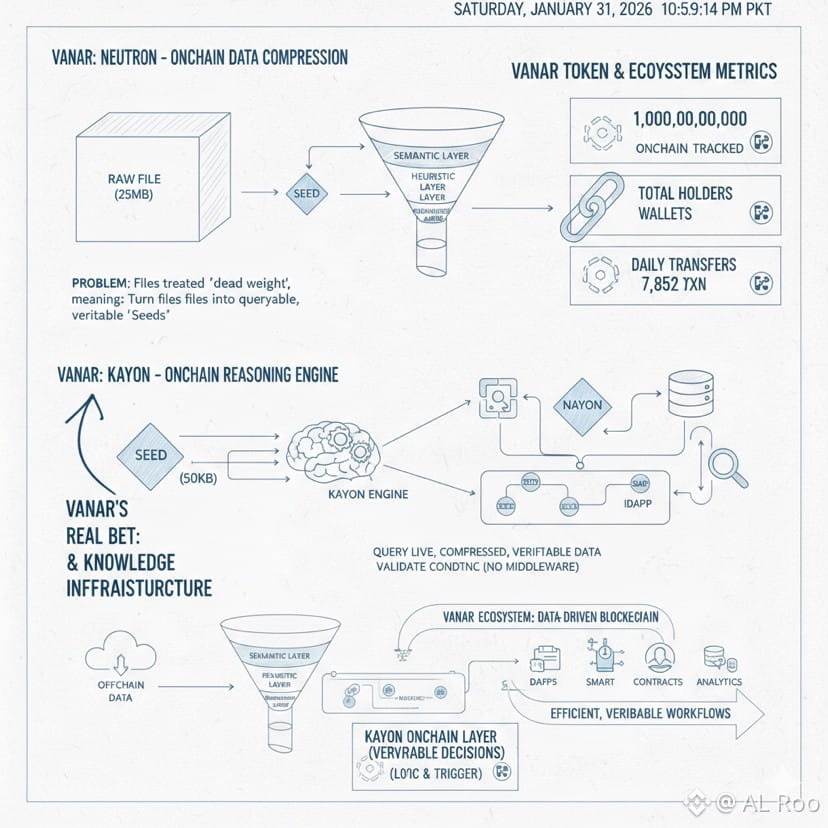
Vanar And then Kayon is positioned as the layer that makes those Seeds useful in real workflows. Vanar frames it as an onchain reasoning engine that lets apps and contracts query live, compressed, verifiable data — and use that to validate conditions and trigger logic without relying on extra middleware.
Vanar That “behind the scenes” direction tells you where their head is: they’re trying to reduce the number of offchain moving parts that usually break consumer apps. Instead of saying “developers will figure it out,” they’re building the memory layer and the reasoning layer as first-class components of the network.
Vanar The token story fits into that same evolution. The $VANRY identity comes from a transition that Vanar itself documented as a one-to-one move from $TVK to $VANRY. That matters because it explains why many people still associate the ecosystem with earlier entertainment and gaming roots, including products like Virtua Metaverse and VGN games network — while the current direction is much more about PayFi, data, and logic inside the chain.
Vanar $VANRY is easy to verify and track because the ERC-20 side is visible on Etherscan with clear supply stats. The token page shows a max total supply of 2,221,316,616 VANRY and the current “heartbeat” metrics like holders and transfers. That transparency is a real benefit: you don’t have to guess whether activity exists — you can measure it.
Vanar So when you ask “what’s happening lately,” the clean answer is: Vanar’s most obvious “latest” shift is how aggressively it’s leaning into Neutron + Kayon as core identity, not side products. Their main stack page spells it out in plain language — chain for fast, low-cost transactions, Neutron Seeds for storing proof-based data directly onchain, and Kayon as logic that can reason over it.
Vanar What’s next is also signaled directly by how they structure their stack. Axon and Flows are shown as the layers above reasoning and memory — meaning the next phase is not just “more features,” it’s “automation plus packaged workflows” that make this stack feel like something industries can actually plug into. If Neutron is “memory” and Kayon is “reasoning,” then Axon/Flows are where it turns into repeatable processes and real applications instead of demos.
Vanar On benefits, the simplest way I’d put it is this: Vanar is trying to make three things true at the same time. Keep transactions cheap and fast at the base layer, make data compressible and provable as onchain objects, and make that data queryable in a way that produces decisions — not just storage receipts. If they execute that end-to-end, it becomes easier for builders to ship mainstream apps without stitching together fragile systems outside the chain.
Vanar On “exits,” if you mean it as “how real the token and ecosystem are in day-to-day terms,” the straight answer is: the token is actively tracked onchain with visible supply, holders, and transfer activity, and the ecosystem is being framed around clear layers (chain → Seeds → reasoning → automation → apps). That’s a healthier setup than projects where everything depends on vibes, because the network can show progress through measurable usage and expanding stack rollout.
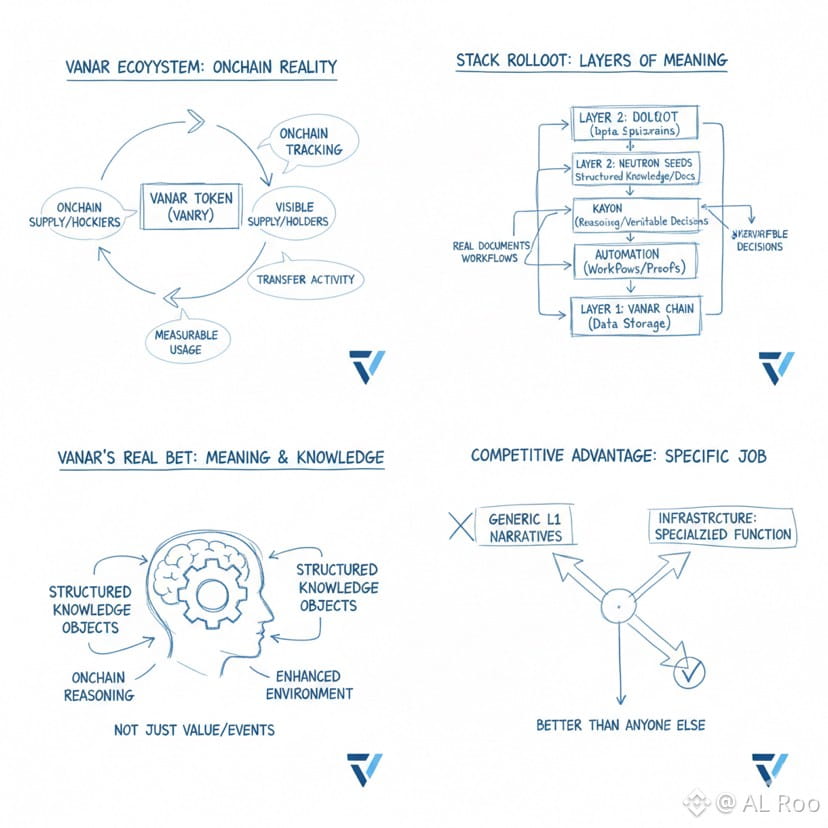
Vanar’s real bet is not speed — it’s “meaning.” They’re building toward a world where the chain doesn’t just store value and events, it stores structured knowledge objects and can reason over them inside the same environment. If Neutron Seeds become something teams genuinely rely on for real documents, proofs, and workflows, and Kayon becomes the layer that turns that into verifiable decisions, then Vanar stops competing with generic L1 narratives and starts competing as infrastructure that does a specific job better than anyone else.
Vanar For the last 24 hours snapshot (based strictly on the live token page you shared), Etherscan shows 7,495 holders (down 0.027%) and 345 transfers in the last 24H (up 148.20%). That doesn’t “prove” anything by itself — but it does say activity picked up noticeably, which is exactly the kind of signal you want to watch when a project’s story is about real usage and real workflows
