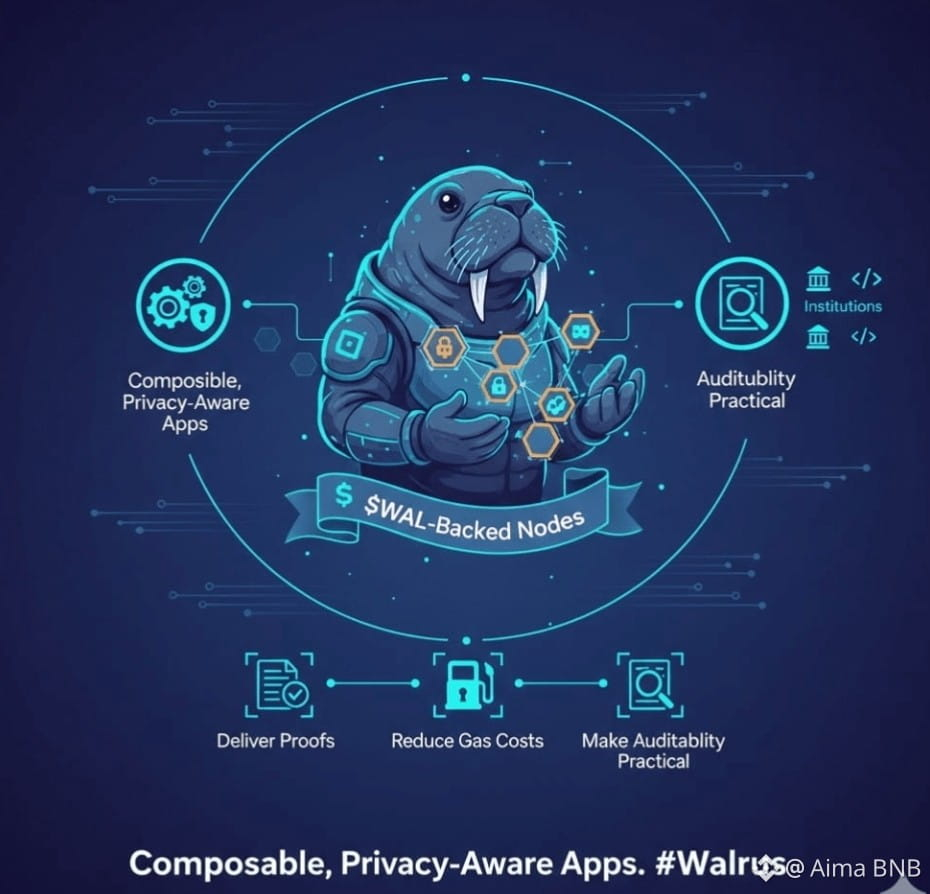
Today I am talk about walrus,s quite sift blockchain:-
Walrus and the Quiet Shift in the Way Blockchains Hold Information-
The truth is, the great majority still believe that a blockchain is merely a tool to support a simple transactional model. Send something, receive something else, maybe update a counter, maybe record a trade. But if you know me, you know that I have been around this space a very long time. And I can tell you that, especially over the last two years, as AI-based transactions, NFT metadata, gaming assets, and social data on chains have grown, the gap in traditional blockchain storage solutions has been an unpleasant truth waiting to be filled. Enter Walrus, a solution, not a buzzword.
Walrus is an incentive protocol for the decentralized storage of data as well as the corresponding guarantee of their availability, developed on the Sui blockchain. Walrus was officially launched to the main network on the 27th of March, 2025, following nearly a year of testing. Walrus is easy to fully understand, while the actual implementation is quite complicated. Traditionally, when users need to store substantial files on the blockchain, the entire procedure is slow as well as highly expensive.
Walrus stores its data outside of the blockchain in a network and provides strong guarantees that it will always be available and verifiable. On a basic level, it's like a decentralized cloud for blockchains, kind of like an Amazon Web Services or Microsoft Azure for blockchains. Only instead of relying on a company, server, or data center of any kind, we rely only on a network.
To understand the significance of the above statement, one shall have to delve into the way data is normally stored in a chain. For instance, Ethereum processes a few megabytes of data, but it is too expensive to do so. For that reason, a Rollup or a Layer Two enhances the data by compressing it. However, when data is unavailable, the chain cannot be validated, and one is left trusting someone’s servers.all
Walrus does this with a technique called erasure coding. This does not mean that the entire file needs to be replicated on multiple nodes in the graph. Because of this, even in the event that some nodes are taken offline, the data can still be recovered. Through a study done on the Walrus network that was released in late May 2025,According to research done by the engineering team at Walrus in May 2025, the 4.5x replication factor of our RedStuff encoding system, compared to a 10x or larger replication factor in older systems, ensures that our system remains at high levels of security and reliability without wasting huge amounts of storage.
By the end of 2025, Walrus had garnered over 120 active projects, with at least 11 full websites running entirely on decentralized infrastructure. Compare this to the large Web2 players and think blockchain adoption leaders; it sounds minor, yet in blockchain circles, such numbers are indicative of economic growth. TradePort, the largest NFT Marketplace on Sui, had migrated NFT dynamic metadata to Walrus in July 2025, it sounds minor, yet in blockchain circles, such numbers are indicative of economic growth. TradePort, the largest NFT Marketplace on Sui, had migrated NFT dynamic metadata to Walrus in July 2025,
So why is this happening this way? A part of the reason lies in the tremendous progress being made in the development of AI systems. Large amounts of information are created through training data, checkpoints, and inference logs in an AI system. In the year 2023, the vast majority of the AI systems had relied on centralized clouds alone. However, in the year 2025, the concerns over data ownership, censorship risks, and lock-in forced the developers to look for decentralized solutions. Walrus had placed itself right in the middle of this trajectory. In March 2025, Walrus had raised 140 million US dollars in a private token sale with the support of Standard Crypto and a16z crypto, along with Franklin Templeton Digital Assets. There are still many roadblocks to a successful journey, but this is indeed a very good sign.
Another factor is the rise of the rollups. The roadmap that Ethereum follows heavily relies on the use of the DATA AVAIL concept to aid in scaling the transaction rate. While the rollups provide transaction information in a condensed format, they cannot exist without the information they are providing. Walrus is just one of many protocols vying to become just such a backbone. So, what sets Walrus apart is how well it is integrated with Sui, enabling it to verify and have access control quickly.
Programmable storage may sound like a strange concept, but it is one of the most intriguing aspects of the protocol. Smart contracts are allowed to reference data stored on the Walrus, and they automatically trigger access permissions and payments or changes to data sets. Access permissions were added to the Walrus protocol in the last week of Septem