


There is a pattern that repeats itself across every serious technology stack and once you see it, it becomes hard to unseen. Someone invents a solution under pressure. It is openly labeled as temporary. A workaround. A patch to buy time. Everyone agrees it’s not “the final form.” And then, slowly, almost invisibly, the system reorganise itself around that patch until removing it feels unthinkable.
@Plasma fits this pattern almost perfectly.
When Plasma was first proposed, the context mattered more than the elegance of the idea. Ethereum was choking. Transactions stalled. Fees exploded. Users waited absurd amounts of time just to move value. Plasma wasn’t pitched as a philosophical breakthrough. It was a lifebuoy thrown into a system that was already sinking under its own success.
The core idea was beautiful in its simplicity. Push most activity off the main chain into smaller environments where transactions are cheap and fast. Periodically commit proofs back to the main chain. If something goes wrong, users can exit and challenge fraud. The base layer remains the ultimate judge, but it doesn’t have to process everything in real time.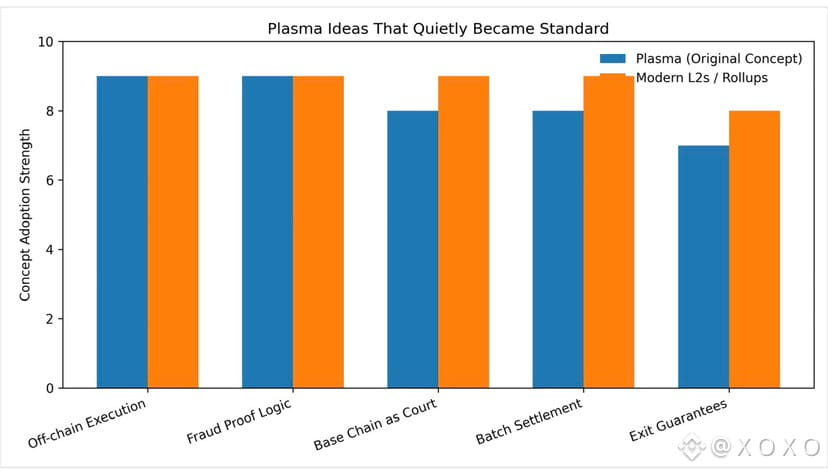
On paper, this was genius. In practice, it revealed something deeper about how hard decentralized systems are to operate at scale.
Plasma’s problems weren’t theoretical. They were operational. Fraud proofs required full data availability, but the moment an operator stopped publishing data, the safety guarantees collapsed. Mass exits sounded fine in a whitepaper, but in real systems they threatened to overwhelm the very layer meant to provide security. And the complexity of actually running fraud proofs meant that very few people were willing to do it outside of controlled experiments.
These weren’t cosmetic flaws. They went to the heart of usability. And over time, the ecosystem responded the way ecosystems usually do: not by fixing Plasma directly, but by moving on.
Optimistic rollups absorbed the idea of fraud proofs but reshaped them. ZK rollups took the idea of off-chain execution and removed the need for dispute games altogether. Plasma, as a named solution, slowly faded from the conversation.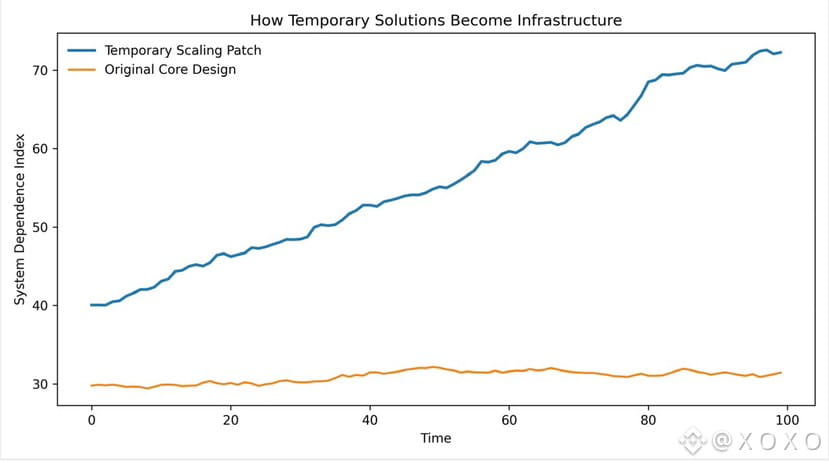
And yet, this is where the story gets interesting.
Plasma didn’t disappear. Its assumptions became normal.
The idea that most transactions shouldn’t live on the base chain anymore? That’s Plasma thinking. The idea that you can batch activity off-chain and only enforce correctness on-chain? Plasma again. The idea that the base layer should be a court, not a factory? Straight from Plasma’s DNA.
Even projects that explicitly moved away from Plasma carried its logic forward. The ecosystem didn’t reject the idea. It rejected the implementation.
This is how “temporary” infrastructure really works. It doesn’t need to survive as a product. It needs to survive as a pattern.
At first, Plasma was framed as a stopgap. Then it became a reference point. Then its concepts were absorbed, refined, and normalized until they stopped feeling exotic. What once felt like complexity started to feel like common sense. The ecosystem didn’t wake up one day and declare Plasma a success. It simply built the future on top of its bones.
That slow normalization is easy to miss because it doesn’t come with announcements. No victory lap. No “Plasma won” headline. Just a gradual shift where doing things without these ideas feels naïve.
This happens everywhere, not just in blockchains. Temporary code paths become permanent architecture. Experimental tools become critical dependencies. Short-term decisions quietly shape long-term behavior. The systems that survive are rarely the cleanest ones. They are the ones that adapt around what actually works under pressure.
Seen this way, Plasma is less a failed experiment and more a case study in how infrastructure matures. Not through perfect designs, but through imperfect ideas that prove just useful enough to keep.
The lesson isn’t that Plasma was right about everything. It clearly wasn’t. The lesson is that once a system solves a real problem, even imperfectly, it leaves a mark that doesn’t wash out easily.
Temporary patches don’t disappear. They either break completely or they become part of the fabric. Plasma did the latter.
And that, quietly, is what technological maturity looks like. No fanfare. No sharp turns. Just a system that wakes up one day and realizes it can no longer imagine life without the thing it once called temporary.