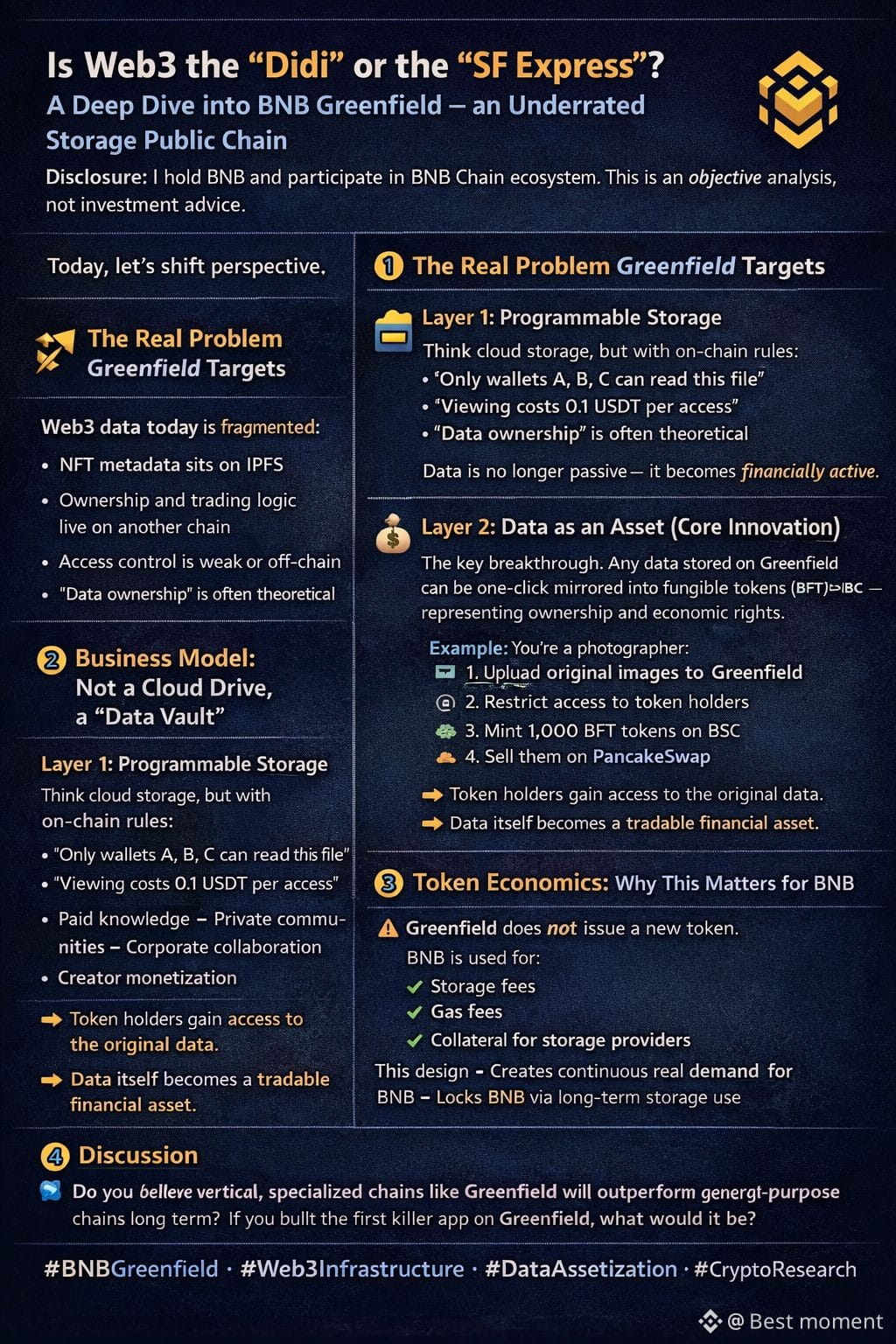
Is Web3 the “Didi” or the “SF Express”?
A Deep Dive into BNB Greenfield — an Underrated Storage Public Chain
Disclosure: I hold BNB and participate in the BNB Chain ecosystem. This is an objective analysis, not investment advice.
Most public-chain discussions feel repetitive:
• Layer 1 = higher TPS
• Layer 2 = lower fees
• Endless technical competition with diminishing differentiation
Today, let’s shift perspective.
BNB Greenfield isn’t trying to replace Uniswap, nor compete in GameFi.
Its goal is far more focused: to become the “data-native layer” of Web3.
1️⃣ The Real Problem Greenfield Targets
Web3 data today is fragmented:
• NFT metadata sits on IPFS
• Ownership and trading logic live on another chain
• Access control is weak or off-chain
• “Data ownership” is often theoretical
Greenfield’s idea is simple but powerful:
👉 Store data, manage permissions, and enable monetization — all natively on one chain.
Every file becomes programmable from birth:
Who can read it
Who can download it
Whether access is free or paid
Data is no longer passive — it becomes financially active.
2️⃣ Business Model: Not a Cloud Drive, a “Data Vault”
🔹 Layer 1: Programmable Storage
Think cloud storage, but with on-chain rules:
“Only wallets A, B, C can read this file”
“Viewing costs 0.1 USDT per access”
This unlocks new use cases: • Paid knowledge
• Private communities
• Corporate collaboration
• Creator monetization
🔹 Layer 2: Data as an Asset (Core Innovation)
This is the key breakthrough.
Any data stored on Greenfield can be one-click mirrored into a fungible token (BFT) on BSC — representing ownership and economic rights.
Example:
You’re a photographer:
Upload original images to Greenfield
Restrict access to token holders
Mint 1,000 BFT tokens on BSC
Sell them on PancakeSwap
👉 Token holders gain access to the original data.
👉 Data itself becomes a tradable financial asset.
🔹 Layer 3: Binance Full-Stack Integration
Inside the Binance ecosystem, the puzzle fits perfectly:
• Wallet: Binance Web3 Wallet
• Trading: BFT tokens on PancakeSwap
• Infrastructure: Storage demand benefits BNB stakers & validators
Greenfield fills the missing link:
📌 Data assetization, allowing Binance to expand beyond pure financial trading into digital creation and ownership.
3️⃣ Token Economics: Why This Matters for BNB
Greenfield does not issue a new token.
BNB is used for: • Storage fees
• Gas fees
• Collateral for storage providers
This design: ✔ Creates continuous, real demand for BNB
✔ Locks BNB via long-term storage use
✔ Avoids gas-token fragmentation
BNB becomes fuel for digital property rights, not just a trading asset.
4️⃣ Risks & Challenges
No innovation comes without friction:
• Cold start problem: needs early creators & storage providers
• UX & cost: must compete with AWS-level convenience
• Regulatory gray zones: data monetization may face compliance challenges
Greenfield is early — adoption is not guaranteed.
5️⃣ Final Takeaway
Greenfield isn’t a short-term hype narrative.
Its real value is introducing a new Web3 primitive:
Data that can be programmed, owned, combined, and traded like DeFi.
If even a few native applications (social networks, creator platforms, enterprise tools) succeed on it, Binance’s ecosystem support could turn into a long-term moat.
This is not a FOMO stage — it’s a learning stage.
Try the testnet, upload files, set permissions, mint tokens.
You’ll understand Web3 data ownership far better than reading headlines.
💬 Discussion
Do you believe vertical, specialized chains like Greenfield will outperform general-purpose chains long term?
If you built the first killer app on Greenfield, what would it be?
#BNBGreenfield #Web3Infrastructure #DataAssetization #CryptoResearch