$River: A Complete Market Cycle in One Chart
Markets don’t move randomly.
They move like nature.
And among all charts, $River behaves closest to a real river — not just in name, but in cycles, violence, calm, overflow, and destruction.
This is not imagination.
This is price history.
Phase 1: The Dry Season (September — $1.5 to $3)
In September, $RIVER barely moved.
Price stayed between $1.5 and $3, unnoticed, ignored.
Just like a river during dry season:
• Water exists
• Flow is thin
• Surface looks lifeless
• Most people assume it’s dead
But rivers don’t die in dry seasons.
They retreat underground.
Liquidity remained
Structure remained
Only attention was missing
Phase 2: The First Rains (October — $5 to $10)
October brought the first rainfall.
#RİVER slowly expanded from $5 to $10.
This wasn’t a flood.
It was a signal.
Early rains always look harmless:
• Farmers notice
• Travelers still ignore
• Only observers understand
Price began carving a path again.
Most people said: “It already moved.”
But rivers don’t stop flowing because they started.
They stop only when rain disappears.
Phase 3: The False Calm (Mid-Nov to Dec — $3 to $6)
Then came silence.
Rain paused
Flow weakened.
Between mid-November and December, price slipped back to $3–$6
To the impatient: “The river dried again”
But in reality:
The riverbed was now wider
Soil was saturated
Pressure was stored beneath
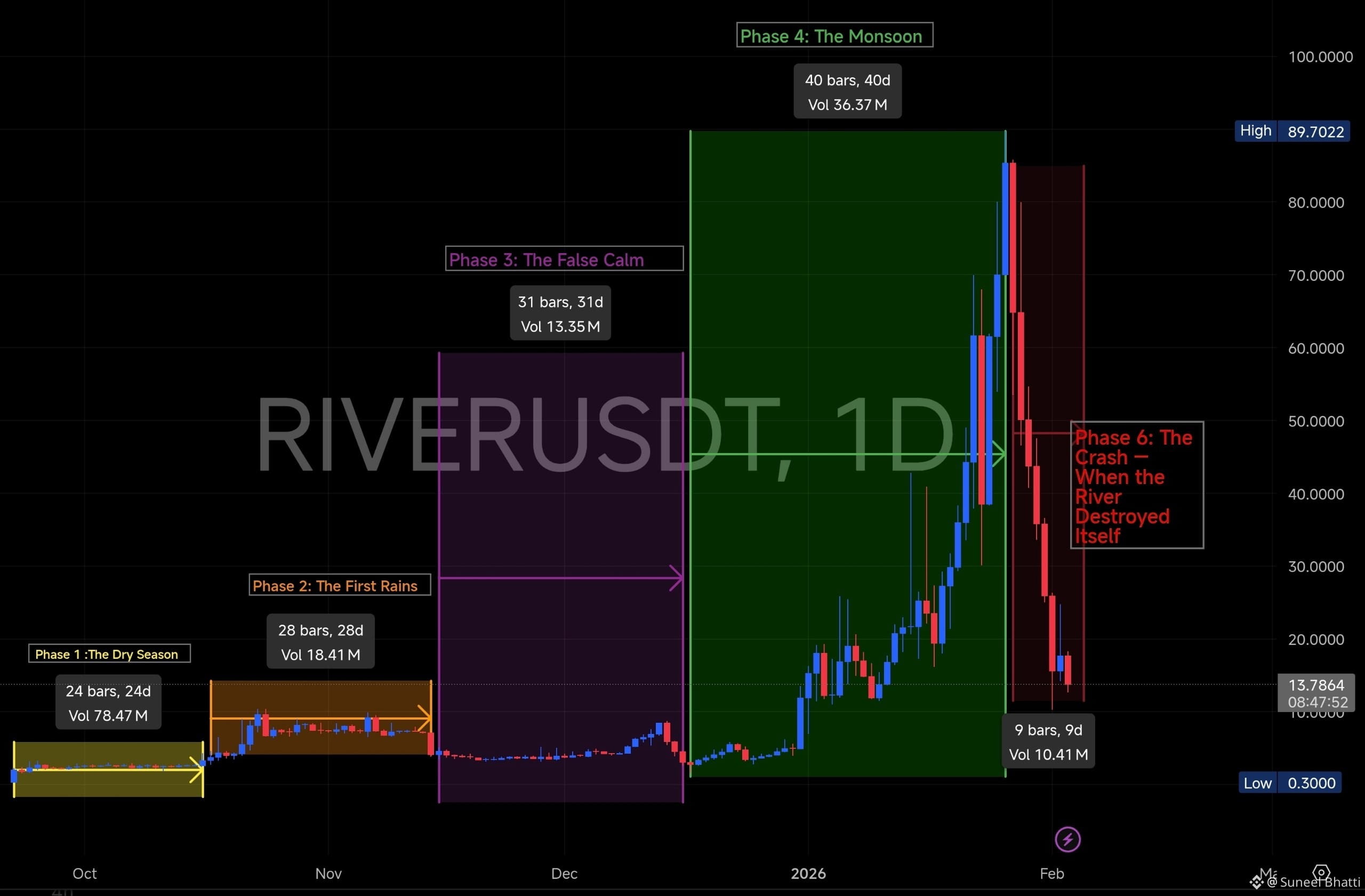
This phase wasn’t weakness.
It was absorption.
> When rain pauses, rivers don’t vanish —
they move quietly underground
Weak hands left
Patient watchers stayed.
Phase 4: The Monsoon (Dec–Jan — $1.6 to $86)
Then the season changed.
Rain returned — heavy, nonstop, uncontrollable.
From around $1.6, #RİVER didn’t rise…
It overflowed.
Within roughly 40 days, price surged to $86
This was flood stage.
What happens during floods?
• Boundaries break
• Fields submerge
• Land gets reshaped forever
That’s exactly what happened:
• Liquidity rushed in
• Resistance lost meaning
• Price discovery exploded
• Logic disappeared
Floods don’t ask questions.
They follow pressure.
Phase 5: 26 Jan 2026 — When the Rain Suddenly Stopped
Nature is brutal when seasons change.
On 26-01-2026, rainfall stopped suddenly.
But worse —
the river started leaking heavily.
Cracks appeared in the riverbanks.
And once leakage begins during flood stage,
collapse is inevitable.
Phase 6: The Crash — When the River Destroyed Itself
What followed was not a pullback.
It was structural collapse.
The river didn’t flow backward gently —
it crashed violently.
Here’s what happened next:
27 Jan: -18%
28 Jan: -20%
Followed by:
-12%
-18%
-27%
-39%
> Floods don’t recede politely.
They tear everything on the way down.
Why This Crash Was Inevitable
Every flood carries a hidden truth:
> The higher the overflow, the weaker the banks.
During the monsoon phase:
Price moved too fast
Structure couldn’t stabilize
Participation became emotional, not strategic
When rain stopped, there was nothing holding the water.
Markets behave the same way:
Fast moves without base = fragile
Vertical rallies = unstable terrain
Liquidity exits faster than it enters
This wasn’t manipulation
It was nature completing its cycle.
The Lesson Traders Must Learn
Most traders only study how rivers rise.
Very few study how they fall.
But survival comes from understanding both.
❌ Expecting floods forever is delusion
❌ Calling crashes “unexpected” is ignorance
❌ Blaming the river after ignoring seasons is denial
Nature gave signals.
Markets always do.
Final Thought
#RIVER didn’t betray anyone.
It behaved exactly like a river should:
It waited
It flowed
It flooded
And when rain stopped…
it destroyed everything unstable
If you only watch rivers during floods,
you’ll think crashes are unfair.
But if you respect seasons,
you’ll understand:
Every flood carries the seed of its own collapse.
And every dry season carries the promise of another river