

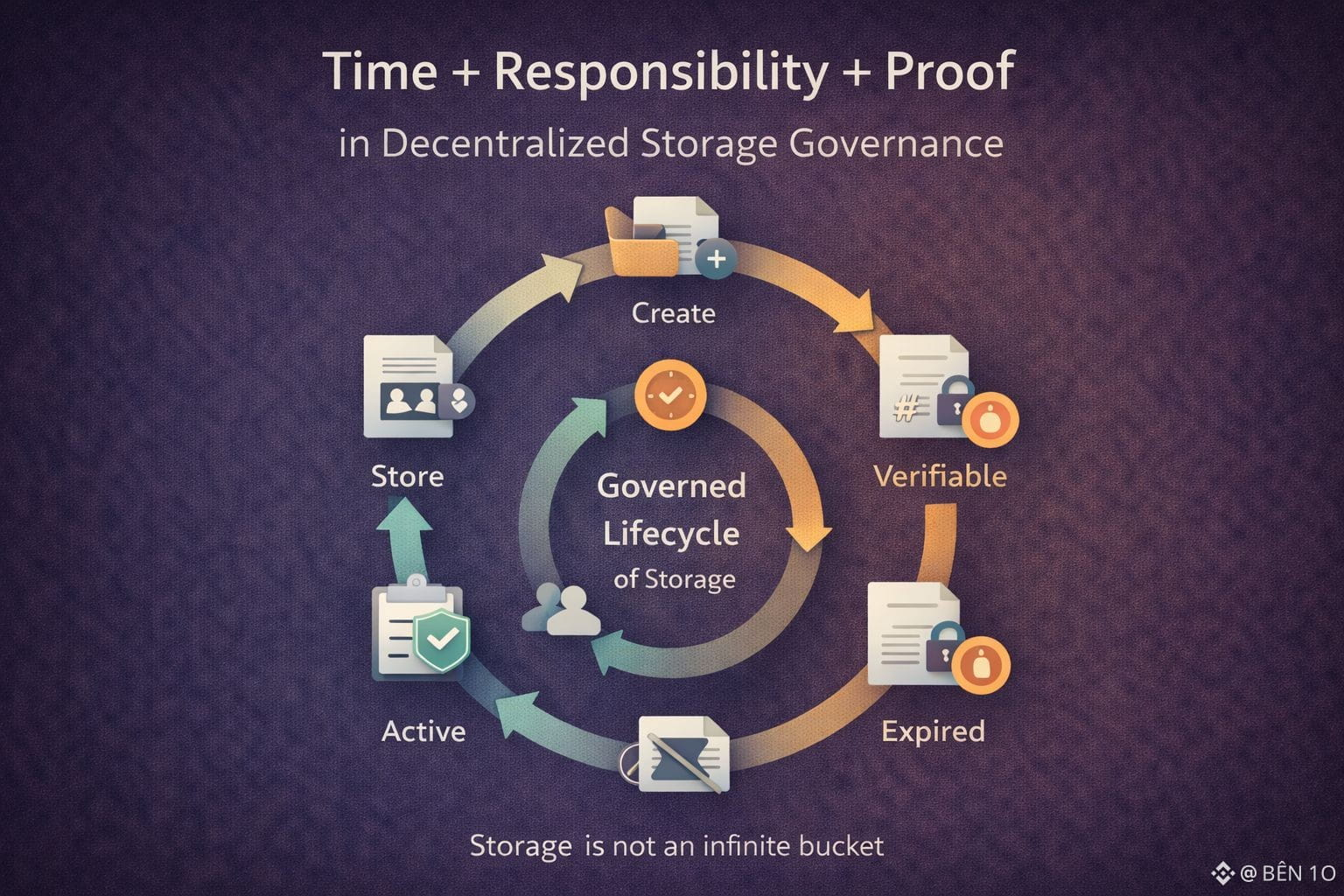
A persistent misconception still shapes much of the thinking around decentralized storage: that it is simply an immutable hard drive distributed across many machines. Closely tied to this is a second assumption that enough redundancy automatically produces reliability. Both ideas are incomplete, and in practice, they are often misleading. Redundancy without accountability degrades quietly. Immutability without lifecycle awareness accumulates risk. What modern infrastructure actually requires is not infinite storage, but verifiable guarantees about who is responsible for data, for how long, and under what conditions.
This is the design space where Walrus Protocol positions itself. Walrus reframes decentralized storage as a service contract enforced over time, not as a passive archive. Its architecture treats time, responsibility, and verification as explicit components of the system, rather than assumptions buried under replication factors and hope.
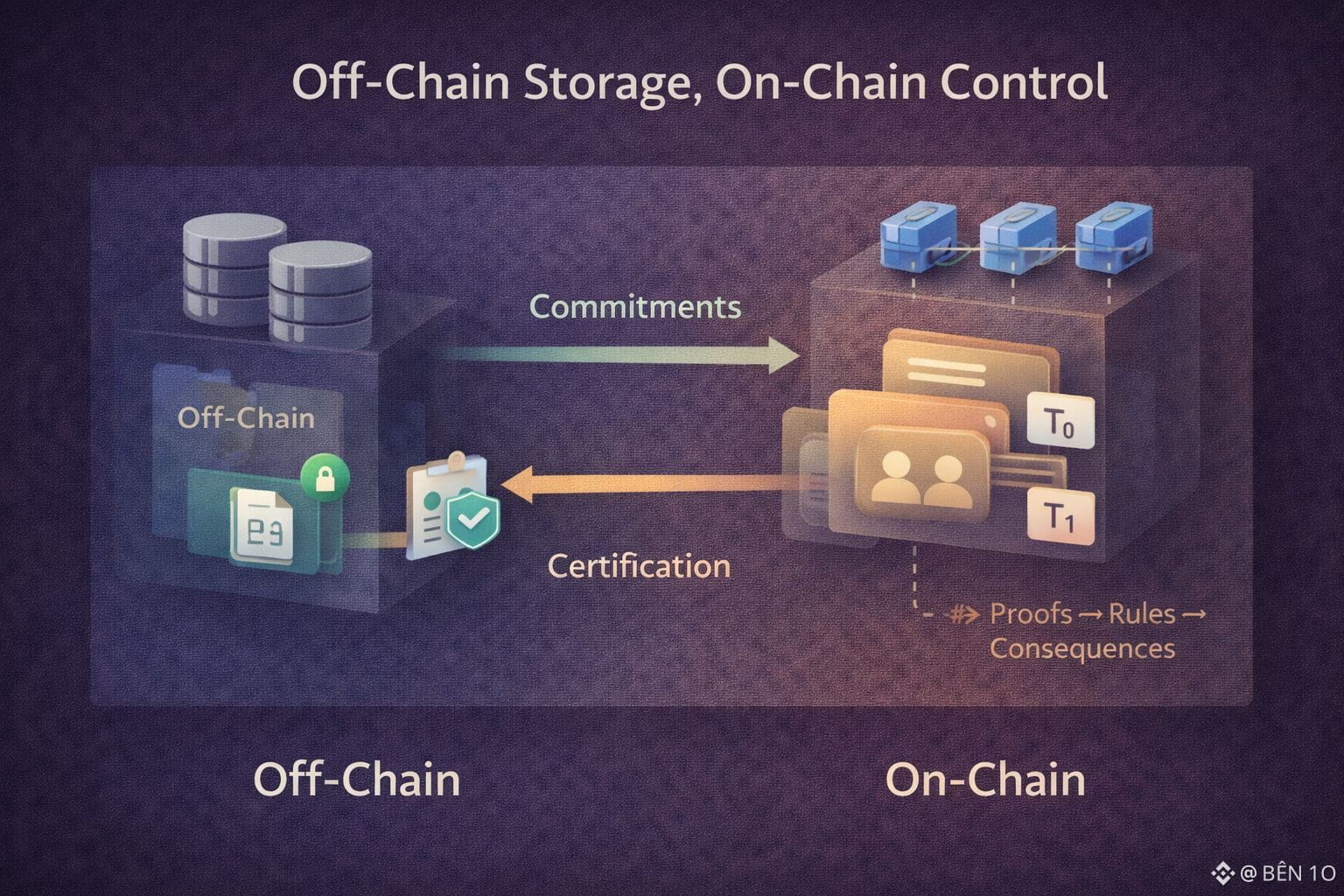
At a high level, Walrus separates concerns in a way traditional blockchains cannot. Large data lives off-chain, where it belongs. The blockchain specifically Sui acts as a control plane. It does not store files. Instead, it stores verifiable statements about storage: who is storing which data, during which time window, under which rules, and with what economic consequences if those rules are broken. This distinction matters. It turns storage from a background utility into a governed process.
Time is central to this model. Walrus does not treat storage as an indefinite promise. It treats it as a sequence of explicit epochs, each representing a bounded window of responsibility. Data is assigned, validated, and revalidated across these epochs. Nodes rotate. Committees change. Responsibilities are renewed or expire. Nothing about persistence is silent. This is a deliberate rejection of the common pattern in which data slowly degrades while the system continues to claim availability.
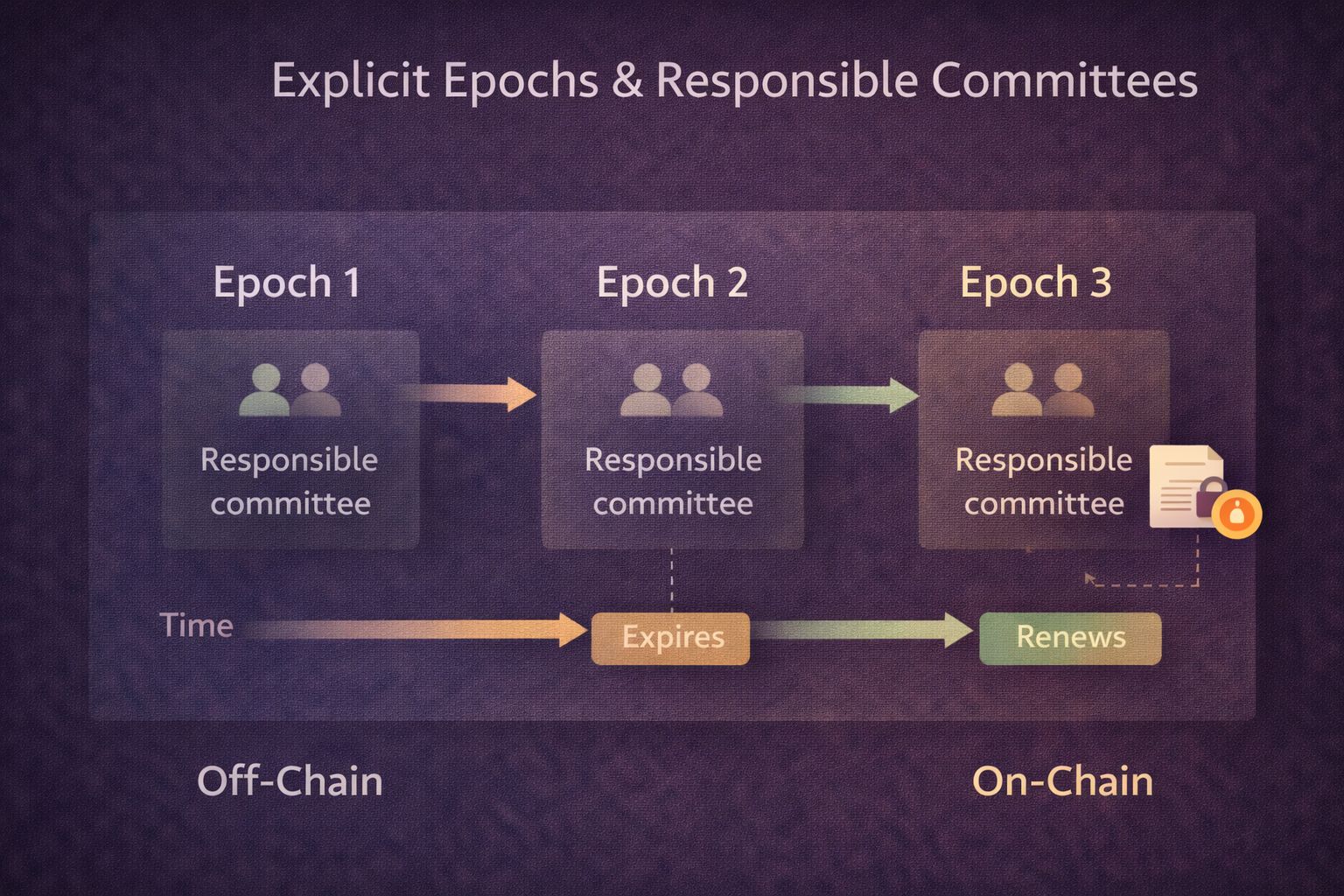 Why does this matter? Because real networks churn. Operators leave. Incentives shift. Hardware fails. In many decentralized systems, these realities are masked until something breaks. Walrus makes lifecycle management visible. Expiration is not failure; it is a first-class outcome. Rotation is not instability; it is how responsibility is redistributed without ambiguity. By acknowledging time as a design variable, the protocol avoids pretending that today’s guarantees automatically extend forever.
Responsibility in Walrus is not abstract. It is assigned. At any given epoch, committees are explicitly responsible for storing specific data. There is no ambiguity about who is accountable “right now.” This clarity is essential for serious applications. Ambiguous responsibility is tolerable for hobbyist systems. It is unacceptable for analytics pipelines, AI datasets, financial records, or media archives where correctness and provenance matter more than raw uptime.
The system’s notion of truth culminates in certification. In Walrus, a file does not become real when an upload finishes. It becomes real when the network publicly certifies its availability. Certification is a cryptographic and economic event recorded on-chain. It signals that the protocol has verified storage commitments and that downstream systems can safely rely on the data’s existence. This moment is critical because it gives applications a deterministic signal. Builders do not have to guess whether data is “probably there.” They can react to an explicit, verifiable state transition.
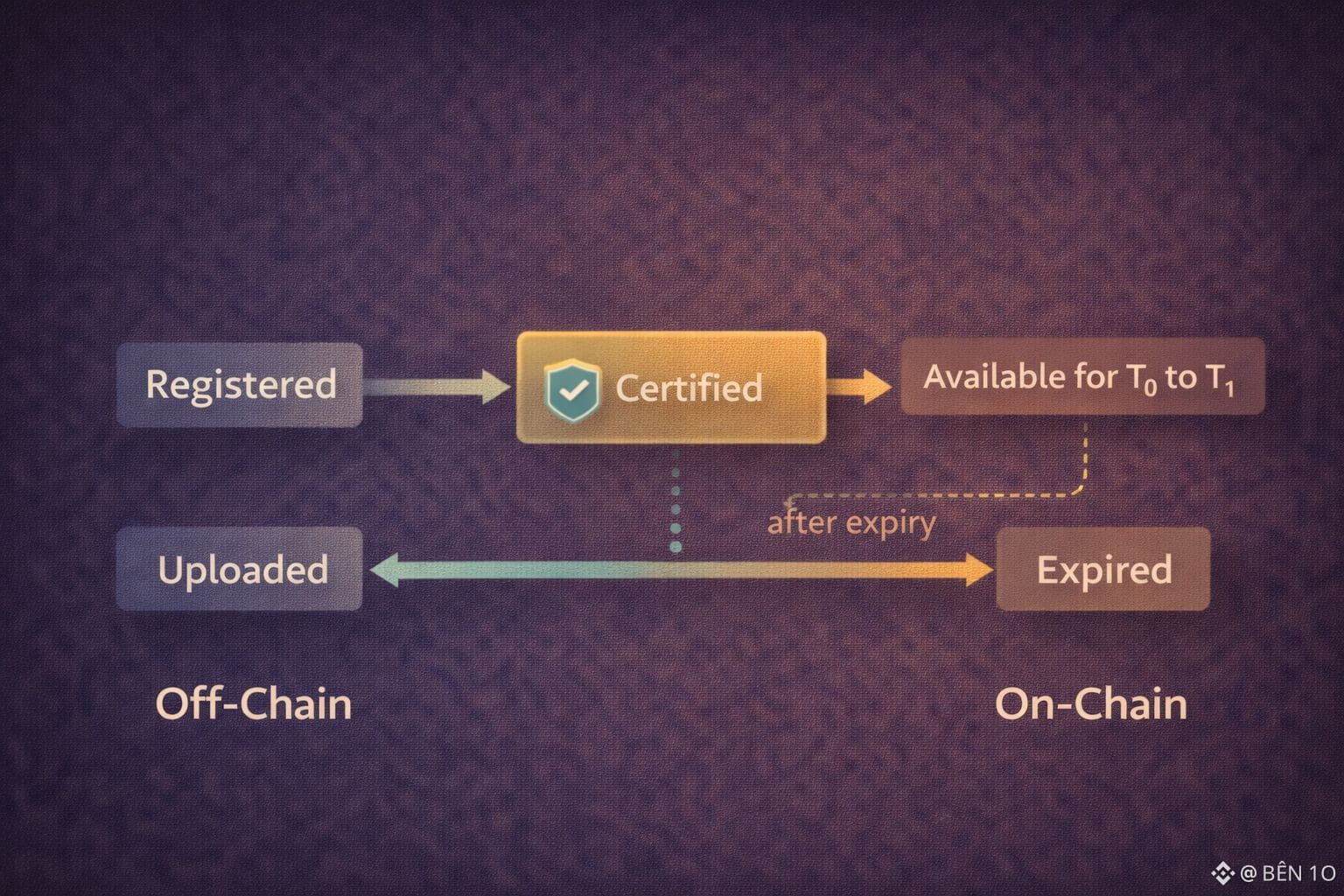 This framing enables a programmable blob model that treats storage as a transaction lifecycle rather than a fire-and-forget action. Data is registered, uploaded, certified, and then made available for a defined duration at a defined cost. Each stage produces observable state. Each state can be referenced by other contracts or off-chain systems. Storage becomes something applications can reason about, automate against, and audit.
Real-world network conditions are not ignored in this design. Walrus assumes asynchrony. Messages can be delayed. Nodes can behave adversarially. Perfect network assumptions are explicitly avoided because they produce fragile systems. To address this, Walrus relies on challenge mechanisms and authenticated data structures that protect against both malicious storage nodes and malicious clients. The goal is not just availability, but integrity under stress. Silent data corruption where data appears present but is wrong is treated as a more serious failure than temporary unavailability.
Getting things right matters way more than just staying online, especially when you’re dealing with loads of data. AI models whether you’re training them or running them need their datasets to stay the same over time. Analytics teams count on historical data not changing behind their backs. People working in finance or media want to know that the information they pull up today will be the same tomorrow. If it changes or disappears, they need to know immediately and clearly. In these fields, “mostly working” just doesn’t cut it. You need proof that everything is correct, every single time. That’s the bare minimum.
For builders, these design choices actually make life easier. Storage states are clear and machines can read them without guessing. Product logic doesn’t have to assume things went well it can just check if something’s really available. Automation gets a lot safer, too, since it runs off on-chain events instead of shaky guesswork. The user experience isn’t just about looking cool; it’s better because you can see and explain how things fail. If something expires, it does so out in the open. If something’s missing, you can point to the exact reason.
This approach sheds real light on how economic mechanisms work. When a token comes into play, it’s just there to help people coordinate and stake their commitment. It keeps everyone’s incentives and responsibilities in sync. That’s it it’s not some trick for growth. The system uses it to make sure contracts actually stick over time. And those economic penalties or rewards? They’re based on real, trackable actions not vague promises.
There’s a bigger takeaway here, even if it’s easy to miss at first. Once storage makes things like lifecycle, proof, and accountability visible, it stops being this nagging, uncertain piece of the puzzle. Developers don’t have to keep coming up with new trust models for every layer. They can finally build on storage that’s governed, trackable, and enforceable. That’s how infrastructure grows up not by piling on features, but by clearing out the guesswork.
Reliable systems are boring by design. They surface state transitions instead of hiding them. They make responsibility explicit instead of implicit. They treat time as a parameter to be managed, not an inconvenience to be ignored. Walrus demonstrates that decentralized storage succeeds not when it claims permanence, but when it provides measurable, verifiable guarantees that hold up under real conditions.
In that sense, the real achievement is not technical novelty. It is restraint. A refusal to promise infinity. A willingness to expose limits, lifecycles, and accountability. That is what makes decentralized storage safe to build on and what turns it from an idea into infrastructure.