

Today, we are going to Dusk Modular Structure and how its going to Build Future of Blockchain. So let's gets started.
The blockchain world faces a big challenge today. How can we have both privacy and compliance at the same time? Most blockchains choose one or the other. But Dusk Network found a smart solution through its modular architecture. Let me explain what makes Dusk special and why this matters for the future of finance.
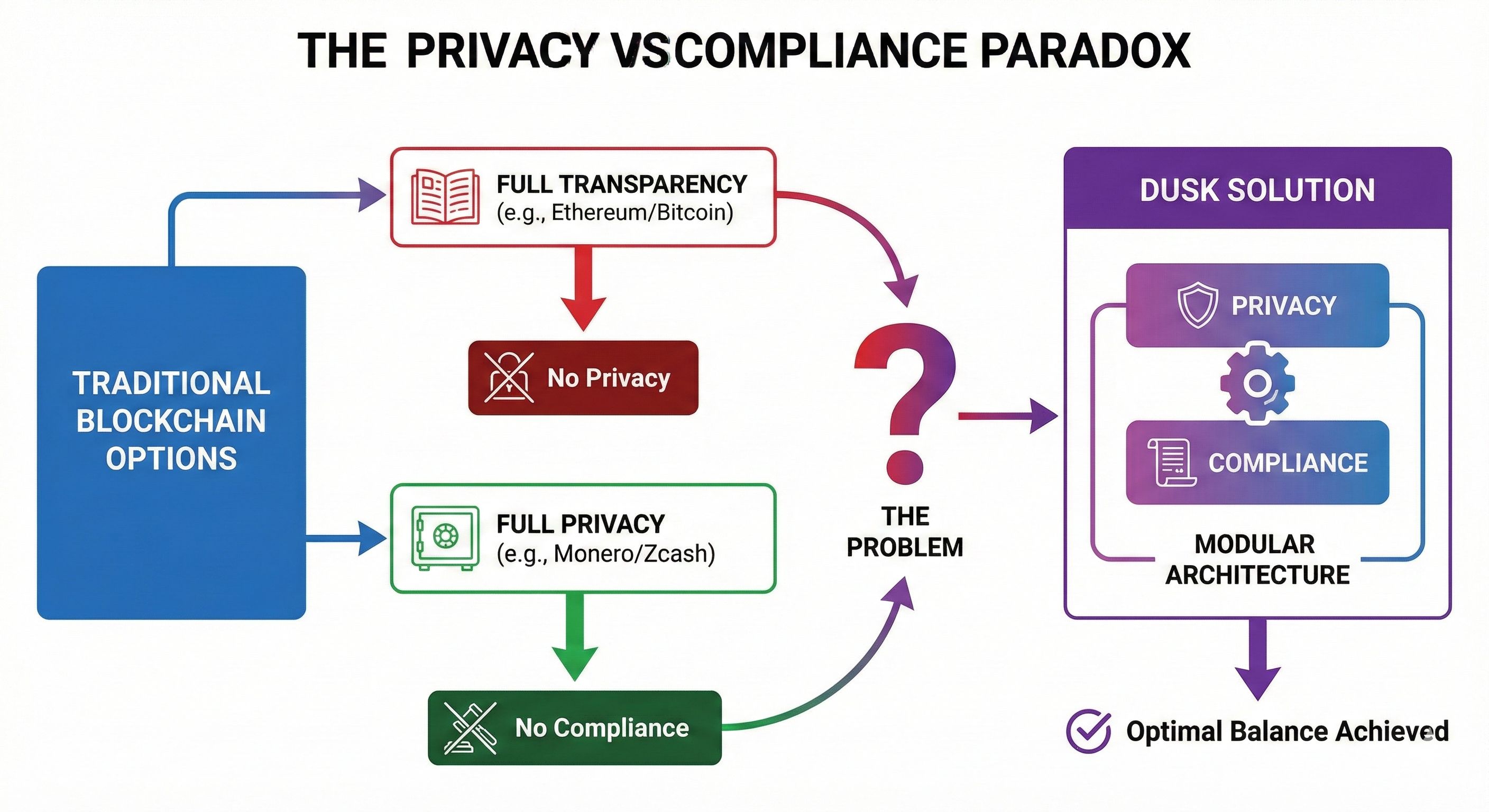
Traditional blockchains face a difficult choice between full transparency and full privacy. Blockchains offer full transparency where everyone can see all transactions. This is good for regulation and compliance but bad for privacy and business secrets. On the other hand, focused blockchains keep transactions completely hidden. This protects user privacy but regulators don't like it because they can't track illegal activities. This creates a privacy versus compliance paradox where financial institutions need privacy to protect business data, but regulators need transparency to prevent crime. Dusk asked a different question: what if we can have both?
Dusk built a modular blockchain to solve this problem. Modular means separating different functions into independent parts, like a factory assembly line where each station has a specific task. Traditional blockchains do everything in one layer including processing transactions, storing data, executing smart contracts, and verifying everything. Dusk separates these functions into different layers where each layer does its own job perfectly. This separation is the key innovation that allows privacy and compliance to work together.
The Dusk architecture has two main layers that work together but handle different responsibilities:
Layer 1: Dusk Protocol (The Base Layer)
Handles consensus (agreement on transactions)
Manages security and validation
Uses SBA (Segregated Byzantine Agreement)
Focuses on privacy and compliance
Layer 2: DuskEVM (The Application Layer)
Runs smart contracts
Compatible with Ethereum tools
Easy for developers to build apps
Connects to Layer 1 for security
This separation allows Dusk to maintain privacy at the foundation while giving developers familiar tools to build applications.
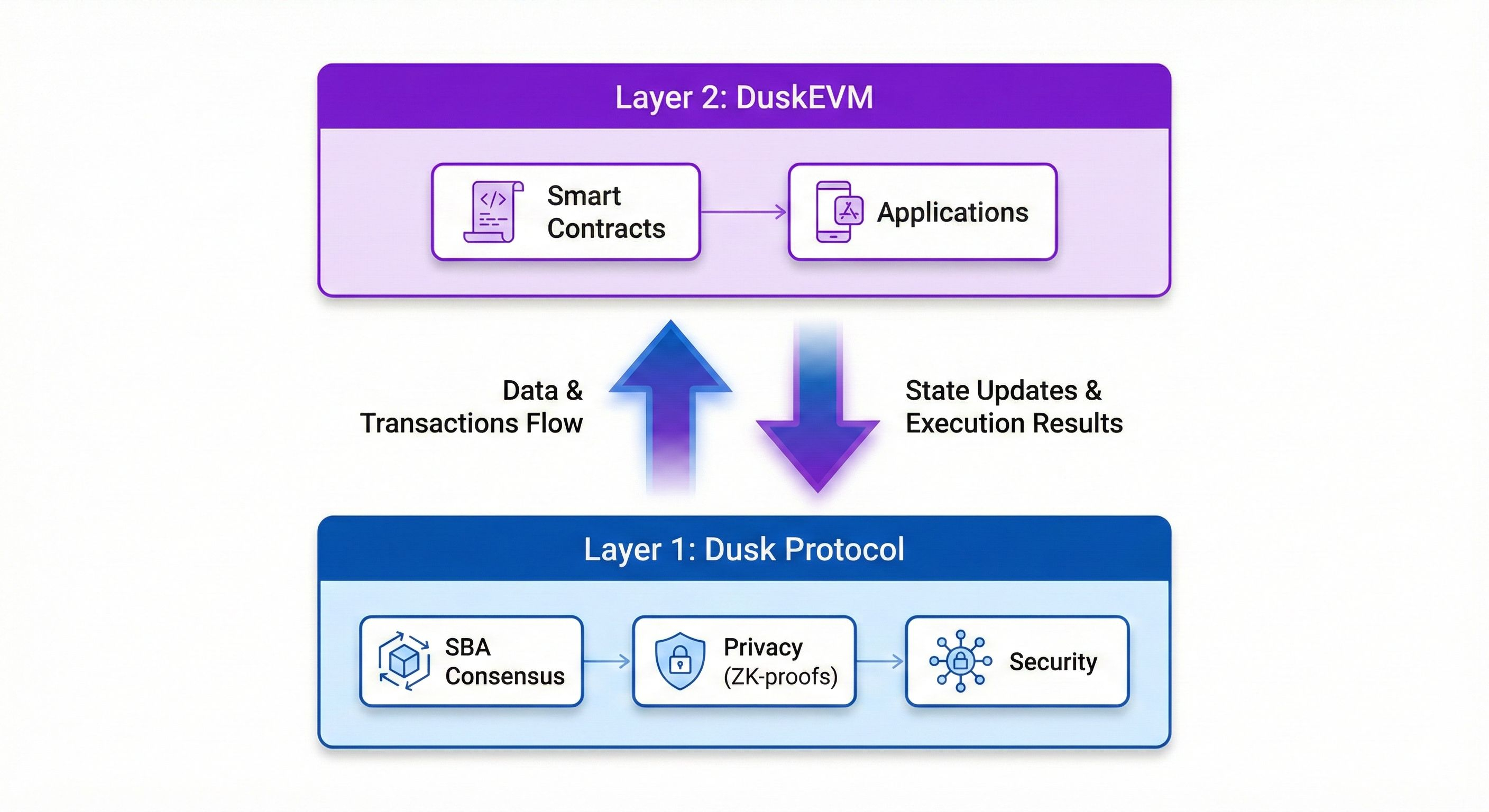
Understanding how consensus and execution work separately is important to see why this matters. When you make a transaction on Dusk, the process follows these steps. First, your transaction is encrypted to keep it private and goes to the consensus layer where validators check if it's valid. The Dusk Protocol Layer then uses SBA where validators agree on the transaction order, privacy is maintained using zero-knowledge proofs, and compliance data is recorded but kept encrypted. After consensus is reached, the transaction moves to DuskEVM where smart contracts execute the transaction, applications process the data, and results go back to Layer 1 for final recording.
By separating consensus from execution, Dusk achieves several important benefits:
Privacy happens at the base layer as a built-in feature
Compliance tools can audit when needed
Developers can build apps easily on DuskEVM
The entire system becomes faster and more secure
SBA (Segregated Byzantine Agreement) is Dusk's special consensus mechanism that makes this all possible. In blockchain, nodes which are computers on the network must agree on which transactions are valid. Byzantine Agreement means nodes can reach agreement even if some nodes are dishonest or broken. What makes SBA segregated is that Dusk separates validators into different groups with different roles:
Provisioners:
Stake DUSK tokens
Propose new blocks
Earn rewards for their work
Voters:
Validate the proposed blocks
Vote on correctness
Chosen randomly for security
This segregation creates multiple benefits including faster consensus because smaller voting groups work more efficiently, better security because random selection prevents attacks, more decentralization because anyone can participate, and energy efficiency because no mining is needed.
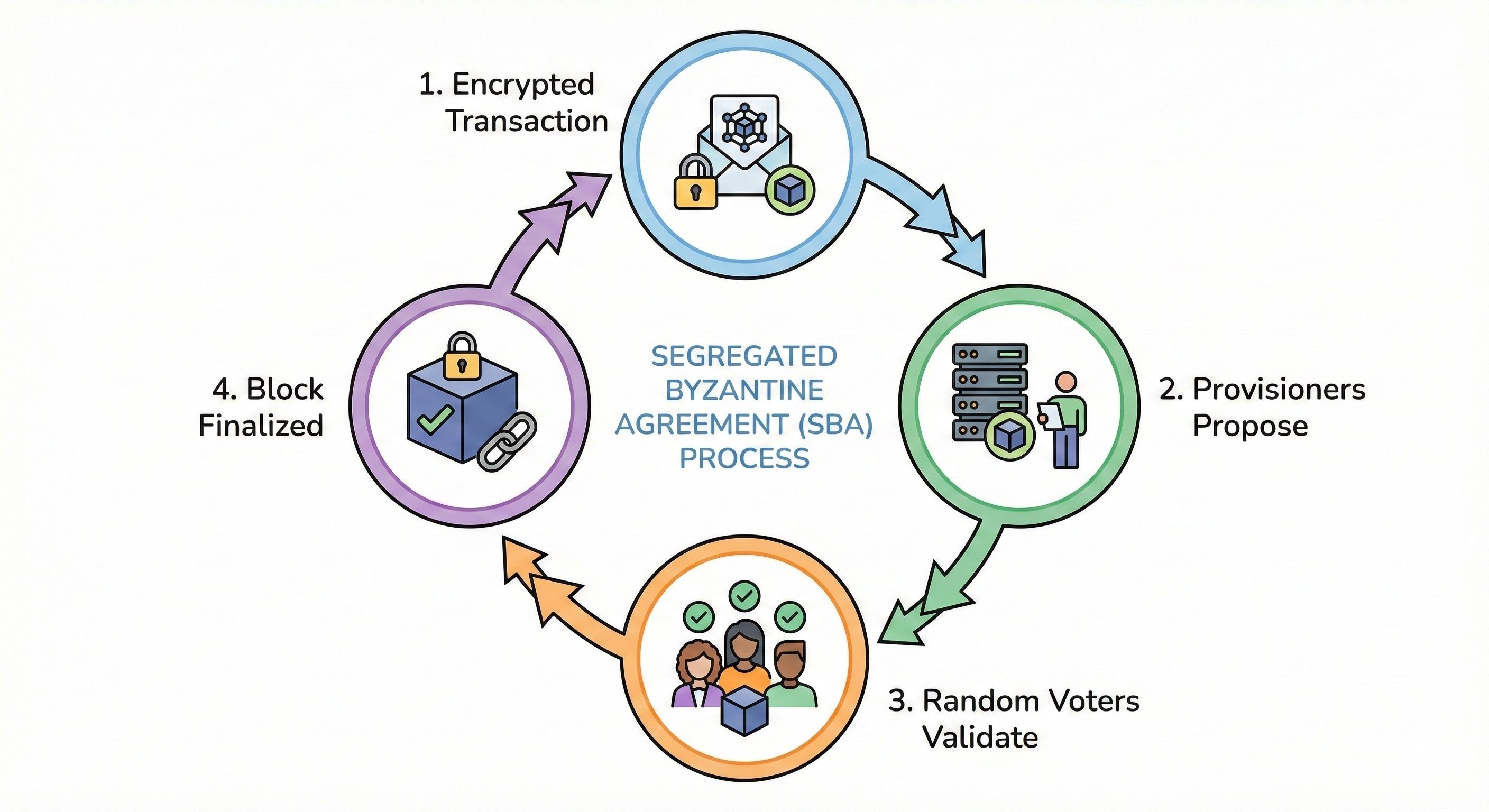
The clever part of SBA is that it works with encrypted data. Validators can verify transactions are correct without seeing the details by using zero-knowledge proofs, which is a mathematical way to prove something is true without revealing the information. For example, I can prove I have enough money to buy something without showing my bank balance to anyone. This allows Dusk to maintain complete privacy while still having a secure consensus mechanism that everyone can trust.
The real-world benefits of this modular design are significant for different types of users:
For Financial Institutions:
Client data stays private
Regulators can audit when legally required
Transactions are fast and cheap
Compliance is built-in rather than added later
For Developers:
Use familiar Ethereum tools like Solidity and MetaMask
Deploy standard smart contracts without learning new languages
Get Layer 1 security automatically
Access privacy features without extra coding
For Regular Users:
Financial data stays private
Transactions are secure and verified
Access to compliant DeFi applications
Protection from both hackers and unwanted surveillance
Most other blockchains cannot do what Dusk does because they were designed before regulation became important in the crypto space. They chose either public transparency, or full privacy. Adding privacy to transparent chains is very hard because their core design assumes everything is public. Adding compliance to private chains is even harder because regulators need some way to verify legal requirements are met. Dusk designed modularity from the beginning so privacy and compliance are core features built into the foundation, not features added on top.
Looking forward, modular architecture positions Dusk perfectly for the future of finance. Real world assets need both privacy and compliance to work properly. Institutions will not use fully public chains because their business secrets would be exposed. Regulators will not approve fully private chains because they cannot verify legal compliance. Dusk solves both problems at the same time. As tokenized securities, private DeFi, and institutional crypto continue to grow, Dusk's architecture becomes more valuable every day.
Dusk's modular architecture is not just technical innovation for the sake of being different. It is solving a real problem that blocks mainstream crypto adoption by traditional finance. By separating consensus from execution and using SBA for private validation, Dusk created something unique in the blockchain space: a platform that respects both your privacy and the law at the same time. For anyone building in regulated finance, real-world assets, or compliant DeFi, understanding Dusk's architecture is essential. This is how blockchain technology finally meets real world requirements and regulatory standards.
If you have any questions or feedback please let me know in the comments.
Disclaimer: This post is for informational purposes only. It is not financial or investment advice. Cryptocurrencies are volatile and risky. Always do your own research (DYOR) before making any decisions.