I remember trying to explain blockchain to a friend once, sitting across from each other in a café that smelled like burnt espresso and ambition. Five minutes in, their eyes drifted toward the window, the foam on their cappuccino collapsed, and I realized the problem wasn’t them. It was us. Blockchain, for all its brilliance, rarely knows how to talk like a human.
Most projects shout. They flex. They promise revolutions in ALL CAPS while quietly ignoring how real finance actually behaves. Real finance is cautious. Regulated. Slightly paranoid. And very, very allergic to chaos.
Dusk feels like it understood that from the beginning.
If most of crypto is a crowded room full of people pitching ideas over each other, Dusk is the quiet table in the corner where the serious conversation is happening. No spectacle. No hype theatre. Just a focused question it’s been asking since 2018: how do you move real financial infrastructure on-chain without turning sensitive data into public graffiti?
Because here’s the uncomfortable truth most blockchains dance around. Finance needs privacy. Not the shady kind. The grown-up kind. The kind where companies don’t broadcast their balance sheets to competitors, yet regulators can still verify what matters. Transparency and privacy aren’t enemies in the real world—they coexist. Most chains pick one and pretend the other doesn’t exist. Dusk refuses to play that game.
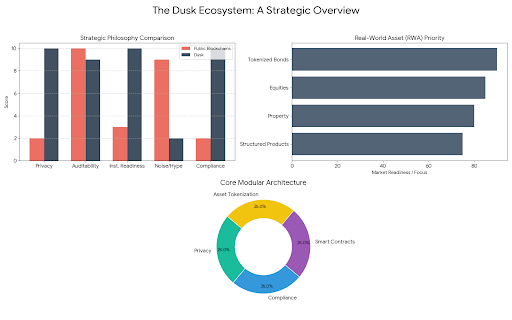
At its core, Dusk is a Layer 1 built specifically for regulated finance. Tokenized securities. Institutional DeFi. Markets that don’t implode the moment compliance enters the chat. Privacy isn’t bolted on as a feature—it’s woven into the architecture, right alongside auditability. Think less “black box,” more “curtains that open when they’re supposed to.”
Here’s the mental image that makes it click for me. Public blockchains can feel like pinning your bank statements to a city notice board. Sure, everything is transparent—but no serious institution would agree to that. Dusk aims for something more realistic: statements locked in a drawer, with receipts, proofs, and timestamps ready the moment an auditor asks. Nothing hidden. Nothing exposed unnecessarily.
This philosophy carries through its modular design. Dusk isn’t rigid or monolithic. It’s more like a carefully organized workshop—components for privacy, compliance, smart contracts, and asset tokenization that can be assembled without tearing the whole system apart. For institutions that value predictability over fireworks, this matters far more than headline TPS numbers.
Someone I once worked with in traditional finance said, “We don’t hate innovation. We hate chaos.” That sentence explains Dusk better than most whitepapers ever could. It doesn’t try to bulldoze existing systems. It meets them halfway, translating blockchain into a language banks, exchanges, and regulators can actually tolerate.
The real-world asset angle is where this approach really earns its keep. Tokenized bonds, equities, property, structured products—these are no longer sci-fi ideas. They’re inching toward reality. But the challenge isn’t just technical. It’s legal, reputational, and deeply human. Nobody wants sensitive deal terms immortalized on a public ledger forever. Dusk’s privacy-first design makes those conversations possible without everyone holding their breath.
What’s almost refreshing is how understated the project remains. No grand claims of replacing global finance by next week. No meme-fuelled hype cycles. Just steady progress, partnerships that make sense, and a stubborn commitment to doing one hard thing properly.
That doesn’t mean the road is easy. Regulated finance moves slowly. Painfully so. Trust is earned in years, not threads. Liquidity doesn’t magically appear. And privacy—no matter how responsibly implemented—will always invite scrutiny. But maybe that’s the cost of building something meant to last, not just trend.
If you’re here for fireworks, Dusk might feel quiet. Almost too quiet. But if you care about how blockchain actually seeps into the real world—into banks, legal frameworks, exchanges, and the unglamorous plumbing of finance—it’s worth paying attention.
Because sometimes the most important ideas aren’t shouted across the room. They’re shared over a second cup of coffee, voices low, intentions clear, and reality firmly in view. That’s where Dusk operates. And honestly, that’s probably where the future of finance belongs.