

@Walrus 🦭/acc Running a storage node used to feel like a weird little side quest—some terminal commands, an old box humming in the corner, and this quiet conviction that decentralization would matter one day. Lately it feels different. The conversation has shifted from “does decentralized storage work?” to “can it carry real workloads without turning into a fragile, expensive science project?” Walrus has been pulled into that shift because it keeps inviting practical scrutiny. In February 2026, the project described a Sui archival system that stores the network’s checkpoint history on Walrus and publishes it publicly, treating history as shared infrastructure instead of a private database.
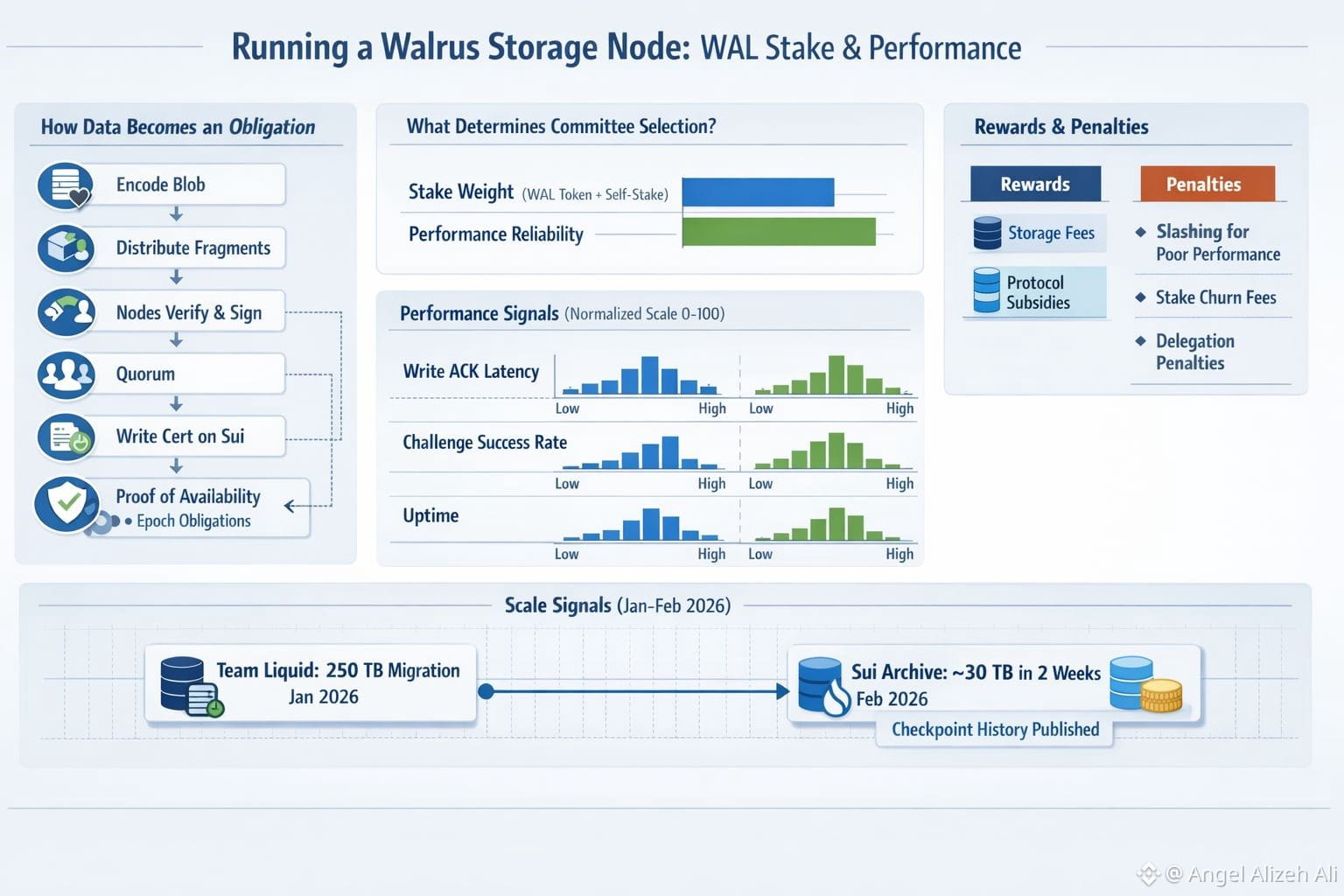
If you’re considering a Walrus storage node, internalize this: your job is not only to store bytes. You’re competing to be trusted with them. Walrus uses delegated staking, where WAL token holders can delegate to node operators and nodes compete to attract stake. That stake weight influences which nodes join the active storage committee for an epoch and, in turn, which operators end up holding the network’s fragments of data. In the whitepaper’s framing, nodes compete for stake and that competition governs assignment, while delegators look at reputation, commission rates, and the operator’s own staked capital.
Stake, though, is not a substitute for doing the work. Walrus leans on the idea that availability should be provable, not assumed. After a blob is encoded and distributed, each node verifies what it received and signs an acknowledgement; a quorum becomes a write certificate, and publishing it on Sui creates the Proof of Availability that marks the official start of the storage obligation. From there, rewards flow at epoch boundaries to active storage nodes and to the people who delegated to them, funded by user storage fees and protocol subsidies designed to bootstrap early network participation.
That’s where performance becomes a daily discipline. Uptime matters, but so does how your node behaves under pressure: how quickly it acknowledges writes, how reliably it responds when challenged to prove it still holds the right fragments, and how often it drops out when bandwidth spikes. Walrus’s own design documents talk about committees evolving between epochs and rewards tied to behavior and reliability, and the whitepaper is blunt that nodes are rewarded or punished based on their actions throughout an epoch, including correctly answering challenges. Incentives matter, but operations are where trust is earned. There’s a quiet fairness in that. It doesn’t care about your narrative; it cares about your evidence.
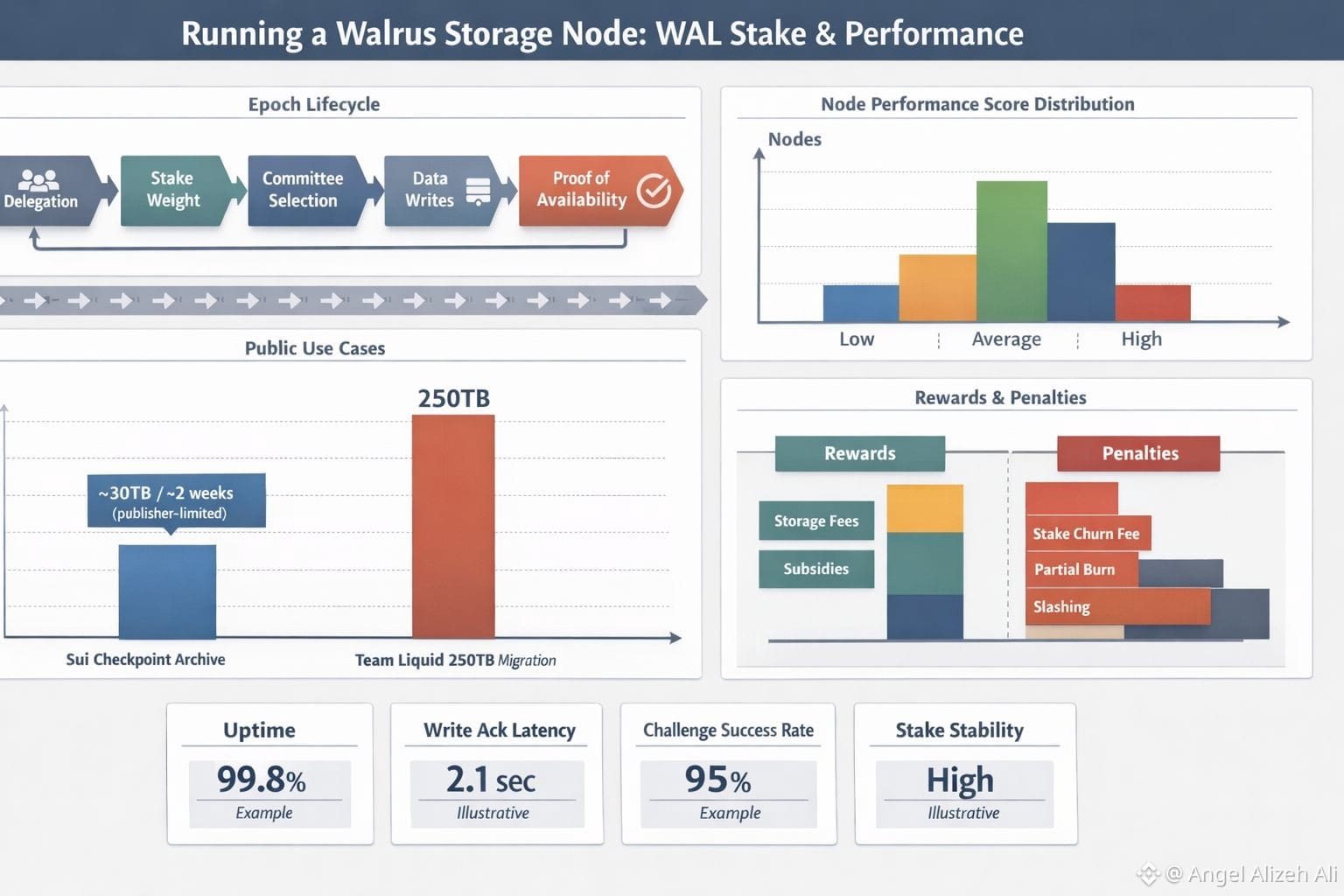
WAL stake also interacts with performance in ways that are easy to miss if you only stare at reward estimates. Stake shifts are not free. Walrus explicitly treats short-term, noisy stake movements as a cost to the network because they can require expensive data migration, and it outlines penalty fees with partial burning to discourage that churn. It also anticipates slashing for low-performing nodes, and even frames “staking with low performant storage nodes” as something that can be penalized. That makes delegation feel less like passive income and more like an ongoing judgment call about operator quality.
So why is this topic trending now, beyond the usual token chatter? Because examples are getting bigger and more public. In January 2026, Walrus announced that Team Liquid was migrating a 250TB archive of match footage and brand content onto the protocol. Whether you care about esports or not, that scale forces uncomfortable questions about retrieval paths, global access patterns, and what happens on a bad day when users are angry and latency is visible. And in the Sui archive write-up, Walrus said the initial process published roughly 30TB over a couple of weeks without a throughput bottleneck, with speed bounded by the publisher’s environment. Those are the kinds of details that pull attention toward operators, stake, and the unglamorous mechanics of staying online.
Running a storage node, in the end, is a commitment to being predictable. WAL stake gets you into the room and gives the network a way to quantify who is trusted with responsibility. Performance is what keeps you there, and it’s what makes the whole idea worth defending when the novelty wears off.