You know how most crypto projects feel like they're shouting at you? Like they're trying to convince you they're the next big thing before you can even ask what they actually do?
I want to tell you about one that doesn't do that. It just... builds. Quietly. While everyone else is losing their minds over meme coins, this small team is making something that actually makes sense.
It's called @Vanar . And honestly? It might be the most interesting thing in crypto right now that nobody's talking about.
So what is it, really?
so picture a gaming company called Virtua. They spent years building virtual worlds, watching how people actually use digital spaces. And they kept hitting the same wall: blockchains are dumb. Like, really dumb. They can store that you bought something, but they have no idea what you bought or why.
So in late 2023, they did something kind of crazy. They scrapped everything and started over. Not a rebrand—an actual rebuild.
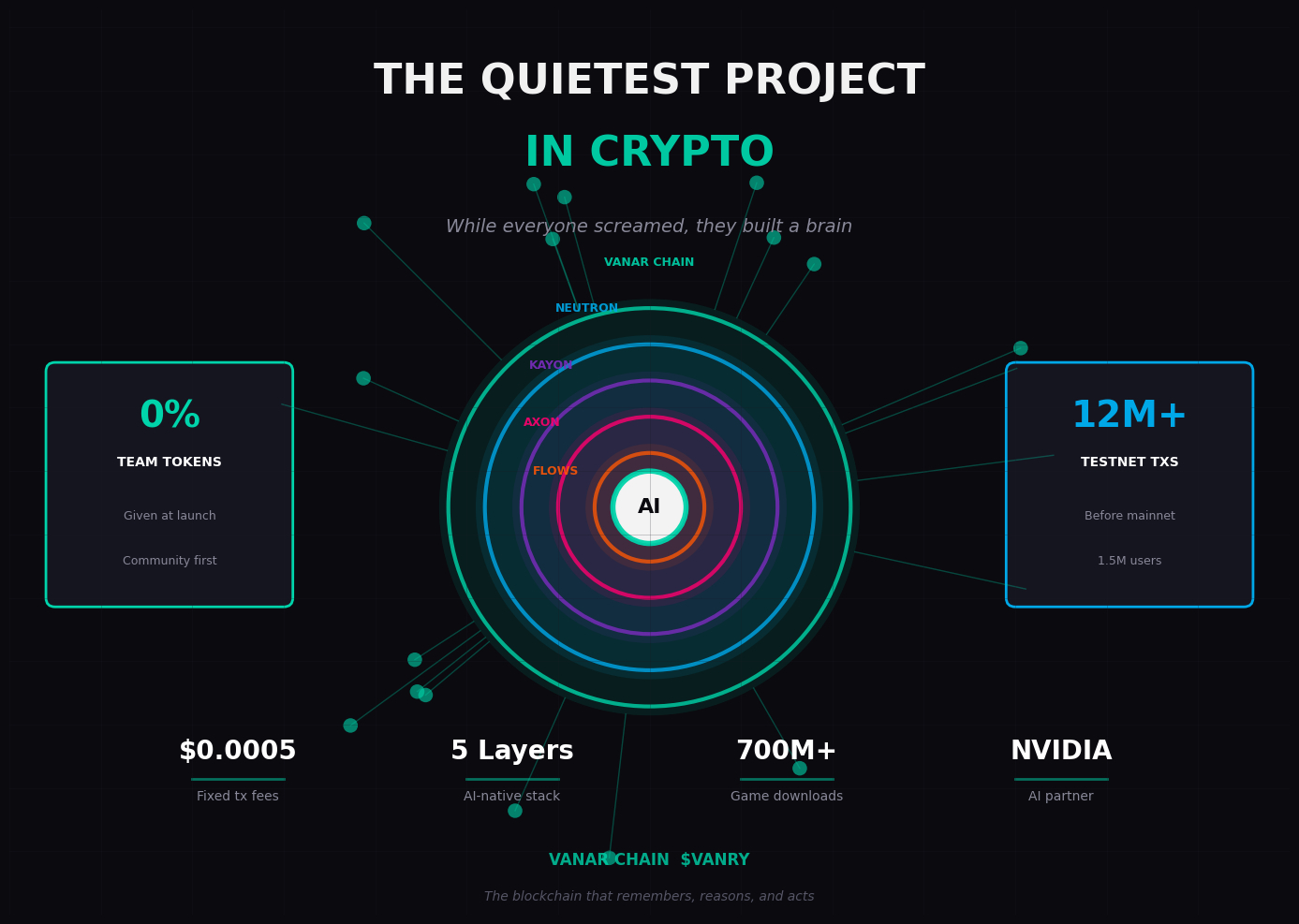
What they made isn't just "Ethereum but faster." It's five layers stacked together like a brain. The bottom layer handles transactions, sure. But layer two, called Neutron? It turns files into something alive. Documents become "Seeds"—compressed, intelligent units that AI can actually read and understand. A PDF isn't just a PDF anymore. It's something you can query, like asking a person questions.
Then there's Kayon, the reasoning layer. You can literally ask it things in English. "Show me everyone who voted against the last proposal but staked tokens anyway." And it gets it. It doesn't just dump data on you. It understands what you're asking.
The whole thing is designed so AI can run on-chain—verifiable, transparent, not locked in some company's server.
Why does this matter to actual humans?
Here's the thing nobody talks about. Right now, AI is powerful but it's a black box. You put your data in ChatGPT, you have no clue what happens to it. You can't verify anything. You don't own it.
And blockchains? They're transparent but blind. They see everything and understand nothing.
#Vanar sits in this weird, interesting middle space. Imagine games where characters actually remember you—not because some developer scripted it, but because the AI learned you. Or financial tools that explain their decisions in plain English and you can audit exactly how they reached that conclusion.
For regular people who don't care about crypto ideology, it means apps that just work better. Faster. Cheaper. Smarter. Transactions cost about 0.0005, fixed. You can actually buy something for a dollar without the fee eating half of it.
The token situation
They call it $VANRY. 2.4 billion exist, that's it. But here's what got me: the team gave themselves zero tokens at launch. Zero. I had to read that twice. In an industry where founders routinely grab huge chunks for themselves, these guys said "nope, community owns this."
You use VANRY to pay for stuff on the chain, stake it for 8-15% returns, and vote on decisions. Next year, you'll need it to access the premium AI features. Real utility, not just speculation.
Who's actually building on this?
Worldpay—the massive payment company—uses it to resolve disputes. NVIDIA partnered with them. Google Cloud runs their infrastructure. Gaming studios with 700 million combined downloads are building here.
Before mainnet even launched, 1.5 million people made 12 million transactions on their testnet. That's not hype. That's people actually showing up to use it.
The messy parts
I should be honest about the risks. Scaling AI on-chain is hard. Really hard. They've proven it works, but can it handle millions of daily users? That's the big test.
Competition is brutal. Other gaming chains got there first. Solana and Ethereum have way bigger ecosystems. And regulation? When you mix AI and blockchain, you hit every legal gray area at once.
The token price swings wildly too, like everything in crypto. The team ignores it and keeps building, but that volatility shakes people.
What I keep thinking about
Most crypto projects feel like they're running from something—chasing the next trend, pivoting to whatever's hot. Vanar feels like it's running toward something specific.
They're not trying to be the fastest. They're trying to be the smartest. In a world where AI is taking over everything but nobody trusts it, they're building the infrastructure that could make AI actually trustworthy—verifiable, ownable, transparent.
Maybe it works. Maybe it doesn't. But in a space full of noise, there's something refreshing about a team that just keeps their head down and builds something meaningful.
That's Vanar. Worth knowing about, even if it's not worth YOLOing your rent money into.