

Blockchains are trusted because they agree on the present. But trust in the present is not enough. Real-world systems markets, governance, audits, risk engines depend on the past. They require the ability to independently prove what happened at a specific moment in time.
That is where the Walrus-powered Sui Archival system steps in not as a storage experiment, but as shared infrastructure for verifiable history.
This system treats blockchain history not as leftover exhaust from nodes, but as a first-class, community-supported public good.
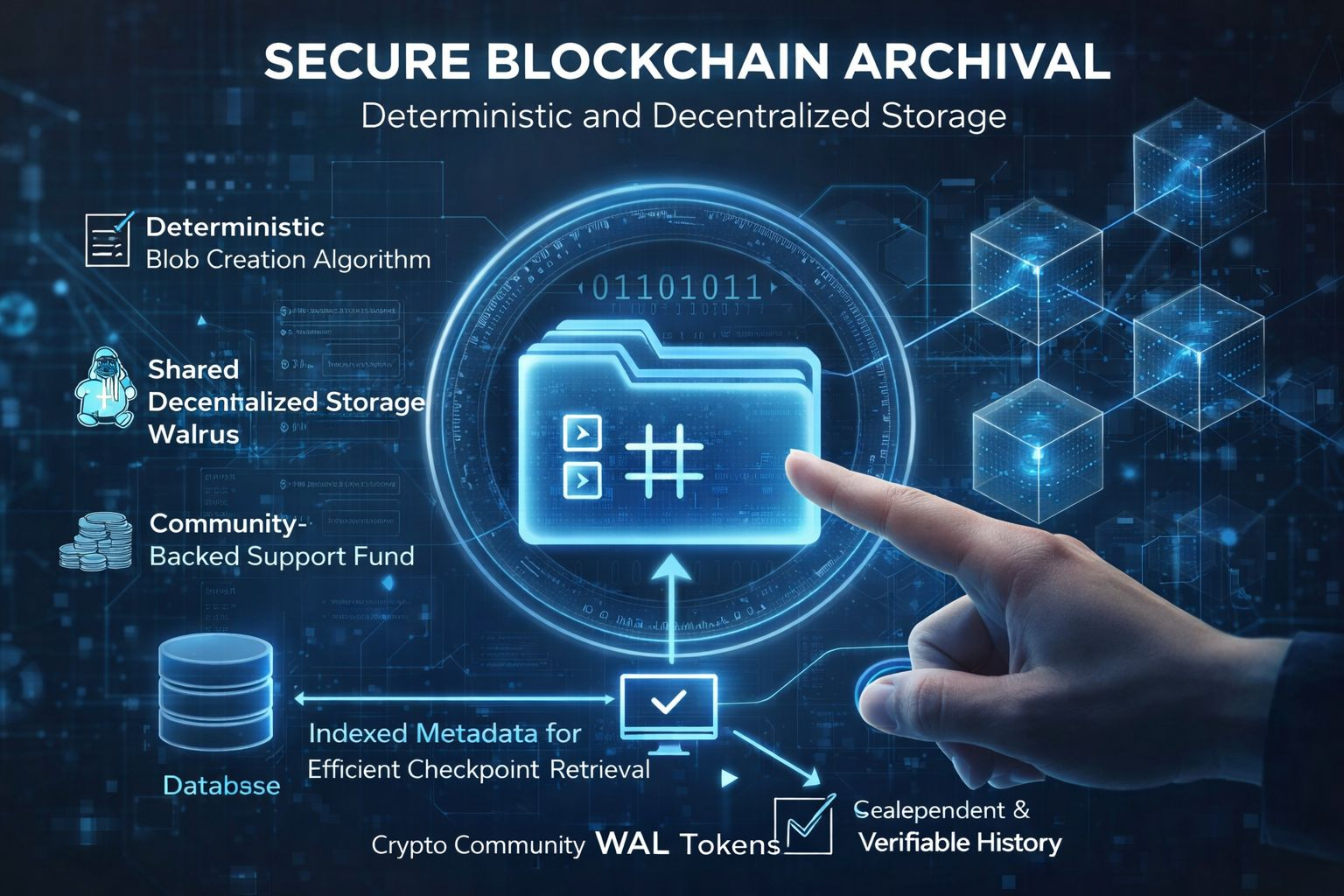
The Problem: Execution vs. Long-Term Proof
As networks scale, historical data often becomes fragmented. RPC providers optimize for performance. Indexers specialize in queries. Infrastructure providers prune older states. Over time, historical checkpoints may exist but not in a way that guarantees independent reproducibility.
This creates a subtle but critical gap:
“It executed” vs. “It can still be independently proven later.”
For financial systems, governance records, liquidation events, and compliance audits, that gap is unacceptable.
The Sui Archival system closes it by publishing checkpoint history continuously to Walrus, where it becomes resilient, publicly accessible, and independently verifiable.
Architecture Overview: Deterministic by Design
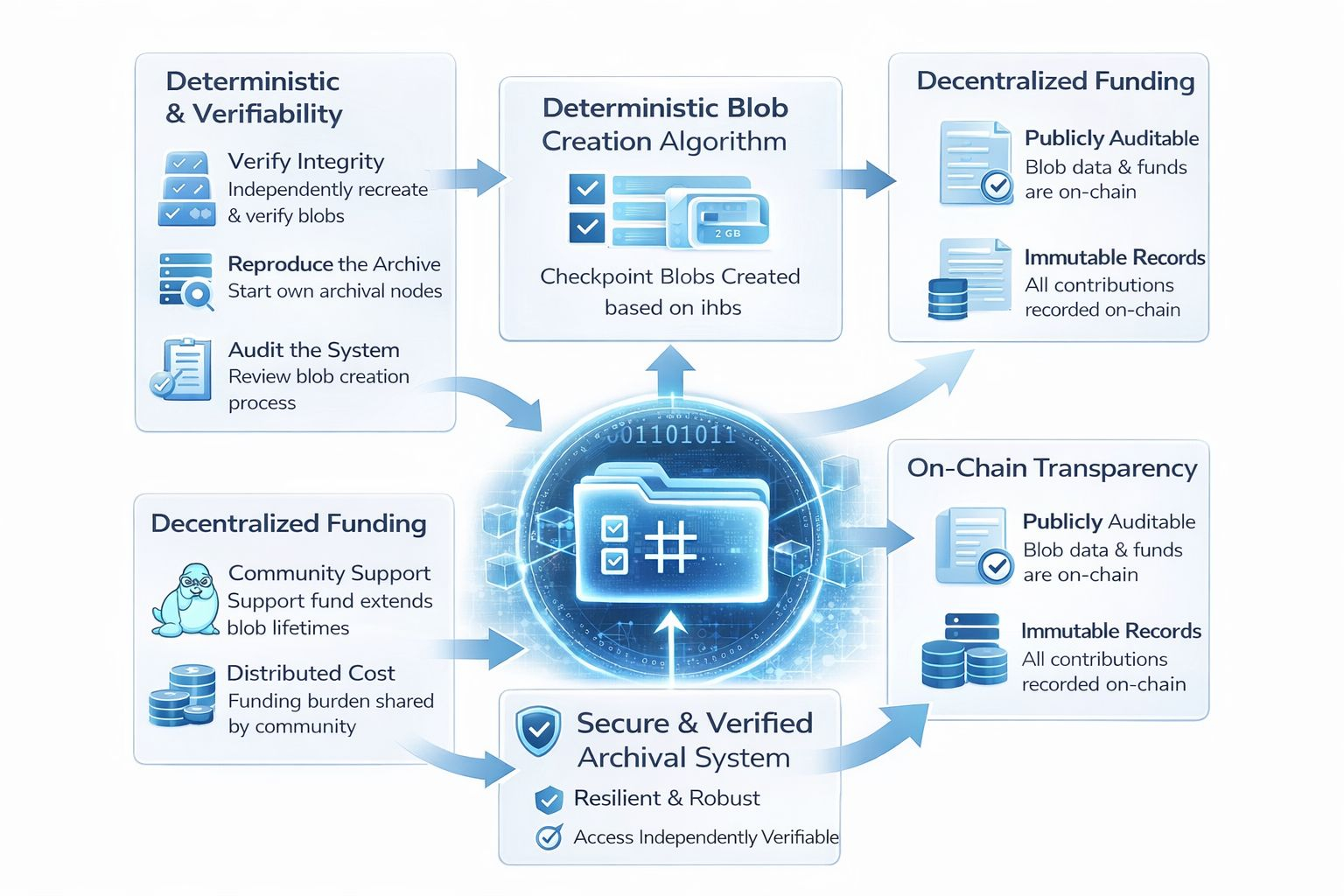
The system is built around a deterministic blob creation algorithm. This is not a cosmetic feature it is the backbone of verifiability.
Checkpoint blobs are created when any of three conditions are met:
A predefined checkpoint count threshold is reached
A size threshold (in GB) is exceeded
An end-of-epoch checkpoint is encountered
Because the algorithm is deterministic, identical inputs always produce identical blobs. This has powerful implications:
Anyone can recreate the blobs independently
Integrity can be verified without trusting the original publisher
Archival nodes can reproduce the full dataset
Determinism transforms storage from “we stored it” into “you can verify we stored it correctly.”
Blob Storage, Indexing, and Efficient Retrieval
Once a blob is created, it is uploaded to Walrus. But storage alone is not enough retrieval efficiency matters.
Each blob includes an index that maps checkpoint numbers to specific byte ranges. That means clients do not need to download entire blobs to retrieve a single checkpoint. Instead, they fetch only the relevant segment.
The read path is intentionally minimal and non-intrusive:
The local database identifies which blob contains a requested checkpoint
Walrus serves the corresponding byte range
This separation ensures that read operations do not interfere with ingestion or archival logic. The system remains scalable and highly available even under heavy query loads.
Blob Lifetime Extension: Community-Supported Permanence
Data longevity is handled through a blob extender component that scans blobs nearing expiration and extends their lifetime automatically.
What makes this model unique is the shared blob functionality. Community members can contribute WAL tokens into a shared fund governed by a Move smart contract on Sui. These funds are used exclusively to extend blob lifetimes.
This creates:
Distributed responsibility — no single entity bears full archival cost
Community ownership — anyone can support long-term preservation
Transparency — all contributions and extensions are recorded on-chain
It is archival infrastructure funded and sustained by its users.
Metadata Snapshots and Service Independence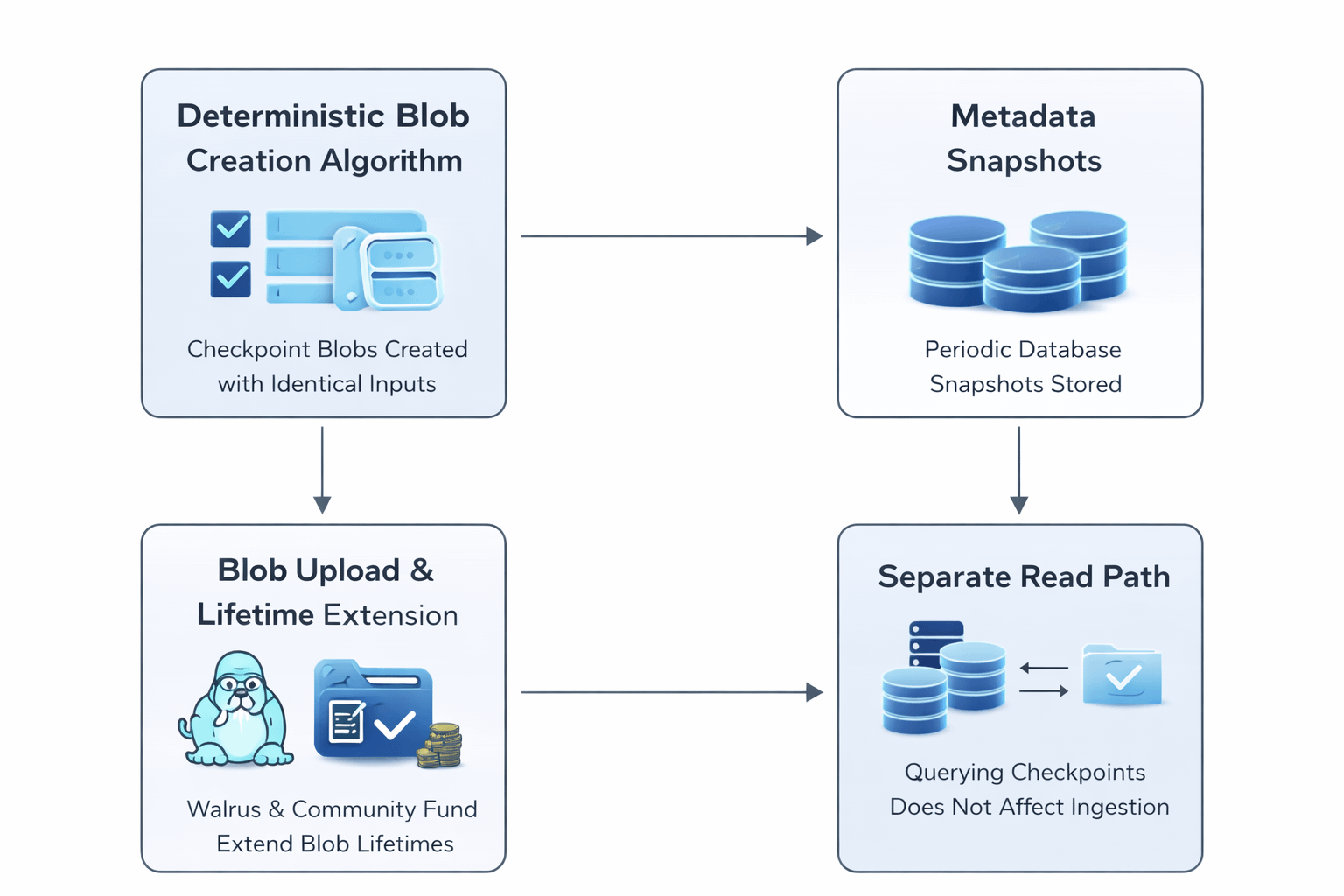
To avoid reliance on any single hosting provider, the system periodically snapshots its database and stores metadata blobs on Walrus.
If an application instance fails, the metadata blob can be fetched from Walrus and used to rebuild the database from scratch.
This achieves:
Service independence
Infrastructure portability
Reduced data loss risk
The archive does not depend on one server, one company, or one region. It becomes reconstructable anywhere.
Scale and Real-World Operation
This is not a theoretical blueprint. The initial archival process published roughly 30TB of Sui checkpoint data to Walrus within weeks.
The upload throughput was not limited by the storage network. It was bounded by the client environment, demonstrating that the approach scales with publisher capabilities rather than network bottlenecks.
Storage costs for the full dataset were measured in WAL tokens, with blobs distributed across multiple epochs and backed by default redundancy.
The takeaway: archival at scale is operationally feasible.
Blueprint for Verifiable History
Although built for Sui, the underlying pattern applies broadly. Any blockchain or DeFi protocol that depends on historical data faces similar risks:
Order book disputes
Oracle price verification during liquidations
Governance artifact review
Parameter change audits
Treating historical data as shared infrastructure — rather than a side effect of node operation — changes the trust model entirely.
With deterministic blob creation, decentralized storage, shared funding, indexed retrieval, and metadata portability, the Walrus Sui Archival system delivers:
Public availability
Independent verifiability
Resilience against provider failure
Community-backed permanence
Conclusion
The Walrus Sui Archival application demonstrates a mature shift in blockchain thinking. Execution finality is only half of the equation. The other half is reproducible history.
By combining deterministic algorithms, decentralized storage, shared blob extension funding, and metadata resilience, the system eliminates single points of failure and makes historical data auditable forever — not just while a provider chooses to maintain it.
In a world where trust depends on being able to look back with certainty, this architecture turns blockchain history into something stronger than memory.
It turns it into shared, verifiable infrastructure.

