
1. Project Overview
Name: HashKey Exchange
Domain: https://www.hashkey.com/
Sector: Regulated Digital Asset Exchange / Web3 Financial Infrastructure / Institutional Market Access
Core Thesis: HashKey Exchange represents a structurally distinct class of crypto infrastructure—a fully licensed, compliance-first digital asset exchange designed to abstract regulatory, custody, and market-access complexity for both professional and retail participants. Rather than competing on speculative velocity, HashKey positions itself as regulated market plumbing for Asia's Web3 capital markets, serving as a compliant gateway between traditional financial capital and on-chain assets.
Protocol Vision: To enable regulated participation in digital asset markets while preserving institutional standards of custody, execution quality, and risk management. The platform operates with a clear compliance-first expansion strategy rather than pursuing regulatory arbitrage.
Stage: Fully operational with dual-entity structure:
HashKey Exchange (Hong Kong): SFC Type 1 (Dealing in securities) and Type 7 (Providing automated trading services) licensed, serving retail and professional investors HashKey Group
HashKey Global (Bermuda): Bermuda Monetary Authority (BMA) Class F Digital Asset Business License, serving global users (excluding US, China, Hong Kong) HashKey Global
Team and Origins: HashKey Exchange operates as the flagship business of HashKey Group, founded in 2018 with long-term strategy centered on regulation-first expansion. The group maintains operations across Hong Kong, Singapore, Japan, Bermuda, and Dubai, with Chairman and CEO Dr. Xiao Feng leading the organization HashKey Group.
2. System Architecture and Market Abstraction Design
HashKey Exchange employs a sophisticated architectural model that prioritizes regulatory compliance and institutional-grade infrastructure over pure technical innovation.
Core Architectural Components:
Asset Access Abstraction Layer: The platform shields users from direct on-chain complexity through:
Segregated Custody: 98% of assets in cold storage with institutional-grade insurance protection HashKey Exchange
Compliance Integration: Native integration of KYC/AML procedures directly into the trading workflow
Banking Connectivity: Partnerships with traditional banks (ZA Bank, Victory Securities) for seamless fiat on/off-ramps HashKey Pro
Execution Engine: Centralized matching engine with regulatory-compliant risk controls, offering:
API-First Design: REST, WebSocket, and FIX protocol support for institutional connectivity HashKey Global API
Omnibus Account Structure: Enables licensed brokers to aggregate client trading while maintaining individual compliance HashKey Pro
Comparative Analysis:
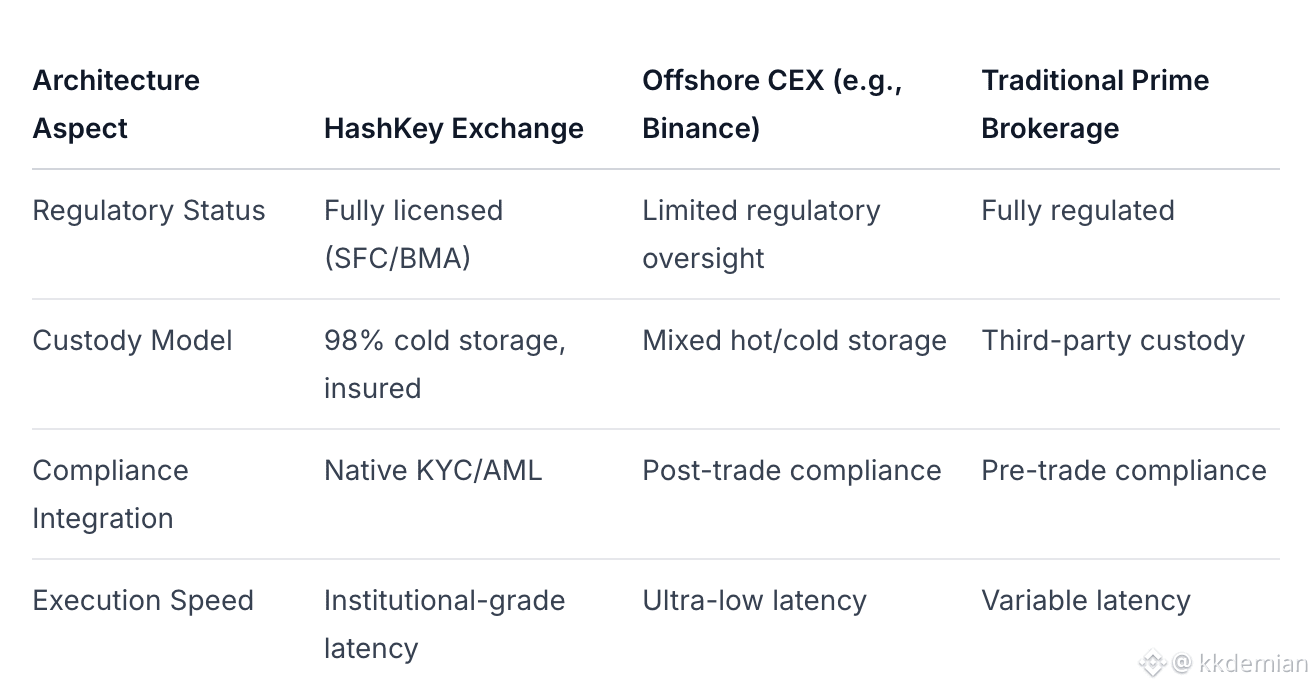
Verdict: HashKey operates primarily as a regulated digital asset marketplace with strong elements of compliance abstraction layer. The architecture reflects traditional financial market structure adapted for digital assets, rather than attempting to reinvent market microstructure.
3. Asset Design, Custody Model, and Capital Connectivity
HashKey's asset framework prioritizes regulatory compliance and institutional safety over innovation velocity.
Asset Listing Standards: Stringent SFC-mandated criteria requiring:
12-month operational track record for tokens
Inclusion in two independent market indices
Comprehensive due diligence on technology, team, and legal status SUI Listing Analysis
Custody Architecture:
Segregated Accounts: Client funds held separately from operational assets
Cold Storage Dominance: 98% of assets in cold storage with military-grade protection
Insurance Coverage: 100% hot wallet insurance + 50% cold wallet coverage
Certifications: ISO 27001 (Information Security) and ISO 27701 (Data Privacy) certified HashKey Exchange
Fiat Connectivity: Integrated banking partnerships with:
ZA Bank: Direct integration for Hong Kong dollar services
Multiple Currency Support: USD, HKD, USDC trading pairs
Global Banking Network: Coverage across 32 countries and regions HashKey Quarterly Report
Trade-off Analysis: The compliance-first approach introduces specific trade-offs:
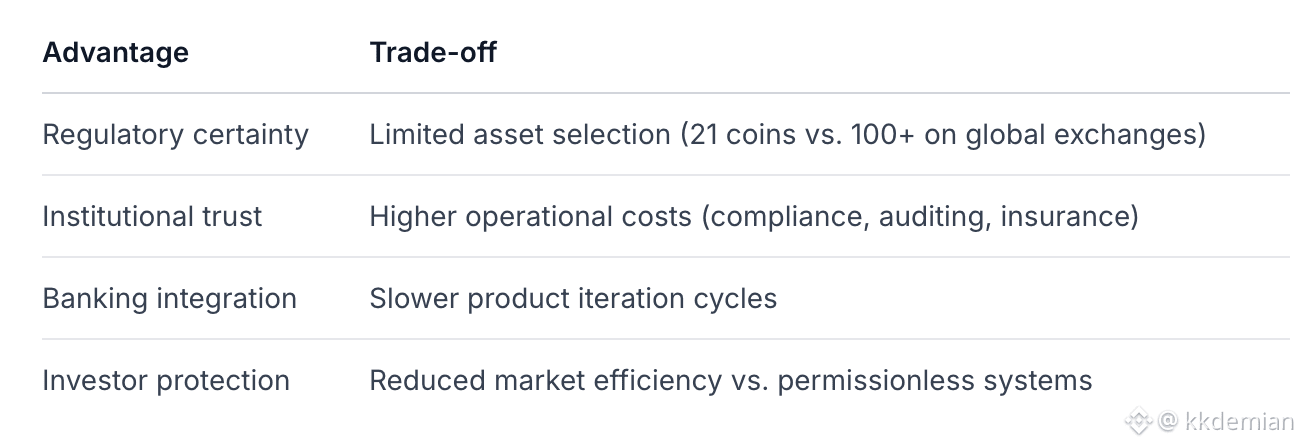
Capital Efficiency Impact: While HashKey's model reduces counterparty risk and regulatory uncertainty, it necessarily sacrifices some capital efficiency compared to offshore exchanges through higher compliance costs and narrower asset selection.
4. Liquidity Routing, Market Access, and Execution Logic
HashKey employs a deliberately conservative approach to market structure that prioritizes regulatory compliance over maximal liquidity.
Market Structure Design:
Siloed Liquidity Pools: No cross-entity liquidity sharing between HashKey Exchange (HK) and HashKey Global (Bermuda) confirmed
Internal Matching: Primary order execution through internal order books
External Connectivity: APIs support institutional routing but no evidence of external liquidity aggregation HashKey Global API
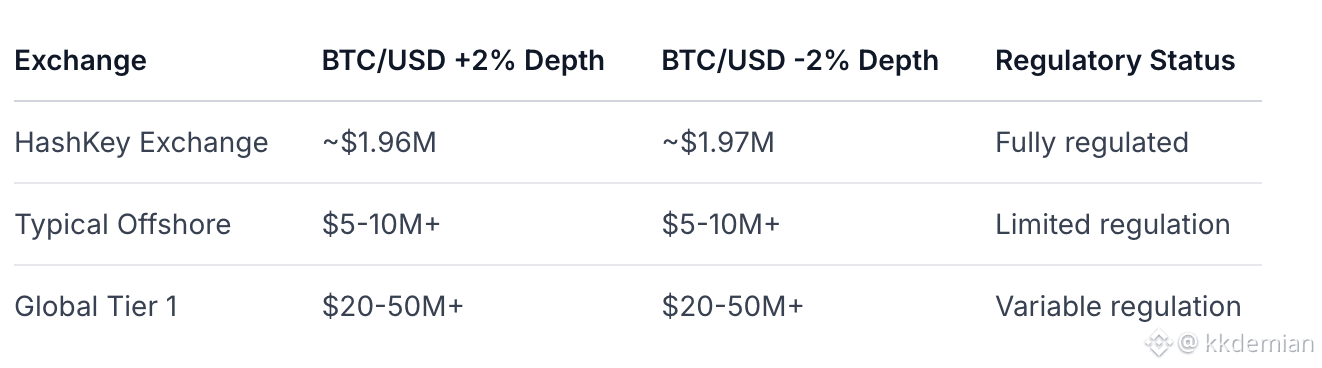
Liquidity Depth Analysis (BTC/USD pair):
+2% Depth: ~$1.96 million
-2% Depth: ~$1.97 million
24h Volume: $262.8 million (Feb 2026) CoinGecko
Comparative Depth Analysis:
Execution Quality Priorities:
Regulatory Compliance: All trades executed within licensed framework
Price Integrity: Minimization of market manipulation risks
Counterparty Safety: Segregated accounts and insured custody
Transparency: Regular audits and regulatory reporting
Institutional Access Tools:
FIX Protocol: Support for 4.4 and 5.0 SP2 versions with drop-copy functionality
Omnibus Accounts: 90% of Hong Kong licensed brokers use HashKey's omnibus structure HashKey Quarterly Report
Algorithmic Trading: API support for institutional trading strategies
Verdict: HashKey's execution logic unequivocally prioritizes regulatory-compliant market integrity and capital protection over maximal liquidity or price efficiency. This results in shallower order books but significantly reduced counterparty and regulatory risk.
5. Platform Economics and Incentive Structure
HashKey's economic model reflects its positioning as infrastructure rather than a speculative platform.
Fee Structure:
Spot Trading: Tiered maker-taker model with negative fees for market makers (-0.005% to -0.01%) HashKey Market Maker Program
Futures Trading: Maker rebates available with volume thresholds
Withdrawal Fees: Dynamic fees based on blockchain network conditions
Institutional Incentives:
Market Maker Program: Requirements include $10M+ in assets and ability to provide liquidity at 0.01-0.02% depth
Benefits: Lower latency, higher API rate limits, and preferential fee rates
Strategic Market Makers: Receive best-in-class trading conditions HashKey Global Market Maker Program
HSK Token Economics:
Fixed Supply: 1 billion HSK tokens
Distribution: 65% ecosystem growth, 30% team, 5% reserve fund HashKey Internal Data
Utility: Fee discounts, staking rewards, and governance (on HashKey Chain)
Value Accrual: Regular token burning from ecosystem revenue
Revenue Sustainability Analysis:
Endogenous Demand Drivers:
Institutional Adoption: 90% of HK brokers using omnibus accounts
Growing TVL: Client assets surpassed HKD 12 billion (~$1.5B) with 220% YoY growth
Diversified Revenue: Spot trading, futures, OTC blocks (single-day peak exceeding HKD 1.1B)
Cost Structure Challenges:
Compliance Overhead: Regulatory licensing, auditing, and reporting requirements
Security Infrastructure: High-cost custody and insurance arrangements
Banking Integration: Complex fiat rail maintenance
Competitive Positioning: HashKey's compliance-first model results in structurally higher costs than offshore competitors, but creates sustainable moats through:
Regulatory licensing barriers to entry
Institutional trust and banking relationships
Reduced regulatory risk premium for users
6. Governance, Security, and Risk Analysis
Corporate Governance:
Parent Entity: HashKey Group, publicly traded (03887.HK) since December 2025 IPO
Stock Performance: ~HKD 7.06 per share (Jan 30, 2026), market cap ~HKD 5-10B Bloomberg
Leadership: Dr. Xiao Feng as Chairman and CEO with traditional finance expertise
Regulatory Oversight:
Hong Kong SFC: Continuous monitoring and reporting requirements
Bermuda BMA: Regular audits and compliance checks
Cross-Jurisdictional Compliance: Operations must satisfy multiple regulatory regimes
Risk Surface Analysis:
Custodial & Operational Risks:
Mitigated: 98% cold storage, institutional insurance, regular third-party audits
Residual: Smart contract risk (for tokenized assets), internal operational risks
Regulatory Risks:
Jurisdictional Changes: Evolving regulatory frameworks across operating regions
License Maintenance: Ongoing compliance with SFC/BMA requirements
Geopolitical Factors: US-China tensions potentially affecting Hong Kong's status
Market Risks:
Concentration Risk: Heavy reliance on Asian institutional market development
Adoption Timeline: Slow institutional adoption could prolong path to profitability
Comparative Risk Profile:
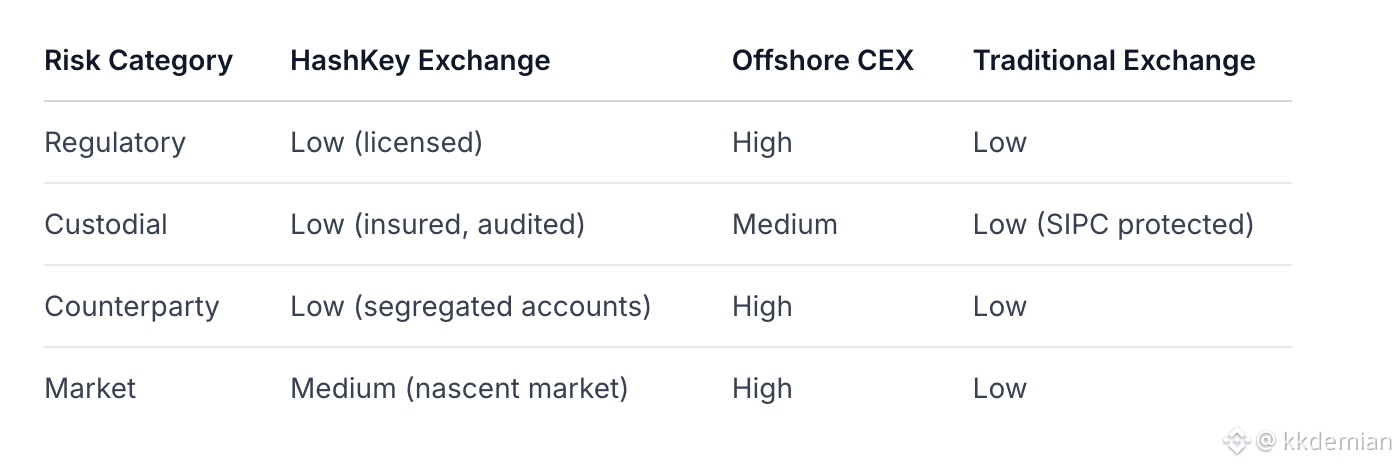
Verdict: HashKey's risk profile most closely resembles traditional regulated exchanges rather than crypto-native platforms, with significantly reduced regulatory and counterparty risk offset by market adoption risks.
7. Adoption Signals and Ecosystem Potential
HashKey demonstrates strong early adoption within its target institutional segment, though broader market penetration remains limited.
Quantitative Adoption Metrics:
Trading Volume: $262.8M daily spot volume (Feb 2026) CoinGecko
Client Assets: HKD 12B+ (~$1.5B) AUM with 220% YoY growth
OTC Volume: 13x YoY growth, single-day peaks exceeding HKD 1.1B
Broker Adoption: 90% of Hong Kong licensed brokers using omnibus services HashKey Quarterly Report
Qualitative Institutional Signals:
Banking Partnerships: ZA Bank integration for direct fiat services
Brokerage Network: Victory Securities and other licensed HK brokers
IPO Success: December 2025 listing oversubscribed 300x, indicating institutional confidence ChainCatcher
HashKey Chain Ecosystem Development:
Current Status: Early development phase with minimal TVL (<$1M)
RWA Focus: Tokenized money market funds (Bosera MMF), insurance products (CPIC)
Institutional Projects: Bosera tokenized MMF ETF ($100M+ launch), China Pacific Insurance tokenized fund
Technical Infrastructure: Ethereum L2 with fraud proofs (Stage 1 security) L2BEAT
Market Positioning Analysis:
HashKey is optimally positioned to capture:
Asian Institutional Flow: Primary gateway for HK/Singapore-based institutions
RWA Tokenization: Regulatory-compliant asset tokenization services
Professional Investor Services: High-net-worth and institutional onboarding
Less suited for:
Retail speculative trading
DeFi-native asset trading
Rapid innovation cycles
8. Strategic Trajectory and Market Fit
HashKey addresses structurally persistent problems in crypto markets through its regulated infrastructure approach.
Problem-Solution Fit:
Regulatory Uncertainty: Provides licensed, compliant access to digital assets
Institutional Onboarding: Abstracts away technical and compliance complexity
Capital Protection: Institutional-grade custody and risk management
Strategic Milestones (12-24 Month Outlook):
Jurisdictional Expansion:
UAE Operations: HashKey MENA licensed by VARA for exchange and broker-dealer services
European Presence: VASP registration in Ireland for EU market access
Asian Dominance: Consolidate position as leading regulated gateway for Asian capital
Product Diversification:
Derivatives Expansion: Perpetual futures and options products
RWA Ecosystem: Growth of HashKey Chain for tokenized traditional assets
Wealth Management: Expansion of professional investor products
Institutional Integration:
Banking Partnerships: Additional traditional bank integrations
Brokerage Network: Expanded omnibus account services across Asia
Custody Solutions: Enhanced institutional custody offerings
Market Fit Assessment: HashKey's strategy aligns perfectly with:
Increasing institutional demand for regulated crypto access
Asian regulatory frameworks promoting licensed operators
Traditional finance migration toward blockchain-based settlement
However, the strategy faces challenges from:
Slow institutional adoption timelines
Competition from global regulated venues
Regulatory fragmentation across jurisdictions
9. Final Investment Assessment
Dimension Scoring (1-5 Scale):
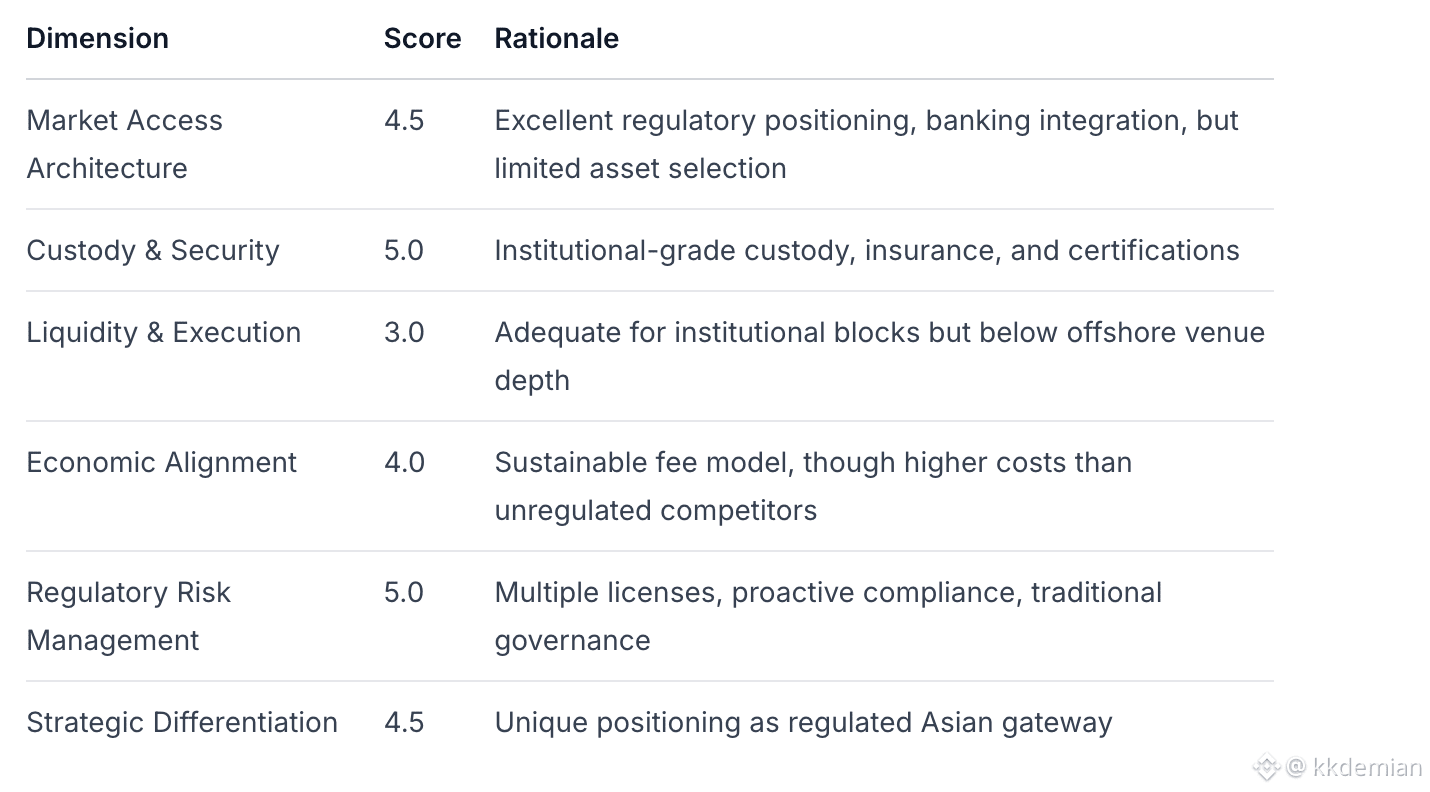
Overall Score: 4.3/5.0
Investment Verdict:
HashKey Exchange represents a durable piece of regulated Web3 financial infrastructure with particular strength as a regional compliance champion for Asian institutional capital. The platform successfully addresses the fundamental tension between crypto innovation and institutional risk management through its compliance-first architecture.
Key Strengths:
Regulatory moats from multiple jurisdiction licenses
Institutional-grade custody and security infrastructure
Strategic positioning as Asian regulatory frameworks mature
Successful public listing demonstrating institutional confidence
Key Risks:
Limited liquidity depth compared to global venues
Dependence on Asian institutional adoption timeline
Higher cost structure than unregulated competitors
Slow product iteration due to compliance requirements
Investment Recommendation: STRATEGIC HOLD for investors seeking exposure to regulated crypto infrastructure. HashKey is optimally positioned to capture institutional crypto flows in Asia, particularly as regulatory clarity improves and traditional finance adoption accelerates. The platform represents essential market plumbing rather than speculative upside, making it a foundation-level investment in the digital asset ecosystem.
The value proposition is clear: HashKey provides the regulatory compliance and institutional safety required for large-scale capital deployment into digital assets, abstracting away the technical and regulatory complexity that has historically prevented traditional finance participation. While growth may be slower than speculative venues, the business model creates sustainable, defensible moats that should compound over time as institutional adoption progresses.