

Vanar Chain is positioning itself as a seamless gateway between traditional crypto liquidity and a purpose-built ecosystem designed for speed, usability, and scalability. The core message reflected in the Vanar Hub interface is simple but powerful: bridging to Vanar is designed to be fast, decentralized, and user-friendly. Instead of forcing users to rely on centralized exchanges, Vanar enables direct cross-chain participation through integrated bridge solutions.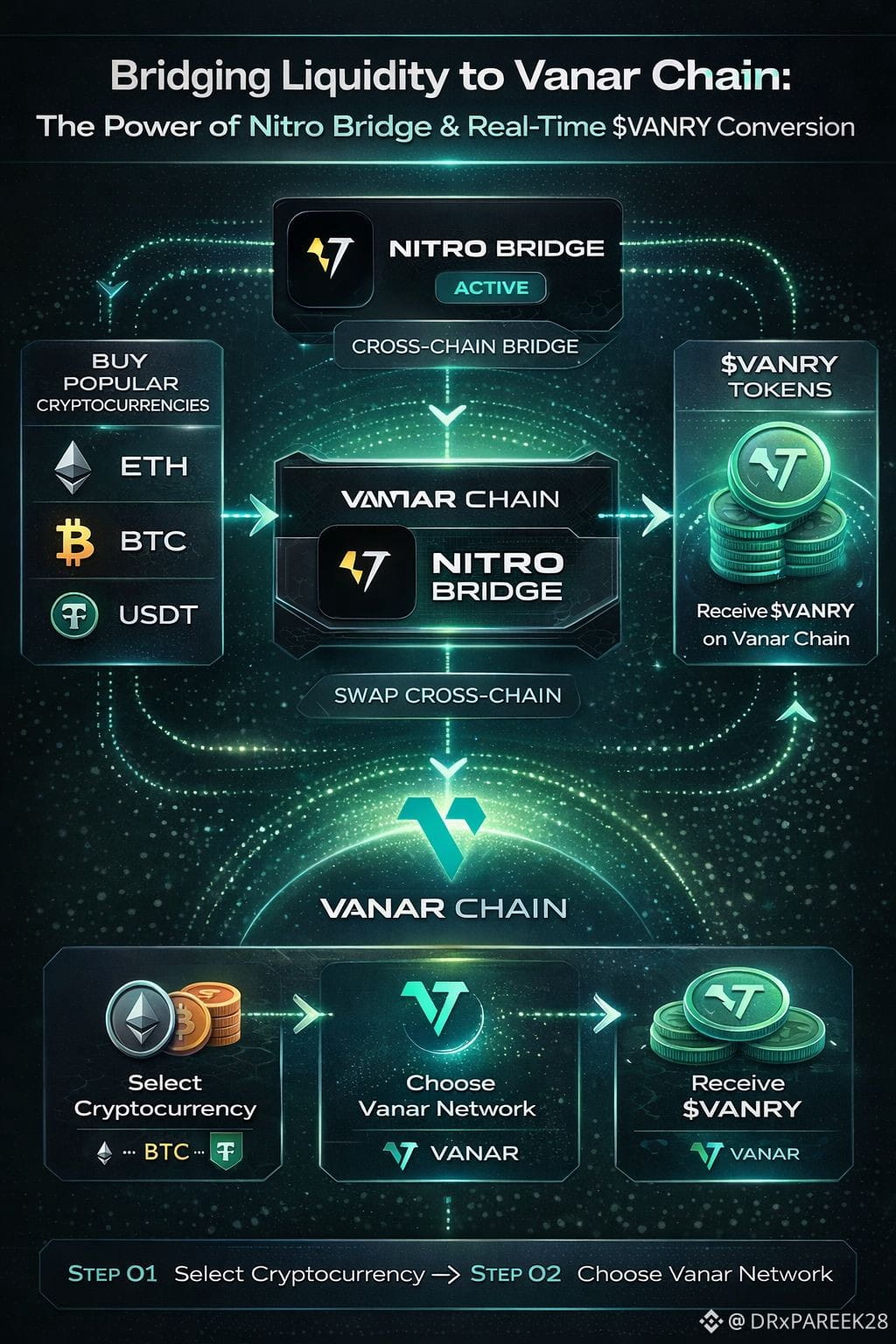
At the center of this experience is the “Bridge to Vanar Chain” feature. Users can buy $VANRY using widely held cryptocurrencies such as ETH, BTC, or USDT. This lowers the entry barrier significantly because it removes the need to first convert funds through multiple platforms. More importantly, the system supports cross-chain swaps between Ethereum and the Vanar blockchain, meaning assets can move between ecosystems without complex manual transfers. This cross-chain flexibility strengthens liquidity flow and improves ecosystem accessibility.
One of the highlighted bridge solutions is the Nitro Bridge, powered by Router infrastructure. It is presented as an active, low-cost, and fast transfer mechanism. The key value proposition is decentralized token swaps across chains. Instead of routing transactions through centralized custodians, Nitro Bridge enables direct blockchain-to-blockchain interaction. This enhances transparency while maintaining efficiency. The process works in real time, which is critical in crypto environments where price fluctuations and network congestion can affect transaction value. Real-time conversion into VANRY ensures that users can immediately engage with Vanar’s ecosystem without extended waiting periods.
The system emphasizes decentralization as a core operational layer. Token swaps are executed securely across chains, and the conversion to $VANRY happens directly on the Vanar blockchain. This design reduces dependency risk while boosting ecosystem interoperability. From a technical perspective, cross-chain bridges serve as infrastructure connectors, linking liquidity pools and user bases from different blockchain networks. In Vanar’s case, Ethereum compatibility appears central, allowing ETH holders to migrate value smoothly into the Vanar environment.
The bridge process itself is intentionally simplified into three structured steps. First, users select their cryptocurrency. This typically includes assets like ETH or USDT, which are widely supported and liquid. Second, they choose the destination network in this case, Vanar Chain. This step ensures that tokens are routed correctly across chains. Third, users confirm the transaction to complete the swap. Once finalized, VANRY is received on the Vanar blockchain. The simplicity of this three-step design reduces friction and encourages broader participation.
The FAQ section reinforces clarity around operational aspects such as supported cryptocurrencies, transaction fees, and time required for completion. Fees in cross-chain environments generally include network gas fees plus bridge service fees, while completion time depends on source-chain confirmations. However, the platform highlights real-time execution, signaling optimized routing and efficient validation mechanisms.
Key benefits for users are clearly structured. First, access to VANRY natively on Vanar without relying on centralized exchanges. This aligns with the decentralized ethos of Web3. Second, diversification of holdings. By bridging assets, users can expand into the Vanar ecosystem and participate in its applications, governance, or token-based utilities. The ability to move capital fluidly across chains also enhances strategic positioning during market cycles.
Overall, Vanar Chain’s bridge infrastructure reflects a broader industry trend toward interoperability. Instead of competing in isolation, modern blockchains aim to integrate liquidity across networks. Vanar’s approach focuses on secure, decentralized swaps, real-time conversion, and a simplified user journey. By combining accessible asset support, Nitro Bridge integration, and a streamlined three-step process, Vanar reduces technical complexity while maintaining blockchain-native principles. This infrastructure layer is not just a transfer tool — it is a gateway enabling seamless participation in the Vanar ecosystem.
