
The conversation about "mass adoption" in crypto is everywhere. Every project claims they’ll be the one to bring in the next billion users. But few ask the hard questions: Who is actually going to use these systems, and what happens when a real human—with feelings, mistakes, and slow internet—interacts with a cold, binary machine?
Usually, humans and complex systems like Vanar don't speak the same language. Vanar is built for high-level computation; humans are built for intuition. When these two worlds collide, it’s a challenge of communication.
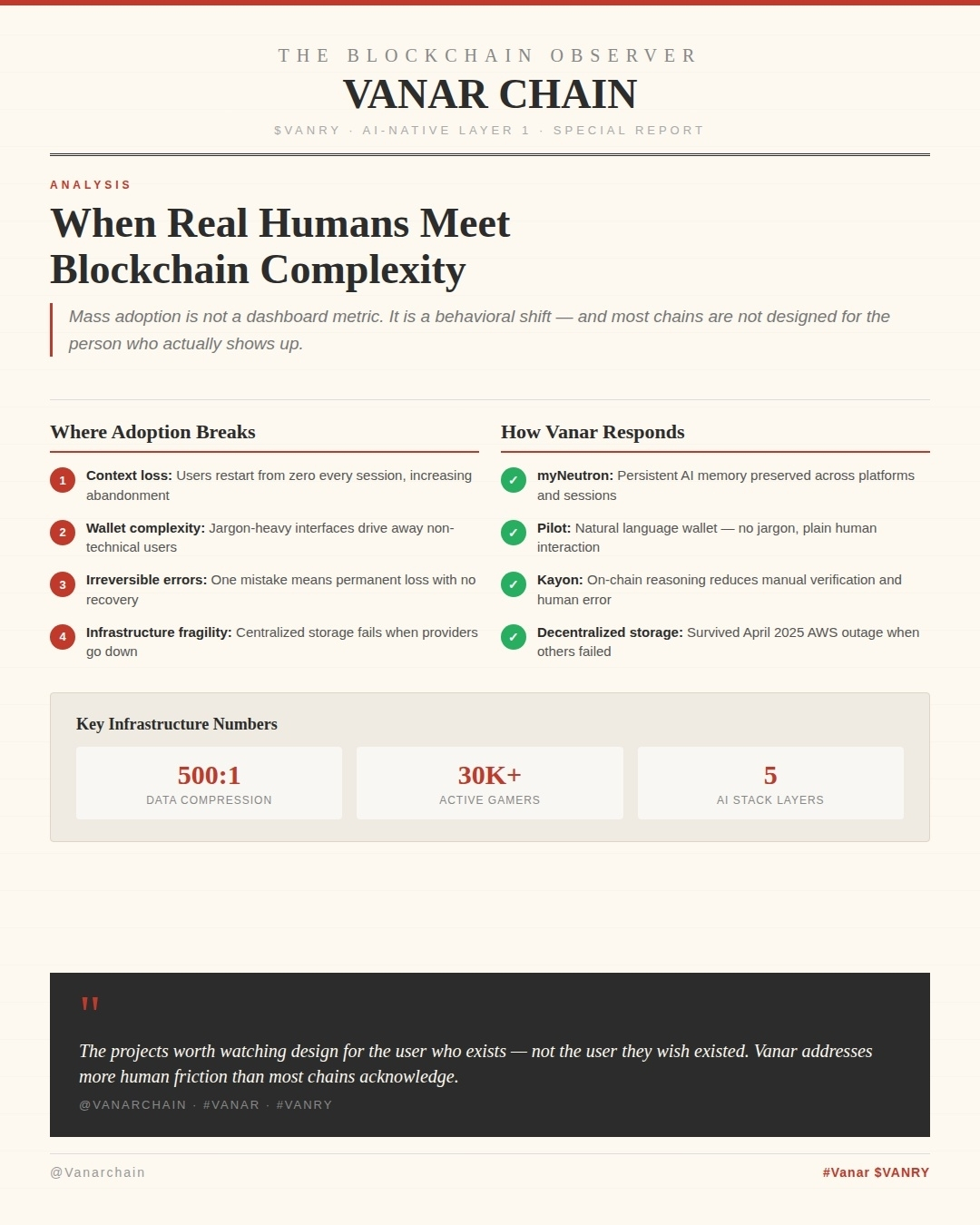
🧠 The Vanar Approach: Solving the "Human" Problem
Vanar isn't just another fast blockchain. They’ve built a layered ecosystem designed to bridge the gap between technical complexity and human behavior.
Layer 1: myNeutron (The Semantic Memory) 🧬
Most Web3 tools make you start from scratch every time. myNeutron uses "Seeds" to store your information across different platforms. It’s not just tech; it’s a practical way to save time and reduce the "mental load" of using crypto.
Layer 2: Kayon (The Reasoning Engine) 🧐
Smart contracts usually just follow "if/then" rules. Kayon allows them to actually reason over data. It checks rules and makes decisions automatically, which means fewer chances for you to make a manual mistake that costs you money.
Layer 3: Pilot (The Human Interface) 🗣️
Forget complex hex addresses and "gas limit" jargon. Pilot is a wallet interface you can talk to in plain language. If you can’t explain it to your grandma, it’s not mass adoption—Pilot is changing that.
Layer 4: Decentralized Resilience 🛡️
In April 2025, when major cloud outages hit big exchanges, Vanar kept ticking. Because data is compressed into Neutron Seeds on the blockchain—not rented servers—your assets and data stay online even when Big Tech goes down.
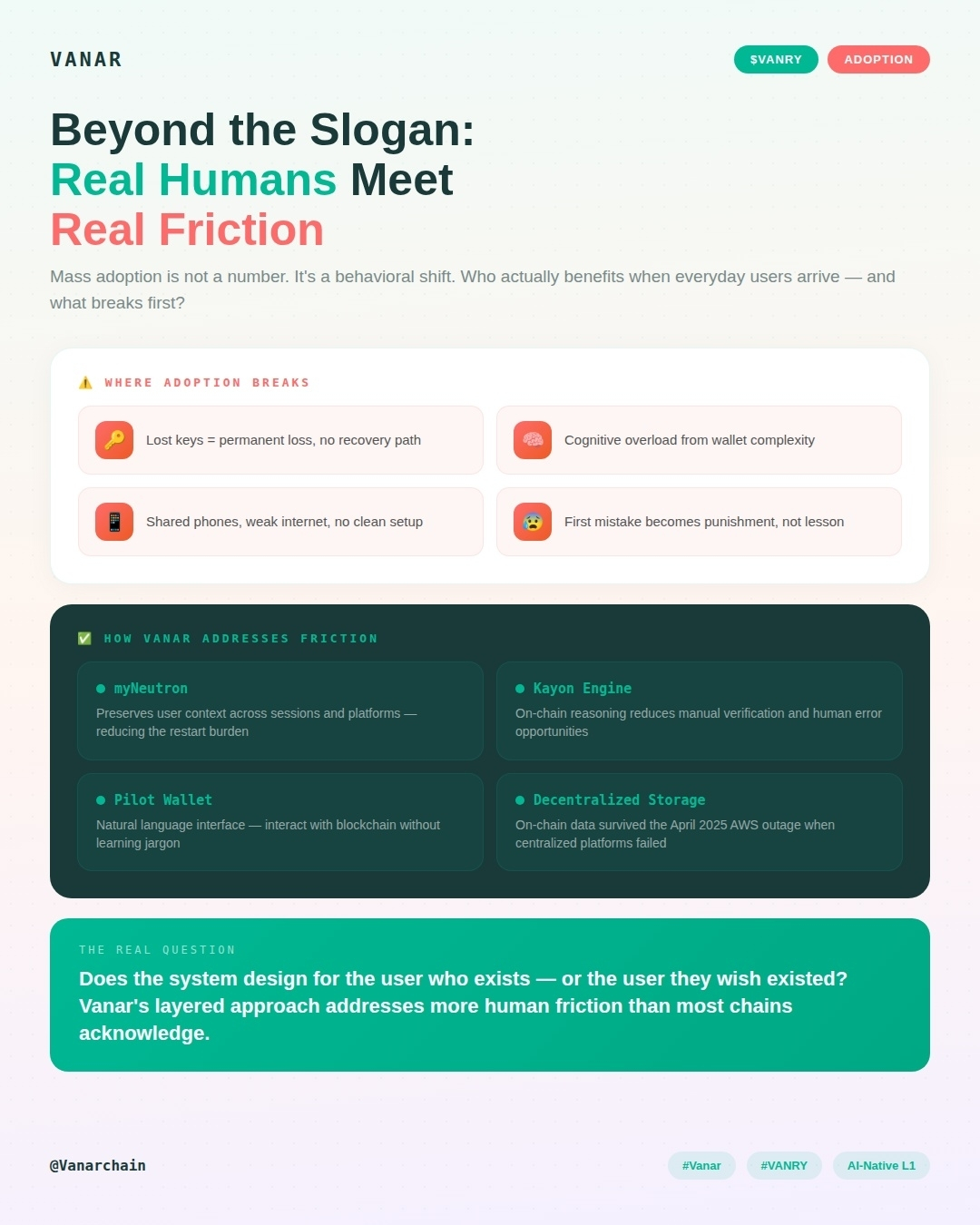
⚠️ The Reality Check
No system is perfect. Vanar’s subscription model for myNeutron could create a "paywall" that keeps out the very people who need simplicity the most. Furthermore, we still need to see better support systems for when a non-technical user loses access.
However, while other projects ignore the "human factor," Vanar is facing it head-on. By focusing on on-chain reasoning and natural language, they are building a foundation that actually cares about the person behind the screen.
Is Vanar the bridge to the next billion? The tech is ready—now it's all about the execution. 📈
