
Vanar is a Layer One blockchain built with a clear intention to support real world adoption rather than abstract theory. From the beginning, the project has been shaped by a team that understands how games, entertainment, and consumer brands actually operate at scale. When I look at Vanar, what stands out to me is not an attempt to reinvent everything at once, but a steady effort to build systems that people outside of crypto could realistically use. Gaming networks, virtual worlds, AI driven platforms, and brand ecosystems all sit on top of the same foundation, powered by the VANRY token, and that focus already says a lot about the kind of future Vanar is aiming for.
One thing that has always lingered in my mind when thinking about decentralized systems is how often they promise trustless execution while quietly relying on centralized data storage. Smart contracts may be distributed, consensus may be decentralized, yet the data those contracts depend on often lives somewhere fragile and controlled. That contradiction has never fully sat right with me. Over time, it becomes clear that decentralization loses much of its meaning when data ownership is treated as an afterthought. If execution is shared but data is not, resilience is only partial, and partial resilience has a way of failing exactly when it is needed most.
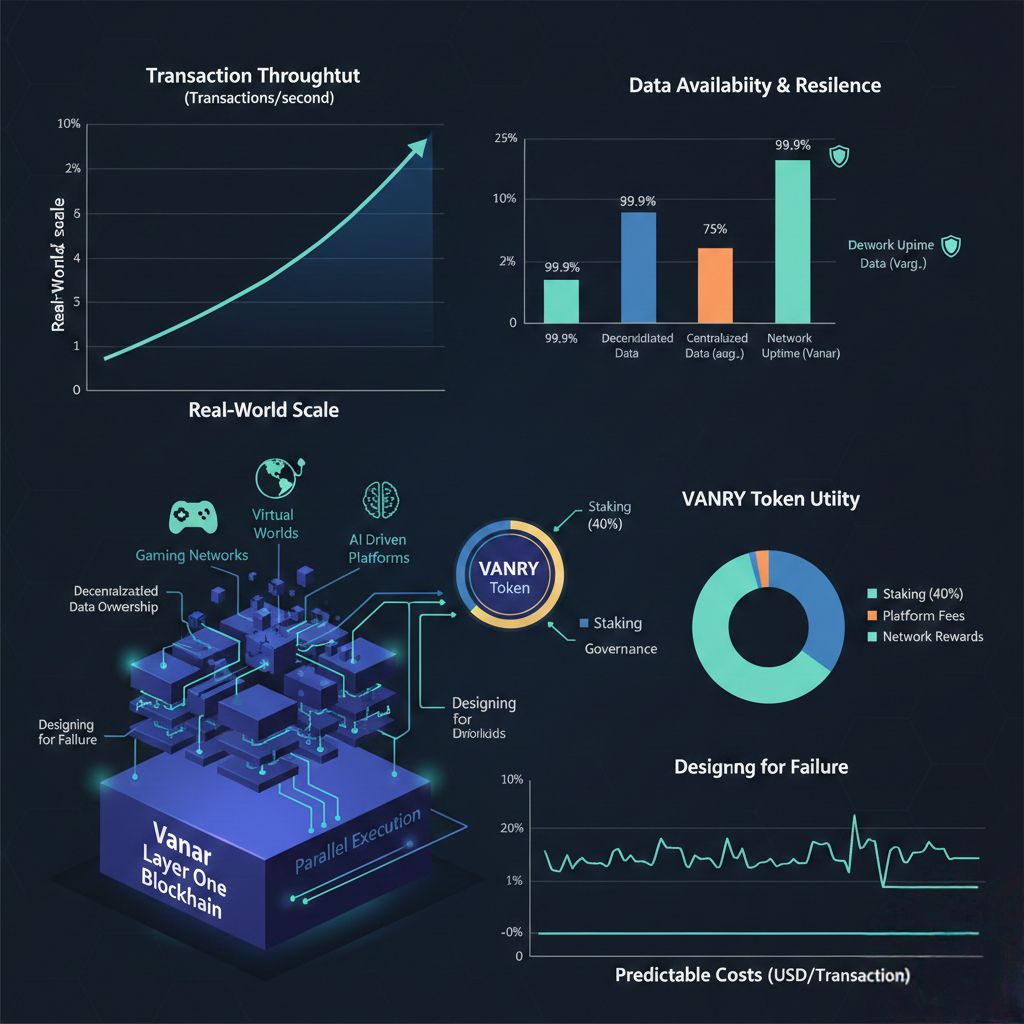
When I look at Vanar through this lens, the design choices feel intentional rather than accidental. The underlying blockchain is built to handle parallel execution and high throughput because real world applications do not deal in tiny, isolated transactions. Games, virtual environments, and consumer platforms generate constant streams of data, often at the same time. Scalability here is not about chasing numbers on a chart, but about making sure the system does not become a bottleneck the moment people actually show up.
What stands out to me is how data is treated as something that must survive imperfect conditions. Instead of assuming a flawless network, the system assumes that nodes will go offline, connections will drop, and failures will happen. Data is broken apart, spread across the network, and stored in a way that no single participant becomes a point of failure. Techniques like erasure coding and blob style storage matter not because they sound advanced, but because they quietly shift the balance between privacy, availability, and trust. Even if parts of the network disappear for a while, the data remains accessible and intact. Designing for failure is often misunderstood as pessimism, but in practice it is a sign of maturity.
As the thinking moves from architecture to adoption, ideology alone starts to feel insufficient. Real users care about predictable costs, reliable performance, and the confidence that their data will still be there years from now. It becomes clear over time that decentralized systems only matter if they can be used at scale without constant friction. Vanar seems to acknowledge this by aligning incentives so that participants are rewarded for honest behavior. Rather than asking users to blindly trust the system, the system makes cooperation the rational choice.

The VANRY token fits into this picture not as a speculative centerpiece, but as a coordination tool. It supports staking, governance, and participation in a way that ties real usage back into the health of the network. When people use the system, secure it, and help guide its evolution, the network becomes stronger. Governance here feels less like control and more like adaptation, a mechanism that allows the system to respond to changing needs without abandoning its core principles.
In the broader market, attention often flows toward what is loud, visible, and immediately exciting. Quieter infrastructure tends to be overlooked until it becomes unavoidable. When I step back and reflect on Vanar, it feels like one of those projects building patiently in that quieter space. It is less about generating excitement today and more about shaping how data ownership and digital experiences quietly evolve over time. In a decentralized future that actually works, this kind of discipline may turn out to be the most important feature of all.
