

@Dusk The phrase “mainnet genesis onramp” can sound like a slogan until you translate it into plain behavior: a controlled doorway from old representations of a token into the first, agreed-upon state of a new network. Dusk spelled out that doorway during its mainnet rollout in late 2024, describing the activation of an onramp contract, on-ramping early stakes into Genesis on December 29, and aiming to produce the first immutable block on January 7.
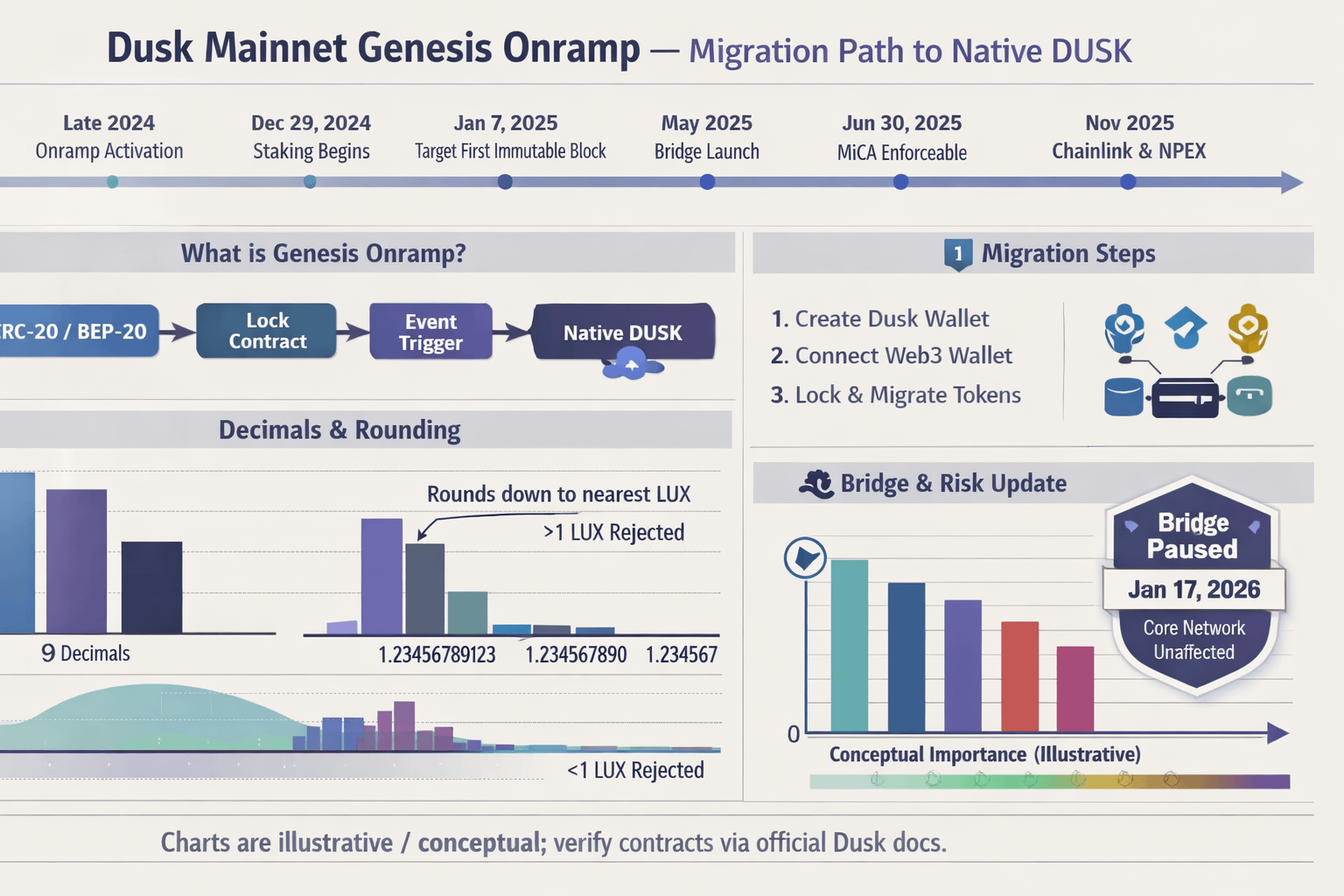
The important twist is that this “onramp” is not a fiat purchase tool. It is the official migration path from ERC-20 or BEP-20 DUSK into native DUSK that actually lives on the Dusk network. The mechanics are intentionally plain: you lock your ERC-20/BEP-20 tokens in a migration contract on Ethereum or BNB Smart Chain, the contract emits an event, and native DUSK is issued to the Dusk mainnet address you provide.
Dusk routes the process through its Web Wallet and uses WalletConnect for the source transaction, which is a practical choice because migrations tend to fail at the user-interface layer, not in the math. You create or import a Dusk wallet, initiate migration, connect your Web3 wallet, and sign the lock transaction. The documentation says the process typically completes in about 15 minutes, and that the original Ethereum/BSC transaction hash is included in the memo field of the corresponding Dusk transaction for reference.
One detail deserves more attention than it usually gets, because it’s the kind of thing that creates needless drama: decimals. ERC-20 and BEP-20 DUSK use 18 decimals, while native DUSK uses 9. That mismatch forces a rounding rule in the migration contract. If you migrate an amount that is not a clean multiple of 1 LUX (the minimum unit accepted), the contract rounds the amount down to the nearest full LUX, and anything below 1 LUX is rejected outright. It’s not dramatic, but it is the difference between a clean migration and a “why is my balance smaller?” moment.
So why is the Genesis Onramp idea trending again now, in early 2026, rather than fading into a historical footnote? Token migrations have second waves. The first wave is urgency and curiosity. The second wave shows up when native utility becomes unavoidable: staking, fees, governance, or access to applications that only make sense on the main chain. Dusk’s token documentation frames DUSK as the chain’s native currency and incentive for consensus participation, which naturally nudges long-term holders to stop treating ERC-20/BEP-20 as “good enough.”
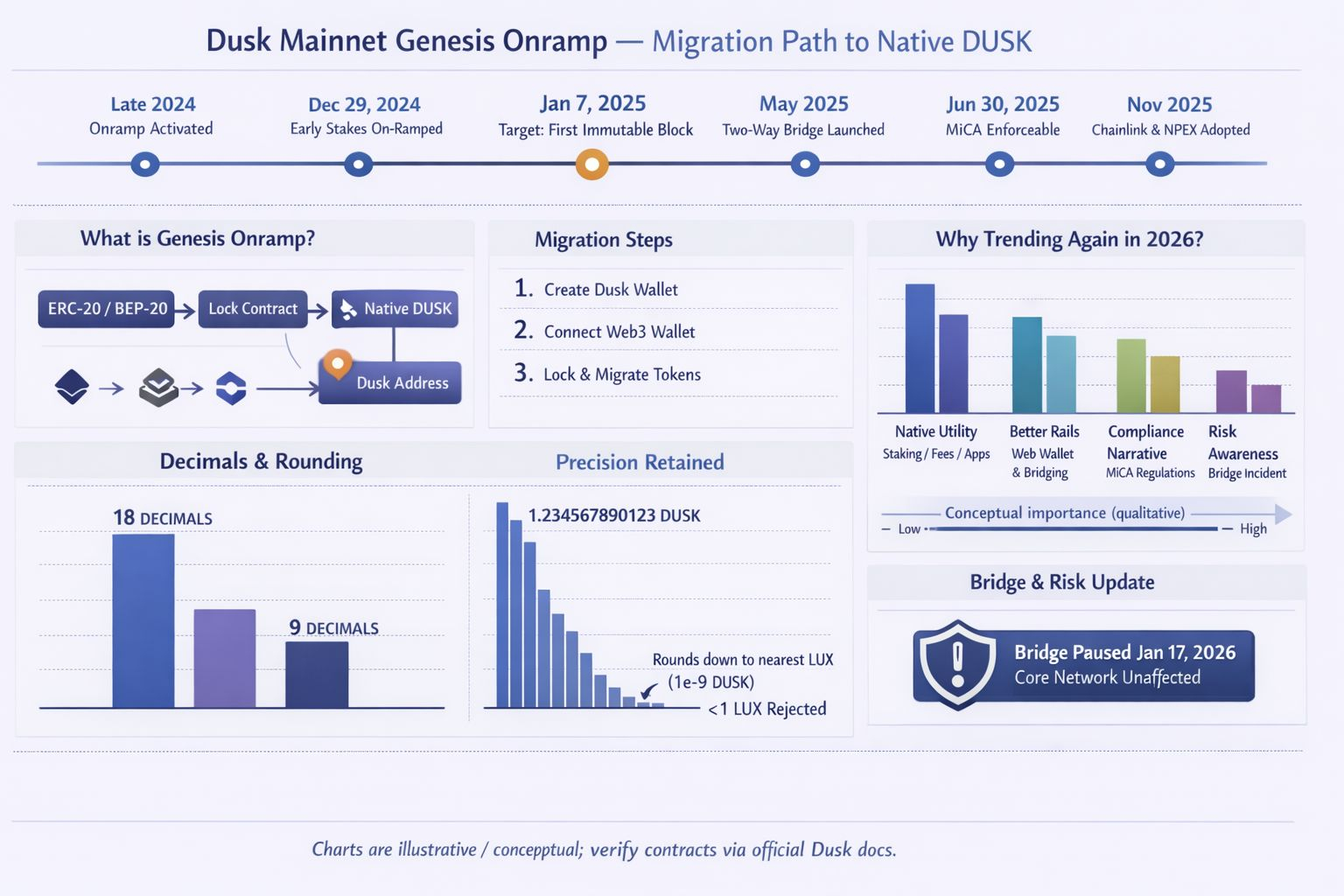
Another reason is that the rails around the onramp have matured, and the trade-offs are easier to see. In May 2025, Dusk launched a two-way bridge to BNB Smart Chain so users could move native DUSK to a BEP-20 form and back, which helps when liquidity and custody habits lag behind new chains. Bridges also concentrate operational risk, and Dusk’s most candid recent update was about that reality. On January 17, 2026, it published an incident notice after monitoring detected unusual activity involving a team-managed wallet used in bridge operations, temporarily pausing bridge services while stating the core DuskDS network was not affected and that it did not expect user losses to materialize.
The broader timing is also about regulation and credibility. Dusk has been arguing that privacy and compliance don’t have to be enemies, and Europe’s MiCA timetable has pushed projects to talk less about ideals and more about readiness. Dusk’s own commentary marked MiCA as enforceable as of June 30, 2025, framing regulatory clarity as a pathway for institutional participation rather than a dead end. In November 2025, Dusk and the Dutch exchange NPEX announced they were adopting Chainlink interoperability and data standards, including CCIP and on-chain exchange data tooling, to support regulated assets and verified market data on DuskEVM.
If you’re holding ERC-20 or BEP-20 DUSK today, the sensible posture is calm and methodical. Use the official wallet flow, confirm you’re interacting with the official contracts, migrate amounts that won’t get clipped by the 1-LUX rule, and treat the onramp as a one-way door for the tokens you lock. I tend to trust networks more when they explain the unglamorous parts—decimals, tracking, pauses—because that’s where real users get hurt when details are waved away.