
Vanar doesn’t come across like a blockchain that exists to win technical arguments. It reads more like a chain that’s trying to survive real humans: gamers who hate waiting, fans who want things to “just work,” and brands that won’t touch anything that feels confusing or risky. The whole “next 3 billion consumers” idea only makes sense if the experience is familiar enough that people don’t feel like they’re joining a new hobby just to participate.
That’s why Vanar’s background matters. When a team has been close to games and entertainment, they tend to obsess over the stuff crypto sometimes hand-waves away: onboarding, simple flows, predictable performance, and making sure the user never feels like they’re doing accounting just to have fun. In consumer worlds, friction isn’t a concept—it’s the point where someone closes the tab and never comes back.
The way I like to think about Vanar as an L1 is this: it wants to be the machinery behind the stage, not the spotlight. If it’s doing its job properly, the player is playing, the fan is collecting, the community is interacting—and nobody’s pausing mid-moment because a wallet prompt is yelling at them. That “invisible infrastructure” mindset is the only way Web3 gets mainstream without asking mainstream people to become crypto-native.
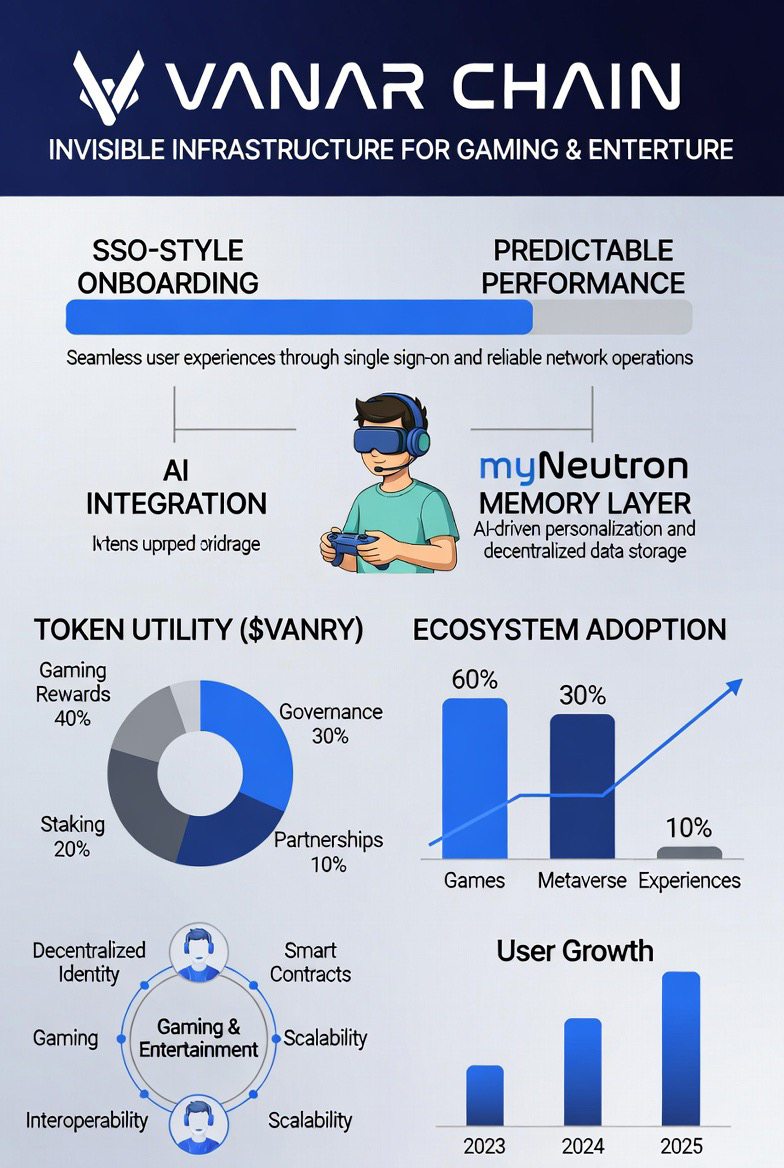
A big clue to Vanar’s direction is that it keeps pointing to real ecosystem surfaces—things like Virtua Metaverse and the VGN games network—rather than only abstract narratives. Games and metaverse-style experiences are basically the harshest test environments you can pick, because they don’t forgive clunky UX. If something feels slow, messy, or complicated, users won’t debate it—they’ll just leave. So anchoring the story in entertainment-grade use cases is almost like Vanar saying, “Judge us by whether people actually stick around.”
What makes Vanar more than “a chain for games” is how it keeps weaving in AI as part of the identity, not as a decorative buzzword. In its own materials, Vanar talks about building infrastructure where data can be stored and retrieved in a way that’s useful for AI systems—more like memory than a dusty archive. The vibe is: don’t just store information, store it so it can be used, searched, and brought back into an application’s context when it matters. Even if you don’t buy every futuristic implication, it’s a coherent direction: blockchain that doesn’t only move value, but also helps keep context and meaning intact.
That’s also why myNeutron is a really interesting piece of the puzzle. It’s presented as a portable memory layer you can carry across major AI assistants so you don’t feel like you’re starting from scratch every time you switch tools. If you’ve ever had that annoying moment where an AI “forgets” your preferences or your project details, you immediately understand the appeal. And the recent myNeutron v1.1 update is notable because it pushes the product into “this is how it sustains itself” territory—monetization, subscriptions, multiple payment rails, and crypto payments in selected regions. That kind of move matters because it suggests Vanar is trying to tie its ecosystem to actual usage patterns instead of only attention cycles.
Then there’s $VANRY sitting at the center of it all. A lot of crypto projects talk about tokens in grand, vague terms, but the more practical way to look at it here is: if Vanar wants real adoption, the token needs to feel like a tool, not a collectible. When users can pay for services, upgrades, or ecosystem activity in ways that feel natural—especially inside products people already want to use—that’s when the token becomes part of the experience instead of a separate “crypto step” people tolerate.
On the gaming side, one of the most important ideas Vanar mentions is also one of the least glamorous: SSO-style onboarding. That’s a fancy way of saying: let people enter in a way that feels normal, and let Web3 features show up gently once they’re already enjoying the experience. That’s how mainstream products are built. Nobody learns the mechanics of the internet before they use an app. They just use the app, and the complexity stays behind the curtain.
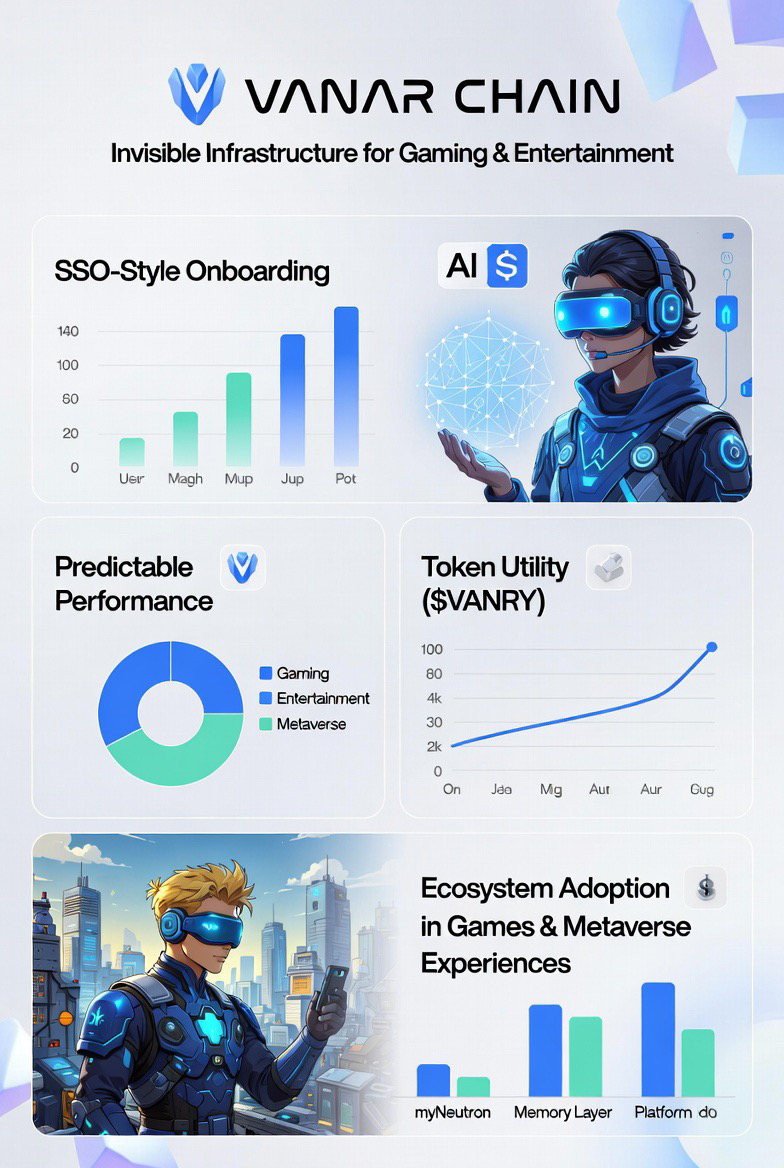
Brands and mainstream verticals fit into the same philosophy. Brands already understand identity, loyalty, digital perks, membership tiers, collectible culture. Web3 can strengthen those things—if it doesn’t demand that customers become crypto experts. If Vanar can turn blockchain into something brands can use without scaring their audiences, that’s a real bridge to mass adoption.
Even the NVIDIA Inception mention (which Vanar has talked about publicly) fits the broader pattern: Vanar wants to be seen as a serious technology stack for consumer experiences that may lean more and more into AI-heavy workflows over time. Not “AI because it’s trendy,” but AI because the future of consumer apps is quickly becoming assistant-driven, personalized, and context-aware.
If you zoom out, Vanar’s whole pitch becomes easier to describe in plain language: it wants Web3 to feel normal. Not dumbed down—just normal. Like something you bump into while doing everyday digital life: playing, collecting, using AI tools, joining communities, exploring virtual spaces. And the best outcome for that vision is kind of funny: if Vanar succeeds, many people will use what Vanar powers without ever thinking, “I’m using a blockchain.” They’ll just feel like the product is smooth, and ownership actually sticks.
If you want, I can rewrite this again with a completely different human voice (more personal diary style, more “builder’s notebook,” or more punchy and conversational), while keeping the facts and making it feel like a fresh piece rather than a revision.
