I started paying attention to Walrus for the same reason I watch any infrastructure token with real utility: storage is where crypto products quietly fail. You can have a fast blockchain, seamless wallets, and sleek apps, but if images, metadata, AI files, or game assets disappear under load, users do not care about the tech stack. They just see a broken product. Walrus is trying to make that failure mode boring and rare, and WAL is the mechanism designed to keep the system honest.
As of February 6, 2026, $WAL trades around $0.077 to $0.081, with a 24-hour volume of roughly $20 to $30 million and a market cap near $125 to $126 million. Trackers report a 5 billion max supply and about 1.6 billion circulating. Future token unlocks and emissions will shape how the market prices its utility.
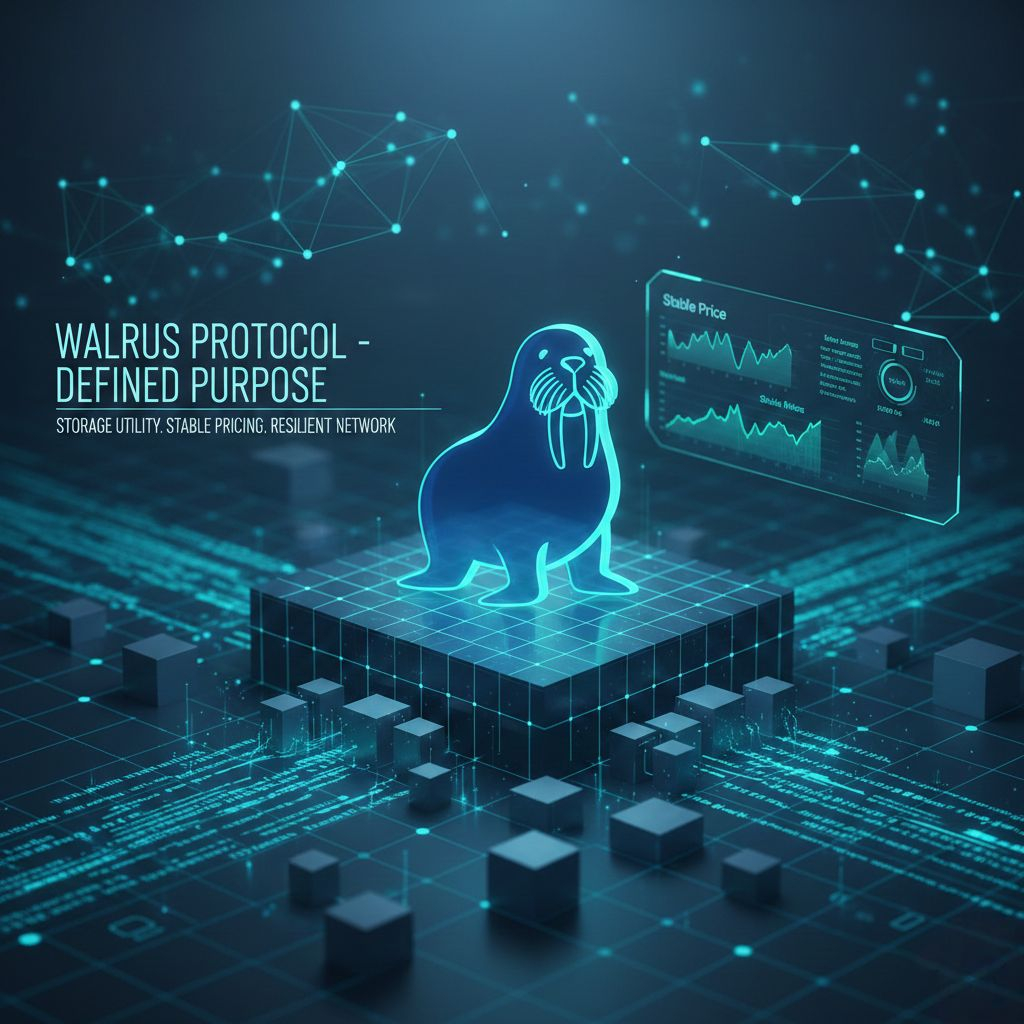
WAL is the payment token for storage on Walrus. The critical detail is how payments are structured. Walrus aims to stabilize storage costs in fiat terms so developers do not have to constantly adjust pricing. Users pay upfront for a fixed period, and payments are distributed over time to storage nodes and stakers. For any consumer-facing app, this matters. Volatile costs force teams to overcharge, subsidize, or quietly disable features. Stable-feeling pricing turns decentralized storage from a concept into a product that can actually ship.
WAL also powers incentives for storage providers. Token holders can stake with nodes and earn a share of fees, while the network coordinates node performance and reliability. If usage drives fees and fees reward providers reliably, the network keeps capacity online and resilient. This creates a measurable, usage-linked economic loop that aligns developers, providers, and token holders.
Walrus’s real differentiator is technical: erasure coding, specifically a two-dimensional scheme called Red Stuff. Instead of storing full copies everywhere, data is split into redundant pieces so it can be recovered even when parts of the network fail. Red Stuff achieves high durability with roughly a 4.5x replication factor and supports self-healing recovery, where bandwidth scales with the lost data rather than the full blob. The implication is critical: durability, recoverability, and efficiency determine whether storage can truly be cheap, reliable, and decentralized.
Imagine running a small NFT game studio. Your NFTs reference images, characters reference animation bundles, and metadata powers a marketplace. If storage fails, NFTs remain on-chain, but users see blank thumbnails and broken assets. Support tickets spike and the community assumes something went wrong. Walrus’s promise is to treat off-chain assets as first-class infrastructure, make them resilient by default, and ensure providers are properly compensated.
$WAL is a usage-linked token in a measurable sector. If Walrus becomes a default storage layer, fee flows and staking rewards matter more than hype. If adoption does not materialize, $WAL risks becoming another infrastructure token traded mostly on narratives, with utility that exists on paper rather than in cash flow reality. Competition is intense, incentives must continue when subsidies fade, and fee-driven rewards are only effective if usage is consistent. Traders should watch liquidity, unlock schedules, and market sentiment. Investors should focus on real storage demand, developer adoption, and whether fee flows and network reliability hold under stress.
When someone asks why Wal is not just another token, the answer is simple. It has a defined purpose, paying for storage with stable pricing, rewarding providers, and maintaining a resilient network. The technology is real, the economics are explicit, and the token has a measurable job. The market treats $WAL like an early-stage infrastructure asset rather than a proven utility monopoly. Its long-term value depends on adoption, reliability, and sustainable fee-driven incentives, the metrics that make a token genuinely useful.