When I first tried to understand Dusk Network, I didn’t think about blockchains at all. I thought about glass. Not the kind you shatter, but the kind used in interrogation rooms and trading floors. One side sees clearly. The other side sees nothing. Both sides know the glass exists, yet each experiences a different reality. That strange balance between visibility and privacy is exactly how real finance works. Deals happen quietly. Positions are guarded. Strategies are hidden. But when regulators knock, the books must open without excuses.
Dusk Network feels like it’s building that glass directly into the protocol, especially now in early 2026, amid Binance’s spotlight on hot topics like AI innovation, regulatory advancements, and institutional adoption. 11 16 Most blockchains grew up in the open air of radical transparency. Every wallet exposed, every trade permanent, every move observable. That’s beautiful for ideology, but awkward for institutions—particularly as crypto sentiment rebounds from recent dips, with Bitcoin plunging below $70,000 and markets eyeing a turning point. 13 A hedge fund doesn’t want its positions broadcast. A company issuing tokenized equity doesn’t want every shareholder’s activity public. A regulated venue cannot rely on “trust us” when auditors ask questions. Public chains often force these actors into uncomfortable compromises. They either sacrifice privacy or retreat into permissioned systems that quietly defeat the purpose of decentralization.
Dusk seems to be asking a softer, more practical question, aligning with Binance’s push for secure, compliant ecosystems: What if privacy wasn’t a feature you add later, but a default behavior? What if auditability wasn’t a patch, but a native property? 23 Instead of shouting “everything is transparent,” it whispers something more mature: “the right people see the right things at the right time.” This resonates amid Binance’s SAFU Fund updates, where they’re converting assets to Bitcoin for enhanced security, emphasizing trust in volatile times. 6 And with AI themes dominating Binance’s Word of the Day and contests—like their AI Short Drama Contest encouraging creative content to combat FUD—Dusk’s privacy tech could integrate AI for smarter, hidden financial strategies without exposing sensitive data. 4 15
That difference feels small on paper. In practice, it changes everything, especially as 2026 shapes up with Binance highlighting 12 key themes: macro policy shifts, energy dynamics in mining, and on-chain innovation that favors privacy-focused layers like Dusk’s. 16 As I dug deeper, what struck me wasn’t flashy tech or marketing slogans. It was restraint. The architecture reads less like a revolution and more like civil engineering. A base settlement layer focused on security and finality. Execution layers that feel familiar to developers. Identity and asset frameworks that quietly handle compliance logic under the hood—perfect for the institutional shift Binance ecosystems are pushing, with tokens like PancakeSwap (CAKE) leading DeFi recovery. 18 It doesn’t feel like a playground. It feels like plumbing. And oddly, that’s comforting, mirroring Binance’s advice on hardware wallets and 2FA for zero-trust security. 8 9
Because real finance is boring. And boring is what you want. No pension fund ever said, “We moved billions because the chain looked exciting.” They move because it feels stable, predictable, and survivable—qualities Dusk’s recent mainnet launch in January 2026 delivers, with stable block production and compliant privacy drawing “heavy capital” on-chain. 22 24 Dusk’s modular approach, blending regulated settlement with more familiar execution environments, suggests it understands this psychology. It’s not trying to reinvent how developers build. It’s trying to remove friction so they don’t even notice they’re building on something different, much like Binance’s new Futures features for smoother trading. 10
The emotional shift here is subtle but important. Most chains chase attention. Dusk seems to chase trust, fitting into Binance’s broader narrative of rebounding sentiment and venture capital focusing on resilient projects amid market challenges. 14 There’s also something very human about the way it treats privacy. Not as secrecy for the sake of hiding, but as dignity. In everyday life, we don’t live on stage. We close doors. We have private conversations. We share information selectively. Yet blockchains historically forced us into permanent exhibition. Dusk feels closer to how people naturally behave. You control what you reveal. You can prove things without exposing everything. You’re not naked just because you’re on chain—echoing Binance’s warnings on public WiFi risks. 7
That design philosophy hints at a future where institutions don’t feel like intruders in crypto. Instead, they feel like residents, especially as top buys in the dip—like Solana and Ondo Finance—highlight privacy needs in DeFi. 12 Of course, none of this is guaranteed. A multi-layer system adds complexity. Bridges must be seamless, as Dusk’s recent precautionary pause on bridge services showed operational discipline. 26 Security must be boringly reliable. Token incentives must sustain validators without turning the network into a yield circus. If any of those pieces wobble, the whole “regulated trust layer” vision collapses into just another speculative chain.
But if it works, Dusk might not become famous in the loud, social media sense. It might become something stranger and more valuable. Invisible. The kind of infrastructure people use without thinking. Like electricity. Like fiber cables under the ocean. Like clearinghouses that quietly settle trillions while nobody tweets about them. And in 2026, with Binance ecosystems thriving on BNB’s utility and predictions of growth to over €500 by year-end, Dusk could quietly integrate as the privacy backbone for it all. 19 20
And maybe that’s the real signal. Not a chain trying to be seen. A chain trying to let others operate without being seen.
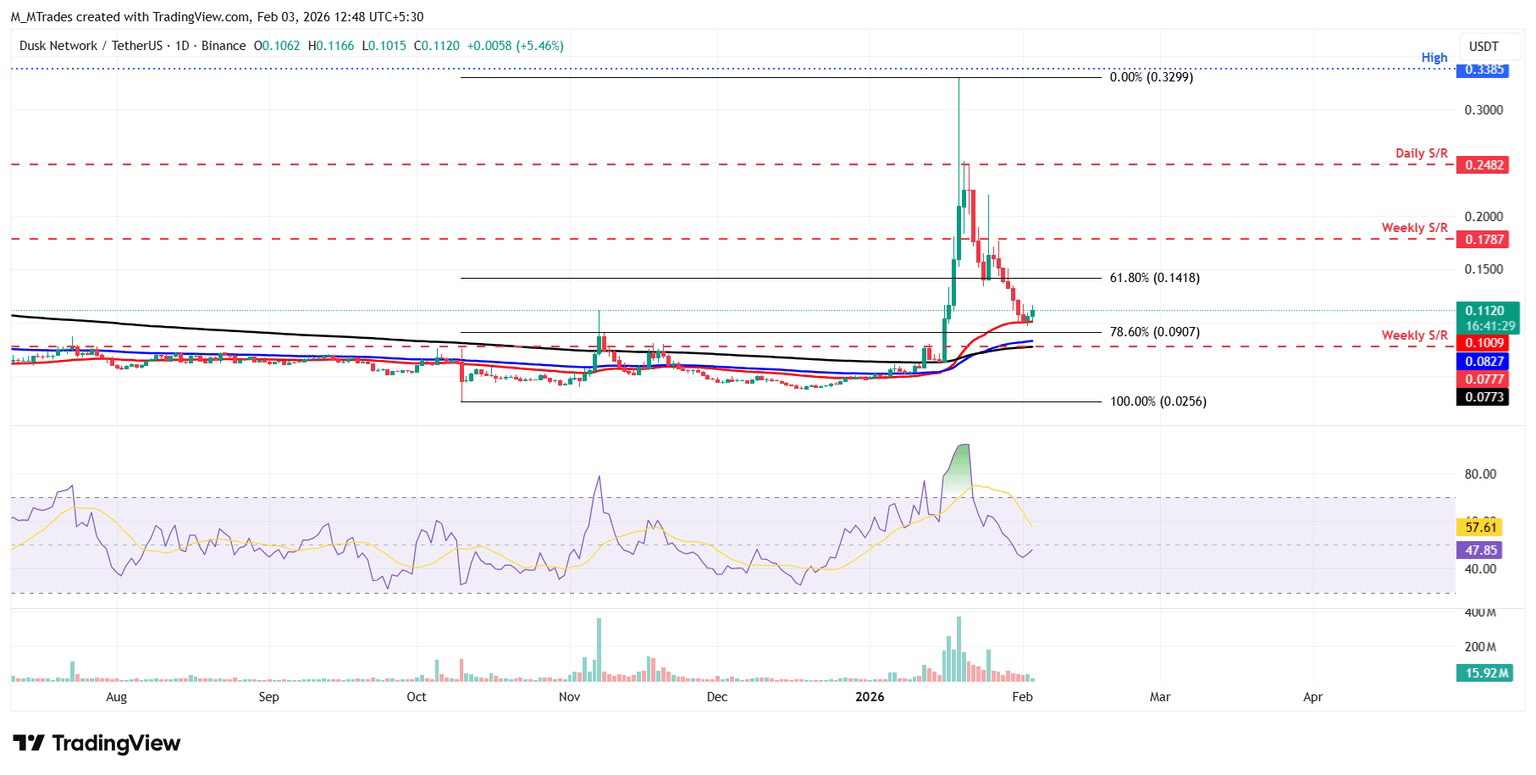
To illustrate Dusk’s momentum amid these trends, here’s a recent price chart for the DUSK token as of early February 2026. It shows a downward trend from late 2025 highs, with key support levels around $0.077 and resistance at $0.1418, alongside fluctuating RSI indicating potential oversold conditions for a rebound. Volume bars at the bottom highlight spikes during market dips, suggesting institutional interest aligning with Binance’s recovery narratives. 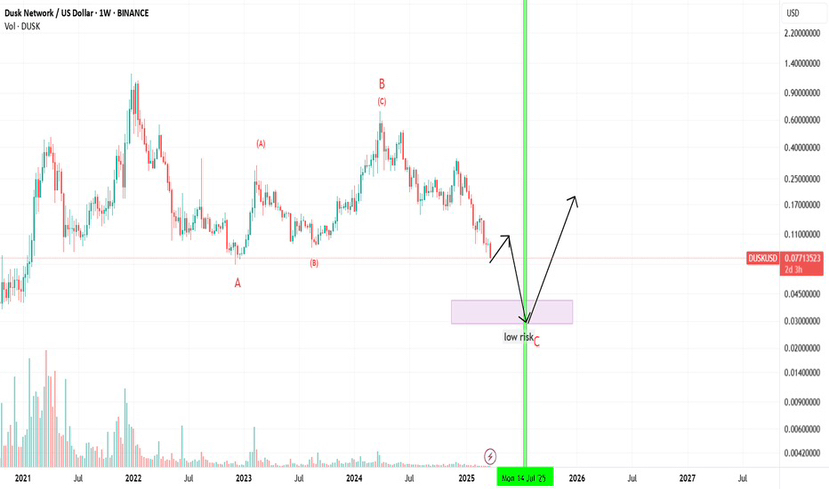
For a longer-term perspective, this chart projects DUSK’s trajectory into 2027, with historical patterns from 2021 onward. It marks accumulation zones (low risk) and potential breakout points, reflecting Dusk’s transformation post-mainnet. The volume overlay shows building activity in early 2026, tying into hot topics like ZKP advancements and Binance’s emphasis on ecosystem tokens for 1500x potential gains.