
As the adoption of Web3 and Layer-1 blockchain infrastructures accelerates, the issue of crypto scams is no longer peripheral — it is central to user protection and ecosystem credibility.
With the launch of the Plasma Network — a stablecoin-focused infrastructure platform — and the native token $XPL, a foundational asset securing transactions and consensus through Proof of Stake, it becomes essential for participants to understand how to operate safely, avoid fraud, and maintain financial sovereignty.
Why Security Matters in Crypto
Cryptocurrencies and decentralized systems are inherently irreversible. Once a transaction is executed on-chain, it cannot be undone. This immutability is a core strength of blockchain architecture — but it also makes user mistakes and scam activity economically final.
Losses cannot be reversed.
Fraud prevention reports consistently highlight that phishing, fake wallets, impersonation schemes, and social engineering remain among the most significant threats affecting both retail and institutional participants.
Scam tactics continue to evolve:
— Phishing attacks impersonating trusted services
— Fake airdrops or token giveaways requesting private keys
— Impersonation of community members or team representatives
— Malicious smart contracts designed to drain tokens
Understanding these patterns is the first layer of defense.
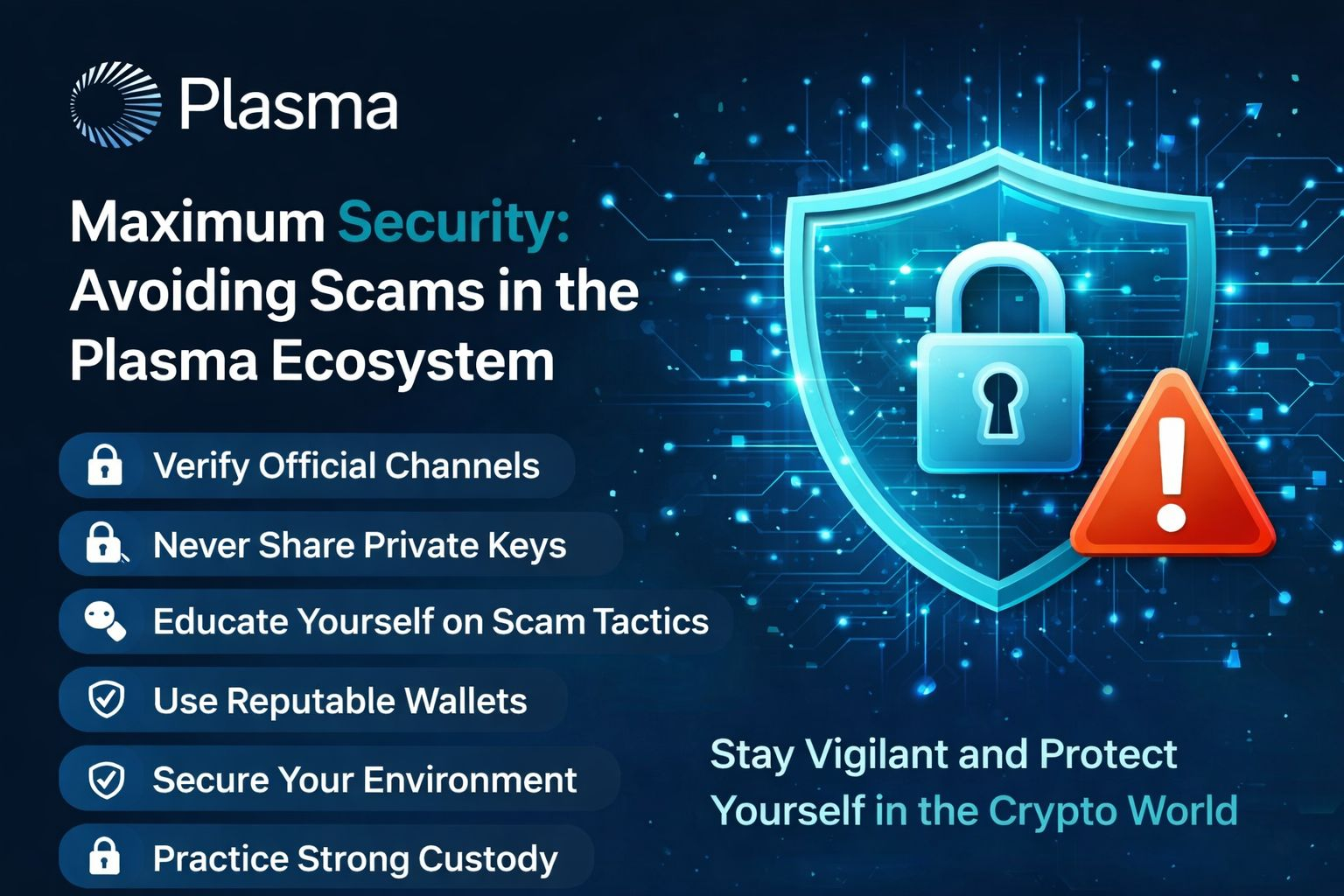
Core Principles for Scam Avoidance in the Plasma Ecosystem
1. Verify Official Channels and Documentation
Always source links and information from verified Plasma channels and official documentation. Scammers frequently create cloned websites and social profiles to simulate legitimacy.
Before interacting with any interface, confirm URLs carefully and cross-reference them with official documentation or trusted community announcements.
Verification precedes interaction.
2. Never Share Private Keys or Seed Phrases
No legitimate service — including official Plasma infrastructure or supported wallets — will ever request your private keys or recovery phrases.
Sharing these credentials equals transferring full asset control.
There are no exceptions.
3. Use Reputable Wallets and Security Tools
Choose wallets with established reputations and strong security architecture, including multi-factor authentication (2FA) and hardware wallet integration.
For significant holdings, cold storage reduces exposure to malware, phishing vectors, and browser-based compromise compared to hot wallets.
Security scales with discipline.
4. Educate Yourself on Scam Tactics
Fraud typically exploits urgency and emotion.
Be cautious of:
— Unsolicited investment proposals
— Guaranteed returns
— Pressure to act immediately
— “Exclusive” insider access
Scams frequently rely on FOMO and false authority signals. Rational delay is often protective.
5. Secure Your Operational Environment
Technical hygiene remains fundamental.
Maintain updated systems.
Use reputable endpoint protection.
Avoid interacting with unknown links.
Consider browser extensions that flag suspicious wallet addresses or domains.
Operational security is not optional — it is structural.
6. Practice Strong Custody and Key Management
Whether selecting self-custody or a third-party custodian, due diligence is mandatory.
Evaluate:
— Key storage architecture
— Transparency policies
— Regulatory alignment
— Contingency and recovery procedures
Custody is infrastructure, not convenience.
Ecosystem Trust Is a Collective Responsibility
Security within the Plasma ecosystem is not purely a technical layer — it is behavioral and communal.
Safe participation requires vigilance, ongoing education, and adherence to best practices.
As Plasma evolves to support scalable stablecoin infrastructure and decentralized finance, embedding security awareness into user behavior becomes a strategic differentiator between sustainable growth and preventable losses.
By verifying legitimacy, maintaining custody discipline, and understanding evolving fraud vectors, participants can interact with Plasma infrastructure — including $XPL-based transactions and staking — while minimizing exposure to risk.
Education strengthens individuals.
Discipline strengthens ecosystems.
Security is not a feature.
It is a culture.
#Plasma $XPL @Plasma