
“Don’t Panic” — or Don’t Question?
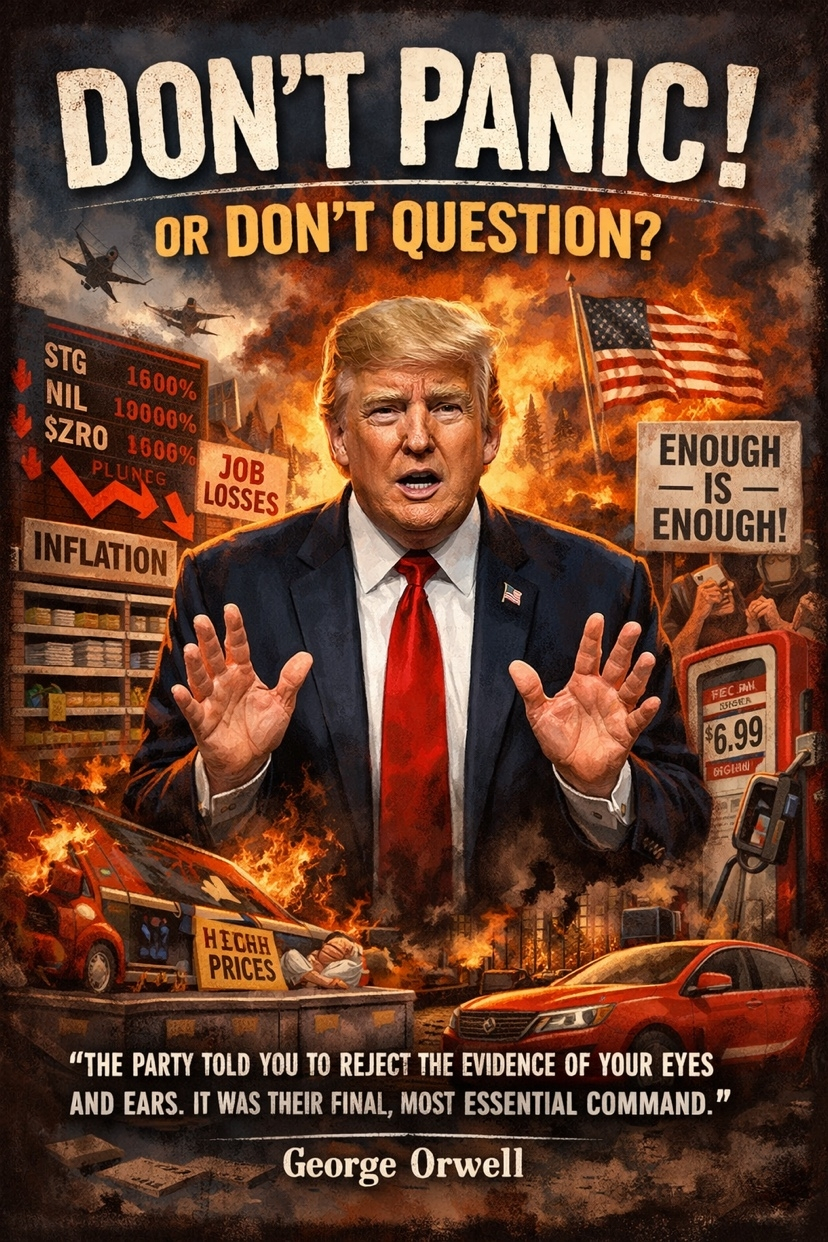
When leaders tell the public not to panic, the phrase is supposed to calm. It signals control, stability, reassurance. But when “don’t panic” is repeated in the middle of visible economic strain and political turbulence, it can begin to sound less like comfort—and more like instruction.
A recent poll showing that a majority of Americans view Donald Trump’s first year back in office as a failure marks a notable shift. Particularly significant is erosion among voters without college degrees, a bloc that has long formed a central pillar of his support. Political coalitions can withstand criticism from opponents. They struggle when doubts emerge from within.
The White House response has centered on messaging: dismiss negative coverage as “fake news,” insist momentum is strong, and urge Americans to keep believing. The framing is clear—perception is the problem, not performance.
Yet perception rarely shifts in a vacuum. Economic sentiment often tracks lived experience. If grocery prices remain high, if wage growth feels insufficient, if job security appears fragile, reassurance alone cannot override daily reality. Public confidence is shaped less by speeches and more by receipts, rent, and paychecks.
This tension—between official narrative and personal experience—is where the phrase “don’t panic” becomes politically loaded. When people are told they are “winning” while feeling financially squeezed, cognitive dissonance sets in. The more forcefully leaders insist conditions are improving, the more skepticism can grow if evidence seems contradictory.
The Orwell quote often invoked in moments like this resonates not because it predicts authoritarianism outright, but because it highlights a universal political instinct: the temptation to redefine reality through repetition. Modern politics frequently becomes a battle over interpretation rather than facts themselves. Is inflation easing or still painful? Is the labor market resilient or deteriorating? Competing narratives seek dominance.
At what point does “don’t panic” shift from reassurance to discouragement of scrutiny?
The answer depends on transparency. If leaders pair calming rhetoric with clear data, accountability, and policy adjustments, reassurance can be credible. If they instead frame criticism as disloyalty or misinformation while offering limited tangible relief, the phrase risks sounding like a request for silence.
Democracies depend on questioning. Markets depend on confidence grounded in facts. Voters depend on evidence aligning with experience.
When reassurance replaces explanation, and optimism substitutes for measurable improvement, “don’t panic” stops being calming advice—and starts resembling a directive not to look too closely.
Public trust is not preserved by insisting everything is fine. It is preserved by proving it.