
$XRP Below Realized Price: Signal or Setup?
When an asset drops below its realized price, most casual traders overlook it. Experienced on-chain participants do not.
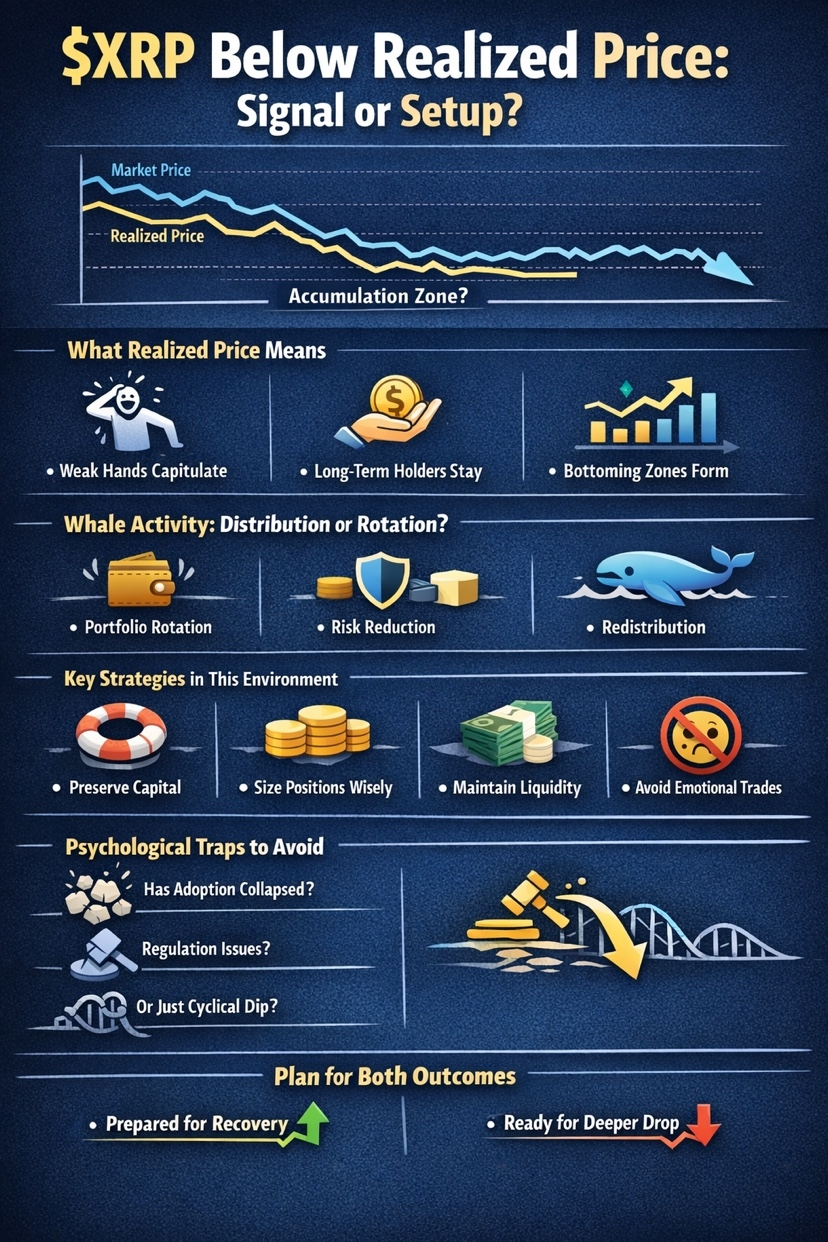
Recently, $XRP moved below its realized price — a level that historically appears during late-stage corrections or early accumulation phases. But before turning this into a “bottom is in” narrative, it’s important to understand what this actually means — and how to respond strategically.
What Realized Price Tells Us
Realized price represents the average acquisition cost of all circulating coins. When market price falls below this level, most holders are sitting at unrealized losses.
This changes behavior.
Weak hands tend to capitulate earlier.
Long-term holders are more likely to stay.
Selling pressure can gradually exhaust itself.
Across past crypto cycles, price moving below realized price has often aligned with bottoming zones — not immediate reversals, but structural accumulation phases.
That distinction matters.
Bottoms form through time, not headlines. They form through:
Sideways movement
Reduced volatility
Emotional fatigue
If XRP is forming a bottom, it will likely look boring before it looks bullish.
Whale Activity: Distribution or Rotation?
Recent on-chain data shows larger wallets reducing exposure. That explains why price feels heavy even without major negative news.
But whale selling does not automatically mean long-term bearishness.
It can reflect:
Portfolio rotation
Redistribution
Risk reduction before re-entry
Markets often require supply to change hands before structure rebuilds. Redistribution can be part of base formation.
What You Should Actually Do in This Environment
A potential bottom signal is not an invitation to rush in blindly.
1. Preserve Capital
Reduce leverage early.
If you cannot survive a 40–50% adverse move, your position sizing is too aggressive.
2. Size Positions Realistically
Never allocate more than you can psychologically tolerate seeing decline by 60–70%. Volatility is structural in crypto.
3. Separate Long-Term Conviction from Short-Term Trades
Mixing investment theses with short-term speculation leads to emotional errors.
4. Maintain Liquidity
Cash or stable reserves create flexibility. Flexibility reduces panic.
5. Avoid Emotional Averaging Down
Buying every dip without structural confirmation is hope — not strategy.
6. Watch Macro Liquidity
Interest rates, risk appetite, and global liquidity conditions influence crypto cycles. On-chain signals during tight liquidity often take longer to play out.
Psychological Traps During Drawdowns
Sharp declines trigger survival instincts. Loss aversion amplifies fear.
In 2018, many believed crypto was finished.
In 2022, institutions were “done.”
Every cycle feels existential at the bottom.
But volatility is not the same as structural failure.
Ask rational questions:
Has network usage collapsed?
Has adoption structurally reversed?
Has regulation permanently impaired utility?
Or is this cyclical deleveraging?
Separating emotion from structural analysis is a core investing skill.
Strategic Preparation
If markets deteriorate further:
Reduce correlated exposure
Diversify across asset classes if possible
Lower risk per trade
Protect mental capital
Reassess whether your strategy works outside bull markets
Practice pre-commitment:
What is your XRP thesis?
What invalidates it?
At what level do you reduce risk?
What drawdown can you tolerate?
Write it down. Follow it when volatility rises.
The Real Takeaway
$XRP below realized price does not guarantee reversal. It signals a zone worth attention.
If structure stabilizes and liquidity improves, mid-term outlook becomes constructive.
If support fails and macro tightens, deeper retracement remains possible.
Have plans for both outcomes.
Potential bottoms reward those prepared to endure uncertainty.
Cycles repeat — but outcomes differ based on behavior.
The question is not whether XRP bounces tomorrow.
The question is whether you are prepared if it doesn’t.