
Every cycle in crypto produces louder promises. Faster chains. Bigger throughput. Higher benchmarks. But when I look at Vanar, I do not see a project trying to win attention through volume. I see one trying to remove the need for attention altogether.
That difference is subtle, but it reshapes the entire conversation.
Most infrastructure debates are internal. They revolve around validator design, decentralization models, consensus mechanics, latency comparisons. Those discussions matter to engineers and protocol designers. Yet the broader world does not measure value that way. People measure value through comfort. Through ease. Through consistency.
The average person does not want to understand a chain. They want to open an app, press a button, and have it work. They want it to cost what it should. They want it to behave tomorrow the same way it behaved today.
Vanar feels aligned with that expectation.
In mature systems, the most important layers are invisible. No one thinks about fiber optic cables when they stream a video. No one studies payment rails before buying coffee. We only notice infrastructure when it fails. Silence is the sign of success.
Vanar appears to be building toward that silence.
When you frame it this way, their focus on entertainment ecosystems, immersive environments, and consumer facing integrations reads differently. It is not simply about partnerships or brand exposure. It signals an assumption about who matters most in the long run.
Not the speculator rotating positions.
The participant returning for experience.
There is a fundamental difference between those two groups. Traders chase narrative and liquidity. Users build habits. Traders generate spikes. Users generate rhythm. And rhythm is what turns activity into structure.
Structure is what economies require.
A single in-game action or digital asset interaction might look trivial. But repetition transforms scale. Millions of small interactions occurring daily create something more durable than episodic capital flows. They create load that is organic, not incentivized.
That load strengthens a network.
Vanar seems to be designing environments that encourage repetition. Games that invite return. Platforms that reward continuity. Campaigns that extend engagement beyond a single click. These are not one time funnels. They are loops.
Loops create stability.
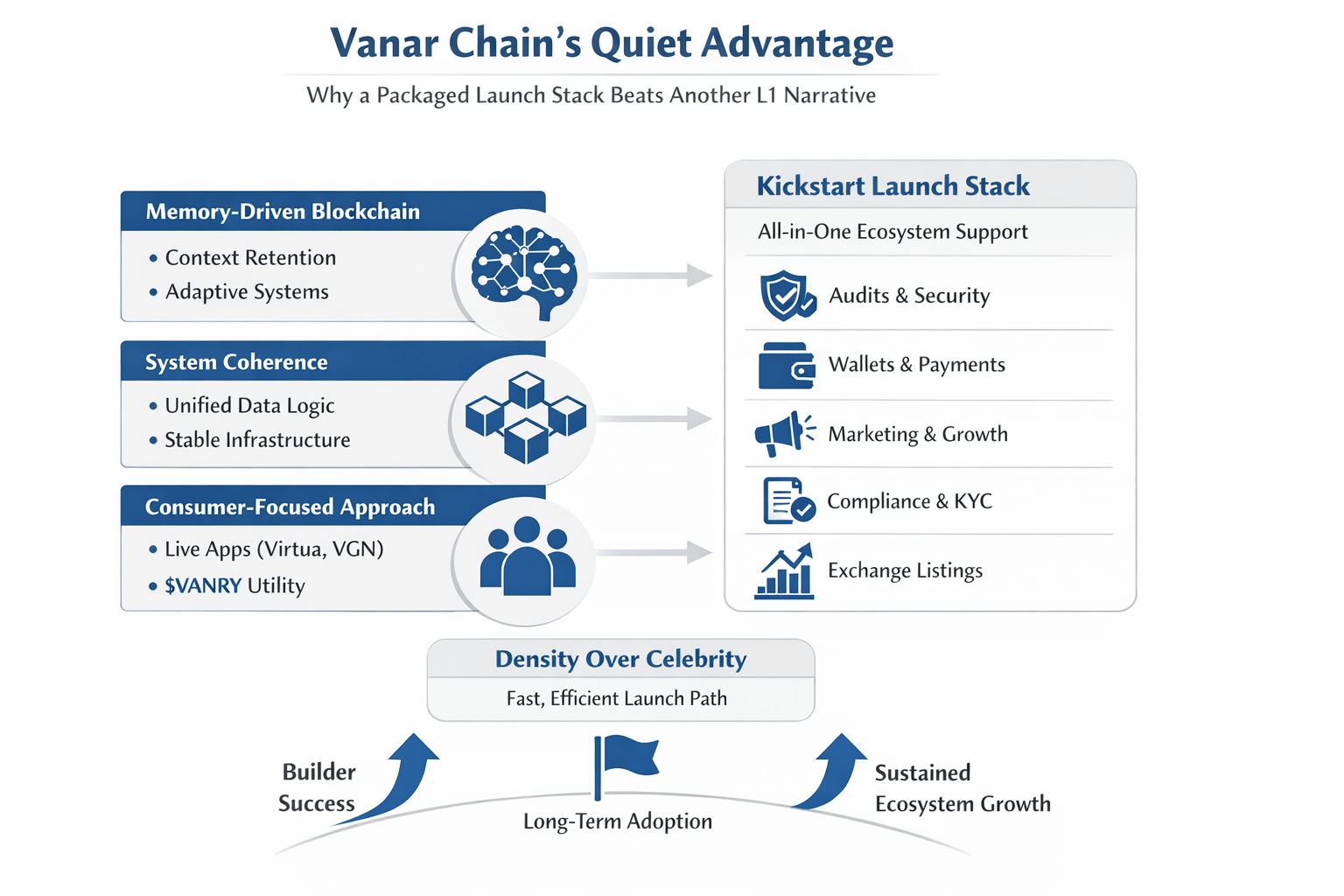 Stability changes how businesses behave. When participation becomes measurable and consistent, forecasting improves. Studios can plan production. Brands can allocate budgets. Developers can design for longevity instead of hype cycles.
Once predictability enters the equation, investment becomes rational rather than speculative.
At that point, the blockchain layer stops competing for headlines and starts functioning like a utility. It settles transactions, coordinates ownership, and maintains state without demanding attention. The user interacts with a product. The infrastructure handles the rest.
The more seamless the experience, the stronger the dependency.
This also reframes how token demand should be evaluated. If the ecosystem matures, the average user may never consciously think about VANRY. They are immersed in a platform. Behind the scenes, operators and partners ensure the fuel required for continuity is present.
Demand shifts inward.It moves from visible speculation to embedded necessity.
That transition is powerful because it aligns value with function. As more consumer environments emerge, they introduce recurring activity. Recurring activity generates recurring infrastructure needs. Those needs anchor the network in everyday behavior rather than episodic excitement.
Excitement fades. Habits remain.
Another important element here is accessibility. Consumer growth does not depend on technical literacy. It depends on familiarity. If onboarding becomes intuitive and the environment feels natural, participation expands beyond crypto native audiences.
Wider participation increases transactional density. More interactions create more structural usage. Structural usage makes the network relevant even when market narratives cool.
That relevance builds resilience.
Networks reliant on large sporadic events often struggle between peaks. Networks supported by continuous micro interactions develop distributed strength. When activity is spread across millions of participants, shocks are easier to absorb.
Distributed behavior stabilizes performance.
For VANRY, this suggests that long term value may be tied less to attention cycles and more to operational continuity. As applications expand and environments deepen, settlement requirements expand alongside them. Security requirements increase. Coordination complexity grows.
The token becomes part of that operational backbone.
Over time, continuity compounds. Each new product connects to existing patterns. Each returning user reinforces system familiarity. Migration away from such an ecosystem becomes difficult not because alternatives are weaker, but because habits are powerful.
Habit is infrastructure’s quiet ally.
When I evaluate Vanar, I look beyond price fluctuations. I observe whether applications sustain engagement. I watch whether creative partners continue building. I look for signals that environments are not just attractive but livable.
Livability is underrated in blockchain discussions.
Surges will test everything. Viral adoption arrives without warning. If performance holds under pressure, credibility strengthens. If it does not, trust erodes quickly. Infrastructure earns its reputation in moments of stress.
Execution is decisive.
But direction matters too. Vanar does not appear to be constructing a temporary spectacle. It looks like an attempt to normalize blockchain as a background layer for digital life. To make ownership, coordination, and settlement feel ordinary rather than experimental.
That ambition is quieter than hype, but it is more enduring.
In the long arc of technology, experiments generate headlines. Utilities generate dependence. If Vanar reaches a point where people interact daily without thinking about the chain beneath them, that may be the clearest sign of maturity.
Because the ultimate milestone for infrastructure is not recognition.
It is irrelevance.And when infrastructure becomes irrelevant, adoption has already begun.
Vanar: Building the Stage, Not the Spotlight.When I study Vanar, I do not see a chain trying to compete in the usual Layer 1 race. I see a project trying to redesign the role a blockchain plays in people’s lives.
Most networks position themselves as the product. Faster than this. Cheaper than that. More decentralized, more scalable, more efficient. The spotlight is on the chain itself.
Vanar feels like it is building the stage instead.
And stages are interesting because no one attends a concert to admire the steel beams. They come for the performance. If the stage is solid, safe, and stable, it disappears into the background. The audience focuses on the experience.
That is the energy I get from Vanar’s direction.
The emphasis on entertainment ecosystems, immersive applications, branded experiences, and interactive platforms suggests a different thesis. The future user is not a trader monitoring charts. The future user is someone playing, collecting, participating, and returning.
Return behavior is the key.
Speculation creates spikes. Experiences create routines. Routines build economies.
If a platform encourages people to come back tomorrow, then it has already crossed an important threshold. It is no longer dependent on hype. It is supported by habit. Habit is predictable. Predictability attracts builders.
Studios want reliability. Brands want consistency. Developers want stable costs and clear performance boundaries. They are not chasing momentary narratives. They are building products that must function every day.
Vanar appears to be positioning itself as a chain that can quietly support that continuity.
There is also something powerful about designing for non crypto native audiences. When infrastructure is simplified to the point where the user does not need to think about wallets, gas mechanics, or technical friction, adoption expands naturally.
Accessibility widens the funnel.
And once the funnel widens, transaction count begins to matter more than transaction size. Millions of small, recurring actions create more structural depth than a handful of large capital rotations. That depth strengthens the network’s foundation.
It changes the nature of demand.
Instead of relying on constant excitement around the token, the ecosystem generates operational need. If applications are live, if platforms are active, if partners are building, then settlement must happen. Coordination must occur. Security must hold.
The token becomes embedded in function rather than conversation.
This is where the long-term story starts to separate from short-term noise. A network that exists primarily for trading liquidity will mirror market sentiment. A network that supports active environments may experience volatility, but its underlying usage can remain steady.
Steady usage compounds.
Over time, more products lead to more participants. More participants create more interactions. More interactions justify further development. The ecosystem starts reinforcing itself.
That reinforcement creates resilience.
I also think about stress scenarios. Viral growth, high traffic events, global campaigns. These are moments where infrastructure is tested in real time. If performance remains stable under load, trust accelerates. If it cracks, credibility fades.
Infrastructure earns respect quietly and loses it quickly.
Vanar’s orientation toward consumer facing ecosystems suggests confidence in its ability to handle repetition, not just peaks. And repetition is what transforms a chain from an experiment into an environment.
Environments are different from platforms.
Platforms attract. Environments retain.
Retention is where value deepens. When users stay, assets circulate. When assets circulate, marketplaces form. When marketplaces form, economic gravity appears. Gravity is difficult to displace because it is built on accumulated behavior.
This is why I do not focus only on price. I watch whether new experiences launch. I watch whether communities remain active. I watch whether partners continue integrating.
Those are signals of structural life.
If Vanar succeeds in making blockchain mechanics invisible while amplifying digital experiences, it will not need to compete loudly in technical debates. Its proof will be in the normalcy of usage.
People will log in, play, interact, and leave without thinking about consensus or gas. Businesses will deploy campaigns without fearing unpredictable infrastructure costs. Developers will build without constantly redesigning around instability.
That is when a chain becomes dependable.
And dependable systems rarely dominate headlines. They dominate daily life.
If Vanar continues in this direction, the most interesting outcome may not be explosive recognition. It may be quiet integration into the background of digital culture.
Because when the stage is strong enough, the audience forgets it is even there.
And that is when real adoption has already happened.
#VanarChain @Vanarchain $VANRY
